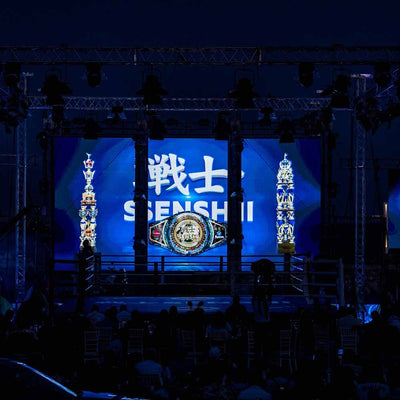
Wushu, also known as modern wushu, is a performance-oriented style derived from Kung Fu. The sport was developed in China after 1949 in an attempt to help a traditional Chinese martial art flourish. With the establishment of the IWUF (International Wushu Federation), wushu grew into an international sport. A world championship is held every two years. The first world championship was held in Beijing and won by Clark Zhang.
Modern wushu consists of two disciplines: taolu and sanda. Taolu routines are much like gymnastics and include patterns and manoeuvres for which points are awarded. The routines consist of basic movements (kicks, punches, balancing, jumps, sweeps and throws) that also occur in other Chinese martial arts. There are routines that must be performed within a specified time. Modern wushu practitioners are increasingly practising aerial techniques such as 540- and 720-degree jumps. Sanda, sometimes also called sanshou or Lei Tai, is a modern martial art and combat method influenced by traditional Chinese boxing, Chinese wrestling methods such as Shuai Chiao, and other Chinese grappling techniques such as Qin Na. Sanda is much like kickboxing and Muay Thai, but includes many more grappling techniques.
History of Wushu
In 1958, the Chinese government established the All-China Wushu Association. It served as an umbrella organisation for establishing regulations within martial arts training. The Chinese State Commission for Physical Culture and Sports took the lead in creating standardised routines for most martial arts. During this period, a national wushu system was introduced that included standard routines, curricula and ranking levels. Wushu was introduced at both universities and secondary schools. In 1979, a special task force was established to promote wushu. Today, many wushu styles are practised in China, both traditional and modern, and all are promoted by the Chinese government.
Routines
There are several routines practised within wushu. These are divided into three categories: unarmed, short weapons and long weapons. Unarmed routines include Changquan, Nanquan and Taijiquan; short-weapon routines include Dao, Jian, Taijijian and Nandao; and long-weapon routines include Gun, Qiang and Nangun. Most of these routines were established in 1958.
These routines are performed as compulsory or individual routines during competitions. Compulsory routines are routines developed for the athlete, meaning that every athlete must perform the same routine. Individual routines are developed by an athlete with the help of their coach. In addition to individual routines, dual and group routines are also sometimes performed. The dual routine, known as duilian, is a routine that includes a form of sparren, with or without weapons. The dual routine is spectacular, and the movements are performed beautifully in sync. The group routine, known as jiti, is even more spectacular, with many athletes performing different movements in sync. Music is often played to help keep the entire performance in time.
Other Routines
Most routines in the sport are new, modern compilations of traditional routines. Nevertheless, routines derived from traditional styles include many new elements. Today, the following routines are generally practised:
- Baguazhang – Eight-Trigrams Palm
- Bajiquan – Eight Extremes Fist/Boxing
- Chaquan – Cha Fist/Boxing
- Chuojiao – Poking Feet
- Ditangquan – Ground-Prone Fist/Boxing
- Fanziquan – Overturning Fist/Boxing
- Houquan – Monkey Fist/Boxing
- Huaquan – Hua Fist/Boxing
- Paochui – Cannon Punch
- Piguaquan – Chop-Hitch Fist/Boxing
- Shequan – Snake Fist/Boxing
- Tantui – Spring Leg
- Tanglanghushi – Praying Mantis and Tiger Style
- Tanglanquan – Praying Mantis Fist/Boxing
- Tongbeiquan – Through-the-Back Fist/Boxing
- Wing Chun (Yongchunquan) – Eternal Spring
- Xingyiquan – Shape-Intent Fist/Boxing
- Yingzhaoquan – Eagle Claw Fist/Boxing
- Zuiquan – Drunken Fist/Boxing