At a recreational/beginner level, the Thai boxing / Muay Thai classes are also very accessible to people who have never encountered the sport before. They mainly use basic techniques, and overall fitness is significantly improved. During these classes, sparring techniques are used that cannot be fully described here. Sparren is certainly not mandatory at most gyms.
Thai boxing for stress relief
Sufficient physical activity, including regular exercise, plays a major role in combating stress, for example. Someone who has never encountered this sport before will notice during the workout that it is much easier than expected. The classes are easy to follow and, above all, not intimidating, but actually a lot of fun.
At competition/advanced level, we are talking about a group of athletes who receive more competition-oriented training, using techniques required for competitions. Sparring techniques are therefore required during these classes, and you must already have a reasonable command of them. Not everyone can simply participate in these classes. You need permission first.
More self-confidence through Thai boxing
A confident child is much less likely to end up in threatening situations. The physical and mental aspects of martial arts increase self-confidence in children (and adults) and teach them, in a fun and natural way, to be assertive. Children learn to set boundaries, say NO, and stand up for themselves!
Young people who start martial arts or are sent there by their parents more often have a short fuse. If they continue for a longer period, this decreases significantly, as the figures show. Through martial arts, they learn to control their aggression. The martial arts world can make an important contribution to the psychosocial development of socially vulnerable young people and inspire them to make—and continue making—choices that keep them on ‘the right path’.”
At all gyms, you can usually take a trial lesson; in that case, you only need to bring sportswear.
Equipment for Thai boxing / Muay Thai:
- Mouthguard, to protect your teeth
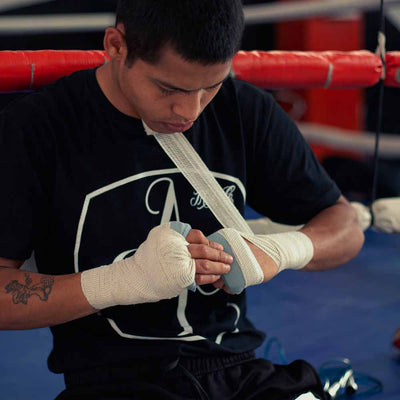
- Handwraps (bandages, wraps), to reinforce your wrists, metacarpal bones, and knuckles
- Gloves for throwing punches
- Groinguard to protect the groin
- Shin guards, to protect the shins
- Elbow pads, to protect the elbows
- A Thai boxing short
- T-shirt; bring an extra T-shirt if you sweat heavily
Positive aspects of Thai boxing / Muay Thai:
- Promoting self-discipline: Most martial arts / combat sports schools focus on self-discipline. Children today are so used to receiving ‘instant gratification’ that self-control and discipline are often in short supply. Children who participate in martial arts / combat sports are constantly reminded of how essential (self-)discipline is for them.
- Developing social skills: For children who find it difficult to meet new people and make friends in social settings, a space filled with peers who share a common interest can be beneficial. Children at the playground do not always have much in common, but when they share a martial art / combat sport, they are often better able to get to know one another. Exercises that must be done together can promote friendships because the children are ‘forced’ to work on their skills together.
- Encouraging physical activity: Martial arts / combat sports are an excellent way to get a child off the couch and make them more aware of their physical abilities.
- Learning to set goals: Most forms of martial arts / combat sports use an ‘achievement system’ in which belts and the stripes on belts (‘slips’) are earned. When your child strives for a new belt or slip, they learn valuable lessons about setting and achieving goals.
- Increasing self-confidence: A child’s self-esteem gets a ‘boost’ when they master a new movement or earn a new belt. Children who struggle with low self-esteem usually become more confident the longer they spend practicing martial arts / combat sports.
- Promoting respect for others: When practicing a combat sport / martial art, it is often required that participants show respect to their instructor and fellow students. In today’s youth culture, respect for authority (parents, teachers, and other adults) is not always present. By practicing martial arts / combat sports, your child will learn what respect is and be reminded to show it.
- Encouraging conflict resolution without fighting: The idea that martial arts / combat sports can only resolve conflicts through physical violence often comes from television and films. Many martial arts / combat sports teach how to resolve conflicts in peaceful, non-violent ways and emphasize the importance of avoiding physical contact.
- Improving listening skills: Martial arts / combat sports teach you to listen better and maintain your attention (focus). This increases concentration and thereby improves development.
- Developing teamwork: There are very few things that a child learns to do in martial arts / combat sports without help from fellow practitioners. Working together to learn new things is a very important life lesson taught through martial arts / combat sports.
- Improving other areas of life: The benefits of martial arts / combat sports often do not end in the dojo (the space where martial arts are practiced), but extend far beyond it. Self-confidence, improved fitness, and respect for others can also help your child find their way in learning and interacting with others at school and at home, as well as in their overall development on the path to adulthood.