A boxing glove is not automatically suitable for every type of training. With some models, you can combine bag work, pad work, and suitable partner exercises. Others are made specifically for sparring or for the punching bag. From the outside, they may look very similar, even though you buy them for a different purpose.
You notice the difference especially once your training changes. A pair that works well on the punching bag is not necessarily a suitable sparring pair. And a specialized sparring glove does not have to be your go-to choice for intensive bag work. If you do both, you may actually benefit from two separate pairs.
In this guide, we compare all-round training gloves, sparring gloves, and bag gloves. We explain where the differences lie and when one pair may be enough. Then we take a closer look at the Rival bag gloves: RB5, RB50, RB10, RB11, RB100, and RFX-Guerrero. Not as a ranking in which the most expensive automatically wins, but as different constructions for different training preferences.
Training gloves, sparring gloves, and bag gloves
“Normal boxing gloves” is not a fixed technical category. The term is used for a variety of models, from a recreational all-round glove to a specialized sparring pair. That is why it is wise not to use the product name as your only indication.
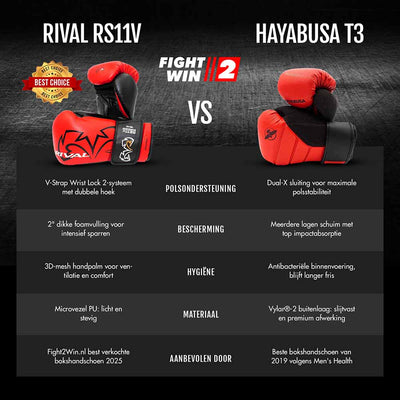
All-round training gloves are offered for multiple exercises. XPRT Top Gloves, for example, are a leather model for bag training, pad work, and light sparring. This makes them a different choice from a Rival RS11V, which is explicitly a sparring glove.
Sparring gloves are intended for controlled partner contact. When choosing, it’s not only your hands that matter, but also whether the padding is suitable for that application and the gym’s rules. A pair that feels comfortable for you must therefore also be suitable for exercises with your partner.
Bag gloves are designed for training on the punching bag and pads. The Rival RB series is a clear example. The training purpose is decisive: a sturdy wrist closure or attractive striking surface does not make a bag glove suitable for sparring.
Competition gloves also form a category of their own. The prescribed design and weight depend on the competition rules. Choosing a competition model because it is compact is not an alternative to a suitable training or sparring glove.
Why sparring calls for a different choice
With a punching bag, your glove hits training equipment. During sparring, it hits a person. That changes the considerations. It’s not only about comfort, fist position, and support, but also about construction intended for partner contact.
That is why asking “does it have a lot of padding?” is not enough. Consider the intended use of the complete model and the condition of the pair. A glove with a thick outer shape may still have been designed for the punching bag.
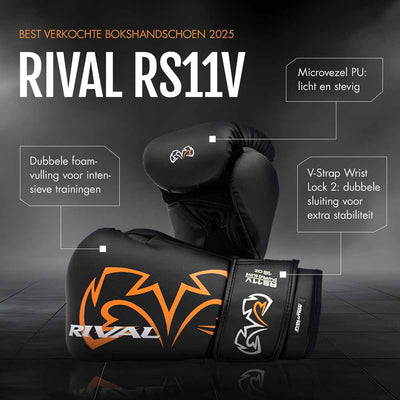
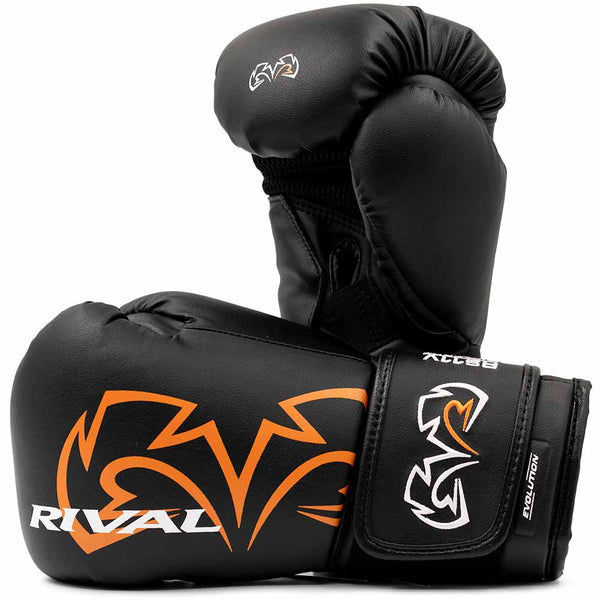
Rival RS11V Evolution and RS100 Pro Sparring are clear examples of sparring gloves. The RS11V has a V-Strap Wrist Lock 2 closure; the RS100 version discussed has laces and an Angled Lace Track. Both use a layered foam construction, but the way they are adjusted differs.
The choice between such models remains personal. Do you want to fasten them yourself, or do you need help lacing them? How does your fist sit in the model, and what weight suits your sparring sessions and your gym’s rules? These questions are more helpful than assuming that every large glove is a good sparring pair.
Do not use a dedicated bag glove for sparren. Not even “just lightly” because it feels comfortable. Training gently and using suitable equipment are two separate requirements, not substitutes for each other.
What makes bag and pad training different
Bag training is not just about hitting as hard as possible. You can work on distance, rhythm, balance, conditioning, or a specific combination. With pads, the position of the target and the trainer’s instructions also come into play. The training equipment and the exercise together determine what you need.
A specialized bag glove may be worth considering when you deliberately want a pair made for those sessions. You can then keep it separate from your sparring equipment and choose the fist shape and closure that you find comfortable during bag work.
That does not mean an all-round training glove should never be used on the bag. Models offered for that purpose, such as XPRT Top Gloves, have a broader range of applications. The distinction is not “bag glove good, regular glove bad,” but which use the model is intended for.
Conversely, a good bag glove will not automatically improve your technique. Distance, a suitable fist shape, and controlled contact remain part of the training. A new pair can be a deliberate equipment choice, but it is not a solution for every uncomfortable impact.
Padding and fist shape: more than thick versus thin
The old idea that “sparring gloves are thick and bag gloves are thin” does not apply across the entire market. Within Rival’s bag range, for example, you will find the slim-built RB5 alongside more advanced models with layered foam and technical closures.
The RB5 is a traditional bag mitt with thin EVA padding. The RB11 Evolution uses a combination of closed-cell foam and latex. The RB10 and RB50 feature Intelli-Shock technology. So they are not simply different colors of the same glove.
The space for your fingers and the position of your knuckles also matter. One model may comfortably enclose your hand, while another athlete may struggle to make a relaxed fist in it. No material name determines that in advance for everyone.
For sparring, assess the padding based on partner contact. For the punching bag and pads, assess how the glove suits those exercises. Compare the complete application, not just a thickness or number of layers. More technical terms on the product page do not automatically mean a better pair for your hands.
Oz and letter sizes: not every bag glove is selected the same way
With many training and sparring gloves, you choose a weight in oz. With bag gloves, you may also encounter letter sizes. These are different ways of offering versions, and you should not simply convert one into the other.
Oz is the stated weight, not a universal measure of hand space. A 16 oz glove from one model may fit differently from a 16 oz version of another. With a letter size, check the sizing information for that specific series.
Take the hand protection you use during training into account. Handwraps affect the available space and how your hand sits in the glove. A comfortably fitting glove without handwraps may feel different with your normal wrapping.
For sparren, follow your gym's weight and other requirements. For bag gloves, look at the model's prescribed size selection. There is no rule that bag gloves should always fall between two fixed oz values.
Wrist closure and thumb: no simple dividing line
Bag gloves do not necessarily have less wrist support or a loose thumb. The category includes a range of constructions. A classic bag mitt may be built very differently from a modern closed model with a technical cuff.
Rival offers various solutions for the wrist closure. RB50 uses the Angled Ergo-Strap-System. RB10 and RB11 have V-Strap Wrist-Lock 2. RB100 uses Wrist-Lock 3, with a separate double hook-and-loop system.
The closure is therefore a reason to compare models individually. Feel how you adjust it, whether you can achieve comfortable tension independently, and whether the cuff does not pinch. A tightly fastened strap does not correct an uncomfortable hand position.
Also assess the thumb for each model. You want a comfortable position without pain or constantly pulling on your hand. A connected thumb is no guarantee against injury, and an open or differently shaped design is not a general recommendation for every bag-training session.
When an all-round training pair makes sense
If you take varied classes and are looking for your first pair, a suitable all-round training glove can be a practical starting point. You do not need to buy a specialized model for every exercise right away.
XPRT Top Gloves uses cowhide leather, multilayer foam, and a wide hook-and-loop closure. It is offered for the punching bag, pads, and light sparring. That broad application is the relevant feature, not just the leather exterior.
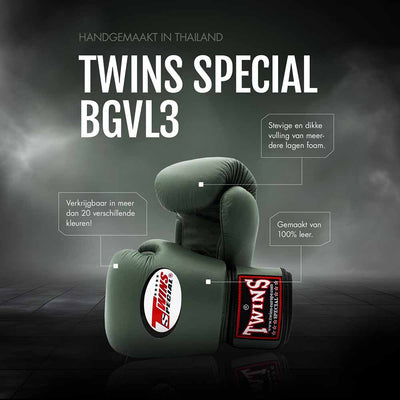
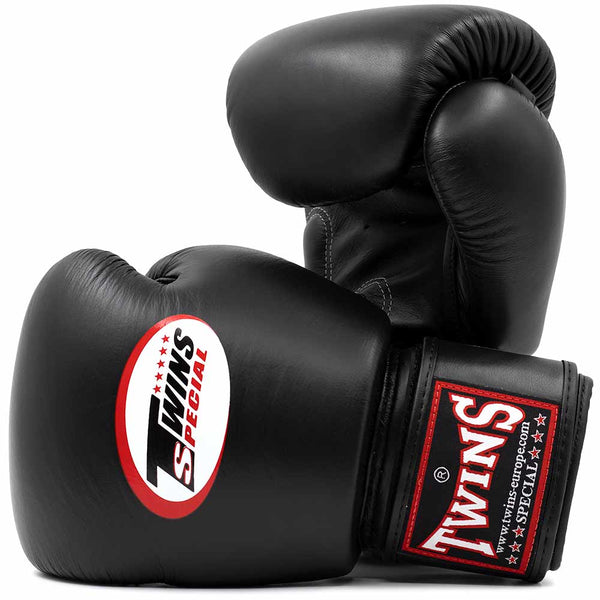
Twins BGVL3 is another example to compare for boxing and kickboxing. It uses cowhide leather, polyurethane foam, and a wide hook-and-loop closure. Within this kind of training choice, the suitable version, fit, and agreements regarding partner contact remain important.
With XPRT Pro V3, you get leather, multilayer foam padding, a molded thumb, and a long, wide wrist strap. Here too, the choice should match the exercises in your class. A brand name or ‘Pro’ on the model does not automatically make it interchangeable with every Sparring or bag glove.
Those who train mainly for recreation can therefore start with a suitable training pair. Only when you notice that bag work and sparring create different needs does a separate bag glove become a targeted next step, rather than a purchase simply because every advanced practitioner is supposedly meant to have one.
When a separate Sparring pair becomes worthwhile
A separate Sparring pair helps you match your equipment to its purpose. You keep one pair for partner training and use equipment intended for bag work. This way, you do not have to expect one glove to cover every training need.
That is especially interesting when you do a lot of punching bag and pad training while also sparring regularly. You can choose a bag glove for its specific hand compartment and cuff, while your Sparring pair continues to meet the requirements for partner contact.
Rival makes the distinction visible with names such as RS11V Sparring and RB11 Bag. A similar exterior or related closure does not mean that you can switch their uses. The same applies to RS100 and RB100: the shared family name does not make them identical gloves.
Continue checking both pairs. Having a separate Sparring pair is no guarantee that it will always remain usable. The padding, stitching, closure, and lining still require attention, just like your technique and the intensity of the exercise.
Rival RB5: a classic bag mitt with its own role
The RB5 is the most clearly distinct construction in this comparison. It is an old-school bag mitt with thin EVA padding, a leather exterior, and Rival's Ergo-Lite construction. The model is offered for technical work where a sense of contact is an important part of the choice.
That makes the RB5 not a smaller version of a Sparring glove. Nor is it simply a cheaper RB10 or RB100. The limited padding reflects a different approach to bag training.
Interesting when: you are deliberately looking for a traditional bag mitt for controlled technical bag work. Consider your experience, hand comfort, and the exercises you want to do with it.
Less logical when: you are looking for one first pair for the entire group class, want to spar, or expect a thin model to have the same construction as a more extensive bag glove. The RB5 is a specific equipment choice, not a general recommendation for every beginner.
Do not evaluate contact feel as a competition to use as little padding as possible. If an impact feels uncomfortable or painful, stop and check your technique, the intensity, and the fit of your gloves. Thinner does not automatically mean better training.
Rival RB50 Intelli-Shock: a focused bag-training choice
With the RB50, the comparison focuses on Intelli-Shock, the hand compartment, and the Angled Ergo-Strap-System. The diagonal closure gives this series a different adjustment than a conventional straight wrist strap.
The palm has mesh and the inside has a soft lining. These are practical elements to examine alongside the padding. How the wrist strap closes and how much room your fingers have with handwraps partly determines whether the glove is comfortable to use.
Interesting when: you are looking for a separate bag glove pair and specifically want to compare this closure and fit with the other Rival series. Intelli-Shock is a feature of the model, not the only reason to purchase it.
What to look for: whether the diagonal strap sits properly around your wrist and you can close your fist without uncomfortable pressure. A product name or shock-absorption technology does not mean everyone prefers the same adjustment.
The RB50 remains a bag glove. Its technical construction is no reason to use it for partner contact. Maintain this distinction in use when comparing it with a comfortable sparring model.
Rival RB10 Intelli-Shock: V-Strap and a closed bag glove
The RB10 combines Intelli-Shock with microfibre, a foam construction with closed-cell foam and latex, a ventilated palm, and V-Strap Wrist-Lock 2. This combination makes it a different bag glove from the RB50, even though both carry the Intelli-Shock name.
Compare the cuff and hand space separately. Related technology does not mean the fit is the same. Especially when moving from a regular training glove to a dedicated bag glove, it is important to feel how your fingers and knuckles are positioned.
Interesting when: you are looking for a closed bag glove with a V-Strap and want to compare the RB10 construction with the RB11 or RB50. Look at the complete model rather than just the technical label.
What to look for: the adjustment around the wrist, the room for handwraps, and how easily you can close them independently. You are looking for a practical position for your own training, not a theoretical “perfect fist” that is the same for everyone.
Intelli-Shock is no guarantee against injuries. A technical glove remains one part of your equipment, alongside suitable training, hand protection, and control when striking.
Rival RB11 Evolution: do not confuse it with RS11V
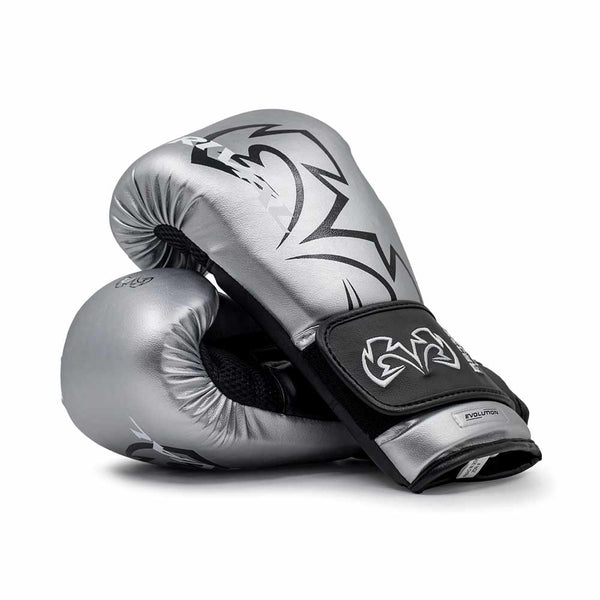
RB11 Evolution uses microfibre, a combination of closed-cell foam and latex, a mesh AirFlow palm, and V-Strap Wrist-Lock 2. This makes the series a distinct bag glove option alongside the Intelli-Shock models.
It is tempting to describe the RB11 as ‘the RS11V for the bag’, but that obscures the most important difference. The intended use and padding must be assessed separately. RS11V is for sparren; RB11 is for bag training.
Interesting when: you are looking for a bag glove with this foam construction and V-Strap. If you already have experience with Rival's diagonal closures, that may be a reason to try on the model, not to assume the same hand space.
What to look for: the connection between the hand compartment and the cuff. Compare RB11 with RB10 based on the construction you are actually buying, without treating the presence or absence of a single technical name as a complete quality assessment.
Microfibre does not make the glove indestructible, nor does it automatically make it better than a leather version. Inspect the complete pair in the same way as other training equipment.
Rival RB100 Professional: a different cuff and fist construction
The RB100 Professional uses microfibre PU, a multilayer foam construction, a mesh palm, and a True-Fist construction. At the wrist, you will find Wrist-Lock 3, with a separate double hook-and-loop system.
That is a concrete difference from the V-Strap Wrist-Lock 2 on the RB10 and RB11. When comparing models, you should therefore look beyond the knuckle side. The way you adjust the belts is an important part of the experience of the complete model.
Interesting when: you consciously want to try the True-Fist construction and Wrist-Lock 3 for a separate bag-training pair. It is a targeted choice for construction and adjustability, not because the number 100 automatically determines a ranking for every athlete.
What to look for: whether your hand rests in a comfortable fist and whether you can adjust both belts comfortably. A more elaborate closure system may appeal to you, but it must not conceal a pressure point or insufficient interior space.
Do not confuse RB100 with RS100 Pro Sparring. The RS100 discussed is a lace-up glove for sparren; the RB100 is the bag version. A shared name and recognizable finish do not make their intended uses interchangeable.
RFX-Guerrero bag gloves: the same family feel, different use
Even within the RFX-Guerrero family, you need to pay attention to the full product name. There are competition, Sparring, and bag versions. The word Guerrero alone does not tell you which pair you need for your training.
The RFX-Guerrero bag versions discussed here combine a leather exterior, Intelli-Shock and V-Strap Wrist-Lock 2. Our range includes Croco, Snake and Cyber Edition, among others. These are different finishes within the bag context, not an invitation to use them as a competition glove or sparring pair.
Interesting when: you are specifically looking for a Guerrero bag construction and want to compare the shape and cuff with the RB series. The appearance may be part of your preference, but the intended use remains the deciding factor.
What to look for: hand space, thumb position and how the cuff closes. An exclusive design does not determine whether the fit is comfortable for your fingers. Compare the exact version, not just a general family name.
An image with a Croco or Snake texture also does not prove that genuine reptile skin is used. The versions described use cowhide with a textured finish. Shape, material and decoration are different parts of the model.
How to compare the Rival bag line without forcing a winner
Start with the biggest construction choice: do you want a traditional thin bag mitt or a more elaborate closed model? This distinguishes RB5 from the other series discussed before you delve into closures and product names.
Next, you can look at the wrist adjustment. RB50 has Angled Ergo-Strap; RB10 and RB11 have V-Strap Wrist-Lock 2; RB100 uses Wrist-Lock 3. The Guerrero bag versions discussed also have V-Strap Wrist-Lock 2, but with their own hand construction and finish.
Then compare the padding and inner shape. Intelli-Shock appears in the RB50, RB10 and the Guerrero bag models discussed. RB11 has its own combination of closed-cell foam and latex. RB100 combines its multilayer construction with True-Fist. None of these descriptions replaces trying them on.
A useful comparison ends with a reason to try a particular model. For example: you are looking for V-Strap, you specifically want two separate straps or you want a traditional mitt for technical work. “This is the best for everyone” is less helpful.
Assess the models with the same handwraps and training purpose in mind. If you are looking for a sparring pair, none of these bag gloves is the right solution. In that case, start with suitable sparring gloves, not the most impressive bag construction.
Trying on, caring for and knowing when to stop
While trying them on, calmly make a fist. Pay attention to the space around your fingers, the position of your knuckles and how your thumb rests. A new pair does not need to be fully broken in, but clear pain or constriction is not part of a good initial fit.
Try them on with your usual handwraps and check whether you can adjust the closure properly on your own. The strap should provide support without compensating for the wrong size. An overly loose glove does not automatically become a proper fit by tightening the wrist strap as much as possible.
Let gloves air out after use and follow the care instructions for the model. Leather cream is not a universal product for every exterior. Instructions may differ for microfibre, leather, and different finishes.
Also check the seams, lining, closure, and padding. An exterior that still looks good does not mean the padding has remained even. A fresh smell does not make worn material suitable for bag training or sparring again.
Stop when training hurts or your hand does not sit comfortably in the model. Check the fit and your technique and reduce the intensity if necessary. Spending more money or choosing a model with more technology is not automatically the answer.
The practical advice: one pair or two?
You are starting with varied boxing or kickboxing classes
First look for a suitable training pair for the exercises in your class. Choose a weight that suits your exercises and take your gym's rules into account when sparring. A suitable all-round model may make more sense than immediately buying a specialized bag glove that you are not allowed to use for sparring.
You mainly train on the punching bag and pads
Then a dedicated bag glove may be a targeted choice. Compare Rival's series by interior shape, cuff, and construction. Look beyond the price: the right closure and comfortable fist position must be usable during every session.
You do a lot of bag work and spar regularly
Consider two pairs: a bag glove for bag and pad training and a suitable sparring pair for partner contact. Rival RB11 and RS11V, or RB100 and RS100, show how a brand separates these applications. You do not have to choose the same brand or family for both purposes.
You want to work technically with a classic bag mitt
Choose RB5 when you specifically want a traditional bag mitt for technical bag work and the thin padding suits your training. The specific contact feel is a reason to consider a traditional mitt, not to train as hard as possible with as little padding as possible.
The most important difference is the intended use, not the size or brand. Choose a pair that suits your training and always consider sparren a separate application. If you want to compare the closures and hand space yourself, you can view and purchase suitable models in our showroom in Waddinxveen. Tell us whether you are looking for one training pair or deliberately want to separate bag work and sparring. That provides a much better starting point than simply ‘regular or bag’.