When you think of Thailand, you think of Muay Thai. And when you think of Muay Thai, you think of the striking shorts worn by fighters of this traditional national martial art.
But these shorts are more than just practical clothing for practitioners of the "art of eight limbs." Originally, these Muay Thai shorts had cultural significance that connected practitioners to the historical heritage of this Thai art.
Thai boxing shorts tell rich historical stories through their colors, designs, and prints. Muay Thai shorts often feature unique designs, colors, and symbols that can represent different aspects of Thai culture, personal beliefs, or even the fighter's personal experiences.
Perhaps you are an experienced Thai boxer, new to this wonderful sport, or simply curious about the history of these colorful and meaningful Thai boxing shorts.
In this article, we tell you more about how this Thai garment has spread around the world and become known everywhere. We also explain how trends have influenced the design and use of these popular shorts, while they continue to embody the true "spirit" and tradition of Muay Thai. Through this detailed blog, you will gain insight into the meaning of these garments, in addition to their familiar and practical use in the ring.

The cultural significance of Muay Thai shorts
The symbolic meaning of colors
Muay Thai shorts have traditionally reflected ancient Thai culture and traditions. The colors used on the shorts have symbolic meanings and often represent much deeper things than may appear at first glance.
The Thai boxing shorts that are mainly worn in the West for their appearance as a fashion item (understandably, because let's be honest, they look cool and tough) are therefore much more than they may seem. In Thailand, each color has its own meaning rooted in Thai, Buddhist, and Hindu mythology.
Each day of the week in Thailand is also associated with its own color, and wearing that color was considered customary in Thailand. You can see this influence in traditional clothing, temple offerings, and even the colors of Buddhist monks' robes. Nowadays, this is (unfortunately or of course) much less common than in the past, due to modern times and the clothing industry.
Some important examples of the colors and their symbolism:
- Red: symbolizes the god Surya and is the color of Sunday. In Muay Thai, red is usually worn by fighters considered the favorite in a match.
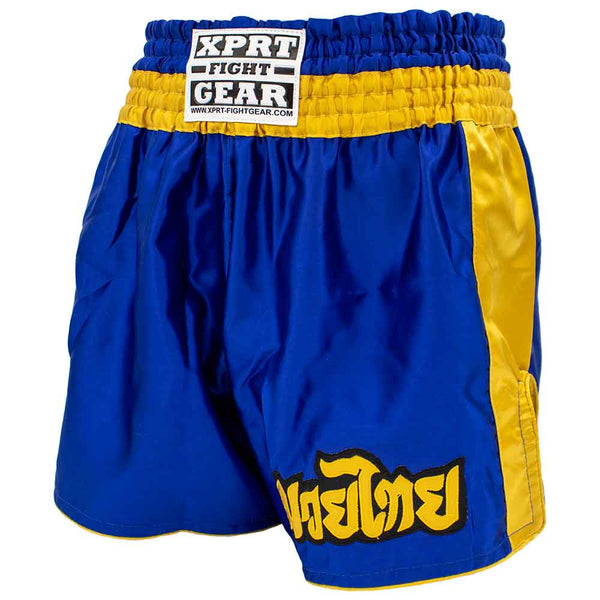
- Yellow: symbolizes the god Chandra and is associated with Monday. This color is especially important because the popular former King Bhumibol (Rama IX) was born on a Monday. As a result, yellow is a sacred color in Thai culture.
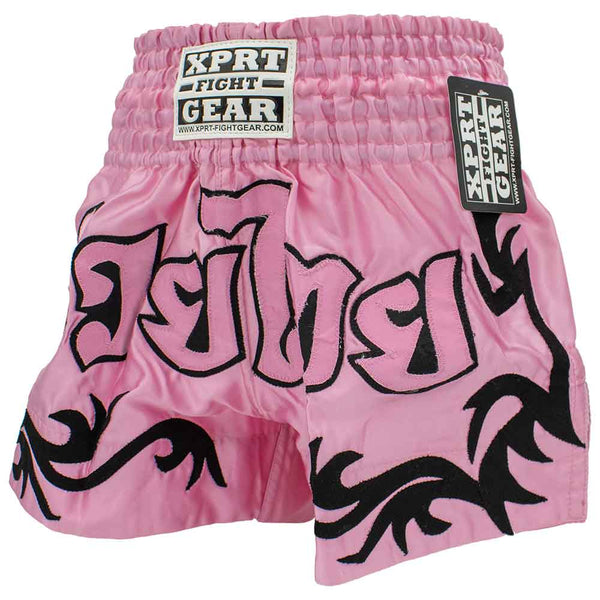
- Pink: symbolizes the god Mangala (god of war) and is associated with Tuesday in Thailand. Muay Thai fighters wearing pink Thai boxing shorts embody strength and endurance.
- Green: symbolizes Buddha and is associated with Wednesday in Thailand. Green represents wisdom, growth, and harmony. In addition, the Hindu god Phra Indra (the god of thunder) is often depicted with emerald-green skin, representing strength and resilience.
- Orange: symbolizes Brihaspati (or Phra Phue Ha Sat), the wise teacher of the gods. In Thailand, orange is associated with Thursday and considered auspicious: it brings wisdom, faith, and protection from negativity. The color originates from ancient astrology and Hindu cosmology.
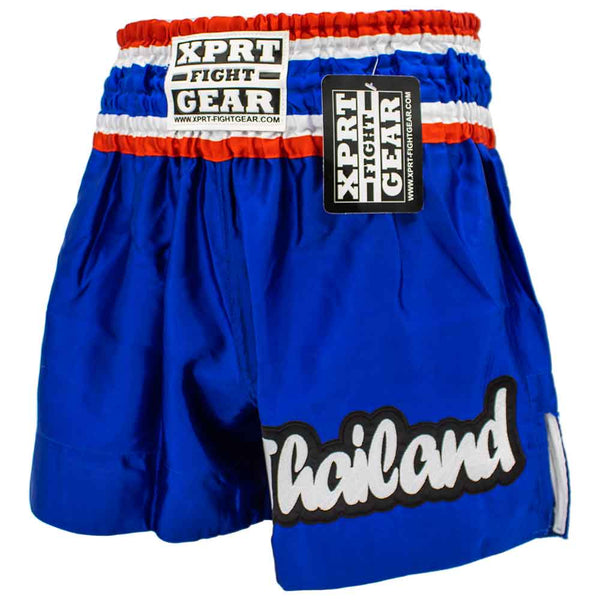
- Blue: symbolizes the god Shukra and is associated with Friday. The so-called "underdogs" in Muay Thai fights often wear blue shorts. The color is also important because it corresponds to the birthday of Thailand’s former queen Sirikit. In Thailand, people often wear blue on Fridays to honor the Queen Mother and bring good luck.
- Purple: symbolizes the god Shani (the Hindu god of justice) and is the lucky color for Saturday. As in many other cultures, purple is also associated with royal allure and wealth. Thai people often wear purple to attract luck, success, and wealth, especially on Saturdays.
Muay Thai shorts sometimes feature multiple colors, reflecting a unique mix of characteristics and energies. Fighters therefore wear these shorts proudly in the ring. They are a blend of culture, religion, and personal beliefs, making them an integral part of Thailand’s national sport.

The unique inscriptions on the shorts
The prints and inscriptions on traditional Muay Thai shorts serve as a form of identity and sometimes even as a tribute. The inscriptions usually include the name of the Nak Muay (นักมวย – Muay Thai practitioner), the name of their training camp, and sometimes the name of a sponsor.
The name of the training camp is often (in fact, almost always) also the fighter's "new" surname. Take the currently hugely popular Stamp "Fairtex" (แสตมป์ แฟร์เท็กซ์ – Nadthawan Panthong is her real name) as an example.
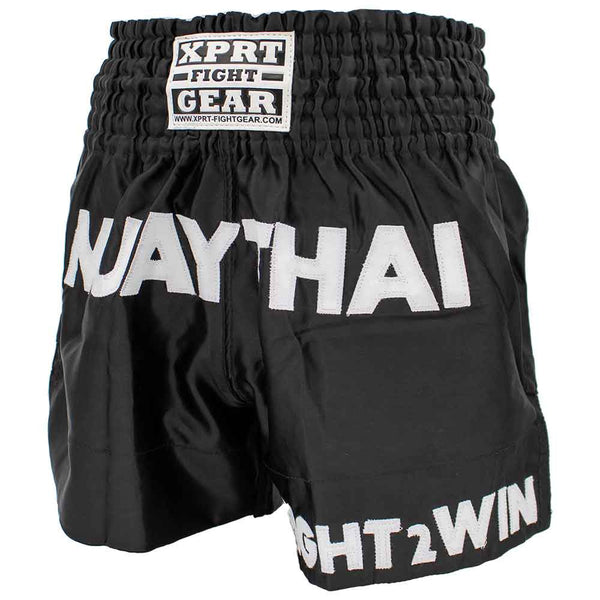
In Thailand, these inscriptions are usually written in Thai characters, which makes them extra authentic and gives them added appeal. As Thai boxing (and kickboxing, of course) has become hugely popular worldwide and Thai fighters increasingly compete abroad, Western characters are being used more often for the inscriptions. This helps bridge the gap between traditional and modern, local and global.

Images of animals
Anyone who has been to Thailand or visited Thai boxing gyms around the world will recognize them: shorts often featuring very cool, tough, and sometimes even mythical animals—monkeys, snakes, tigers, dragons, and elephants.
These are often highly sought-after and beautifully designed Thai boxing shorts, partly because they often stand out more and are clearer than Thai characters, which many people cannot read.
As in many Western cultures, these animals represent special qualities that they excel in or are known for. They feature in many folk tales and are highly respected by many traditionally minded people.
Some common animals and their main characteristics on Muay Thai shorts:
- Elephant: represents strength and majesty. The elephant symbolizes immense power, endurance, and strategic skill. This is deeply rooted in ancient Thai warfare, where the elephant was a revered symbol of strength.
- Snake: represents agility and speed. A snake also symbolizes wisdom, adaptability, and strategic movements. In cultural symbolism, the snake embodies cunning and resilience.
- Tiger: represents fearlessness and courage. Tigers are known for their immense power and strength. The animal embodies a determined spirit and a desire to achieve your goals.
- Dragon: represents determination, supernatural power, wisdom, and hidden knowledge, and embodies an untamed nature and a desire to learn.
- Hanuman: a mythical monkey warrior who holds great cultural significance in Thai tradition. Hanuman embodies strength, agility, perseverance, loyalty, and dedication. For Muay Thai fighters, this symbol serves as a source of inspiration, connecting them with traditional values of respect and courage, and symbolizing their own pursuit of excellence and overcoming challenges in the sport.
- Garuda: a mythical bird-like creature that also has deep cultural and spiritual significance in Thailand. The Garuda is also Thailand's royal and national symbol: a mythical half-human, half-bird creature. It bears the name Phra Khrut Pha, meaning 'Garuda, the vehicle of Vishnu'.

Red & blue corner colors
At Muay Thai fights in Thailand (especially in Bangkok), there is always a red and a blue corner. The red corner is generally reserved for the favorites, while the blue corner is reserved for the underdogs.
Originally, these colors could be found in the fighters' shorts, with red symbolizing the favorites and blue those less likely to win. This color distinction makes it easier for the audience to follow the fighters' scores.
Today, however, fighters are not required to wear the colors red or blue in their Muay Thai shorts. At Lumpinee Stadium in Bangkok (the most famous Muay Thai stadium in the world), there is no fixed rule for color selection.
On special occasions, such as fights held to celebrate the king's birthday, the traditional color scheme is often given a unique twist. During these fights, for example, both fighters may wear yellow shorts, the color associated with the popular former King Bhumibol. To make it clear who the favorite is during these fights, red or blue belts are added to the clothing.
More than just clothing
As you now understand, there is much more behind the colors, inscriptions, and images on the colorful designs of Muay Thai shorts. They reflect the complex Thai culture.
Whether it is the sacred colors derived from astrology and mythology or the inscriptions and images that tell the story of the individual and their journey, every pair of Muay Thai shorts tells a story of its own.
Muay Thai shorts, and Muay Thai as a whole, are deeply rooted in and steeped in Thai culture, Buddhism, and tradition.

Historical background of Muay Thai shorts
Origin
Muay Thai, the art of eight limbs, is a popular, hard-hitting, and effective combat sport that originated in Thailand (formerly Siam). The sport has a rich history, closely intertwined with the history of Thailand and its sovereignty.
The clothing, including Muay Thai shorts, but especially the armbands (prajead) and headbands (mongkhon), is deeply rooted in Thai culture and has undergone various changes over the years. The shorts have continued to evolve to meet the functional and commercial needs of this hugely popular global combat sport.
Traditional meaning
Among the old, original fighters, Muay Thai shorts were not as colorful or vibrant as we see them today. The focus was purely on functionality and effectiveness, just like the tough combat sport itself.
The colors and designs had a specific meaning connected to the gym (ค่ายมวย – khaoy), trainer (ครู – kru), sponsor, or the fighter’s spiritual beliefs.
Over time, as Muay Thai, Thai boxing, K-1, and kickboxing became enormously popular, traditional Thai boxing shorts began to blend with modern aesthetics and popular influences. And that is how we ended up with the incredibly cool and unique Thai boxing shorts we have today.

Western influence
Naturally, the enormous growth in Muay Thai’s popularity among fighters abroad has had a major influence on the clothing worn by Muay Thai fighters—not only aesthetically, but functionally as well.
The sportswear industry has focused on high-quality materials that provide greater freedom of movement, practicality, cooling, and comfort. Naturally, these modern technologies have also been incorporated into the still traditionally styled Muay Thai shorts. This unique combination of (Western) technology and Thai tradition and culture has resulted in a unique garment that is both highly functional and fashionable.
The classic Muay Thai shorts
Although modernization has brought various changes and improvements, fortunately there are still plenty of fighters and trainers who honor the origins of this national sport.
There is a growing trend toward returning to the sport’s traditional Thai roots. Some fighters and enthusiasts of the Thai sport are returning to more traditional designs (or never abandoned them), highlighting the unique cultural elements that make authentic Muay Thai unique. Naturally, traditional Thai characters, colors, and symbols feature prominently here.
Practical and technical aspects of Muay Thai shorts
Material & design
The first thing that comes to mind with any piece of sports equipment, whether it is a pair of shoes or a golf club, is the material it is made from. This choice of material is crucial for every piece of sports equipment, and Muay Thai shorts are no exception.
Muay Thai shorts are usually made from one of the following materials:
- Satin: Muay Thai shorts are traditionally made from satin because of its durability and smooth texture, which minimizes friction with the skin. This is the most comfortable yet still affordable fabric. There are also genuine 100% silk shorts (satin resembles silk but is synthetic), but that is not what was used by fighters, who were often from poor backgrounds.
- Nylon or polyester: these synthetic materials are also very commonly used because they are relatively inexpensive yet strong, durable, and moisture-resistant fabrics. Some fighters and athletes prefer them because they are extremely lightweight and very easy to maintain.
Fit, design, and construction
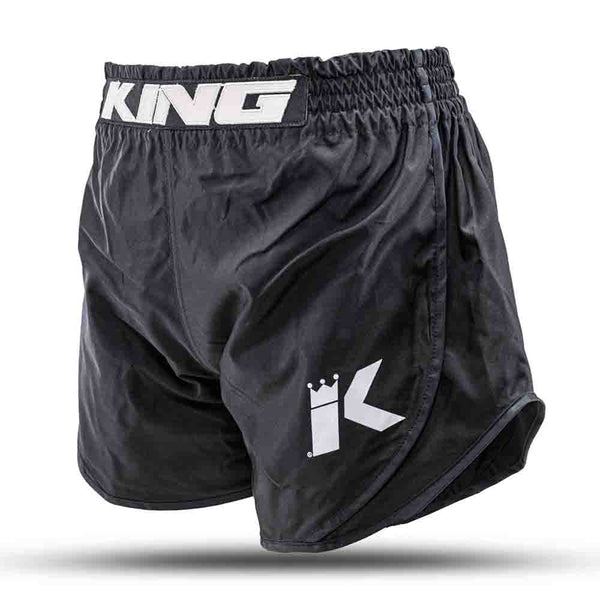
Muay Thai shorts have traditionally almost always been wide and short. This is simply because fighters benefit most from maximum freedom of movement. Both during training and in a fight, this makes it most comfortable to stretch, kick, and perform exercises.
The most important design features of Thai boxing shorts:
- Wide legs: for unrestricted freedom of movement, which is crucial for performing kicks and knee strikes.
- Elastic waistband with or without drawstrings: Thai boxing shorts often have a snug but non-constricting fit around the hips. This is essential for comfort and performance during training, sparren, and fights. Most shorts nowadays have both an elastic waistband and drawstrings to tighten them.
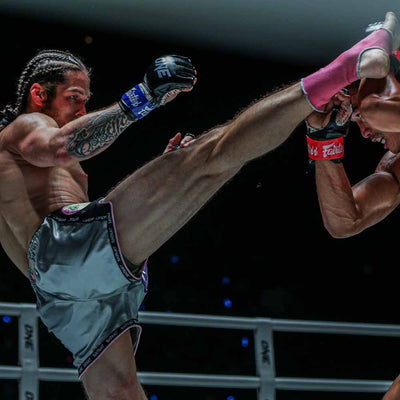
- Length: the shorts are usually shorter than standard sports shorts for more effective leg movements. Muay Thai shorts and kickboxing shorts are considerably shorter than boxing trunks for classic Western boxing, simply because kicking is also allowed in the former martial arts.

Freedom of movement, mobility, and wearing comfort
Muay Thai, "the art of 8 limbs" (the art of eight limbs), encompasses a wide range of movements and techniques. Think of high kicks, knee strikes, jumping, dodging, and quick lateral, spinning, and backward movements.
Mobility, flexibility, and agility are therefore essential requirements for the most successful fighters. The shorts fighters wear must not restrict them in any way, which is why Muay Thai shorts (and kickboxing shorts) are designed with these requirements in mind.
Common features of Muay Thai shorts:
- Short design: Thai boxing shorts should be short, allowing fighters complete freedom to swing their legs easily and high during training and while performing kicks.
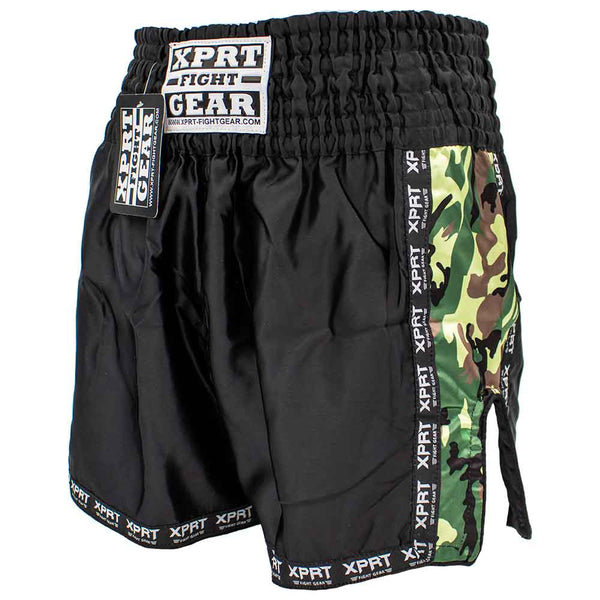
- Side splits: many Muay Thai shorts have splits on the sides to avoid restricting kicks and knees. Despite being short, the shorts almost always also have splits.
- Lightweight: Muay Thai shorts are ideally made from materials that are as light as possible. Like other functional sportswear, they should place as little burden as possible on fighters and not restrict rapid movements.
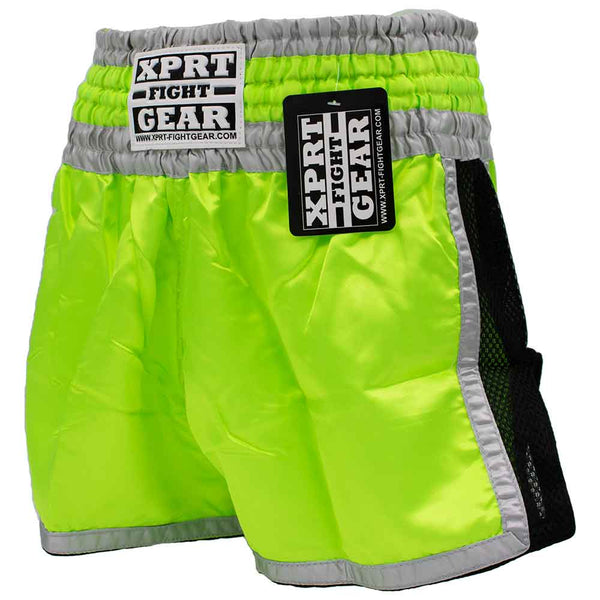
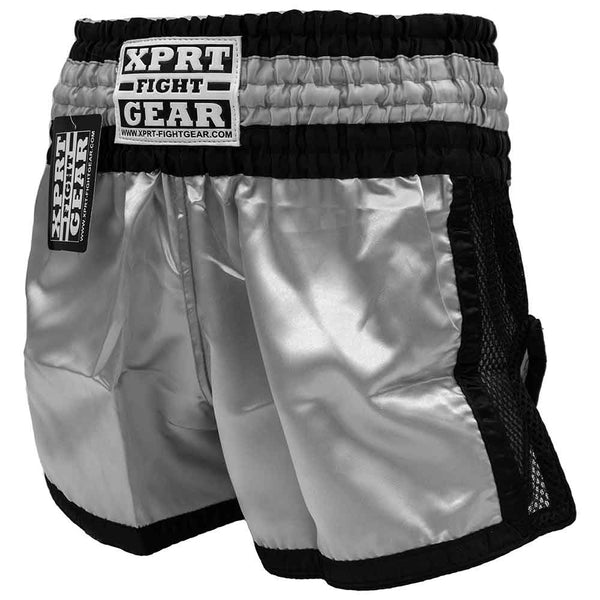
- Mesh panels: a clear influence of modern technology on classic shorts. Although Thai boxing shorts are already pleasantly airy due to their wide and short fit, manufacturers nowadays often add extra mesh panels to the sides for additional cooling. For most athletes, this is now simply a matter of style preference. However, training in Thailand can be extremely hot, so they are certainly not an unnecessary luxury.
Durability
Muay Thai training is physically and mentally intense, demanding, and tough. Under all circumstances, practitioners are pushed to their limits. These physical demands naturally also affect the materials they wear.
The durability and sturdiness of the shorts are therefore important factors if you want to enjoy them for a long time. Although lightweight materials such as nylon, polyester, microfiber, and satin are preferred, they must also be sturdy enough to withstand training.
High-quality stitching and reinforced seams are required to ensure that the shorts can withstand the demanding conditions of both training and fights.
Personal expression
In Thai boxing and kickboxing, you do not use many materials besides your boxing gloves, protective gear, and clothing such as shorts and possibly a shirt or top. A lot is expected of these items, so the primary focus is on functionality. But of course, the kickboxing shorts or Muay Thai shorts are also an expression of your own personality or the characteristics of your gym. After all, it is perfectly fine to look good during training.
That is why many Muay Thai shorts feature all kinds of design elements, prints, and embroidery that emphasize their personal character.
- Embroidery and prints: more expensive shorts may feature embroidered designs, which are generally more durable than prints. Embroidery is often preferred because it stays looking good for longer after washing and intensive use.
- Patches and logos: patches are a type of emblem that can be sewn on or printed. They often represent the gym or the fighter's sponsors.
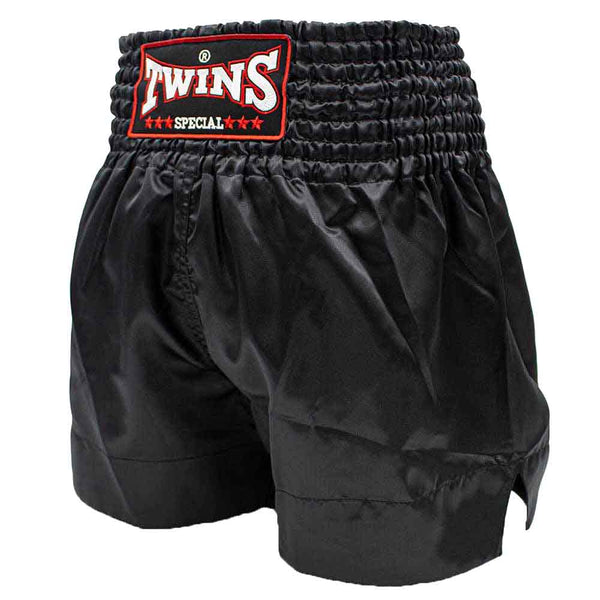
- Metallic and fluorescent fabrics: some of the most modern Muay Thai shorts feature striking aesthetic elements, such as metallic or neon effects. Some highly luxurious shorts we have seen even incorporate scale-like effects into the fabric, resembling those of a dragon or snake. TopKing, Yokkao, Twins Special, and other classic Thai brands in particular offer some such luxury shorts.
Conclusion and summary
The evolution of Muay Thai shorts is a chronicle of the sport's history. It is a beautiful and harmonious blend of traditional cultural elements with modern functionality and materials.
Originally, traditional fighters wore simple loincloths that allowed freedom of movement, essential for the demands of the martial art. Over time, these basic garments transformed into the vibrant and intricately designed shorts we see today, reflecting not only the physical side of the sport but also the cultural significance embedded in every piece.
As Muay Thai gained popularity worldwide, the shorts became more than just functional clothing; they evolved into a canvas for artistic expression. Fighters often choose designs that reflect their personal stories, beliefs, or cultural background. This makes every Thai boxing short unique.
The bright colors, prints, and symbols on modern Muay Thai shorts not only enhance their visual appeal, but also honor the sport's rich heritage and connect practitioners with their roots and ancestral traditions.
Ultimately, Muay Thai shorts symbolize the spirit of the martial art itself: dynamic, resilient, and deeply rooted in culture. They represent the journey of fighters who embrace both the sport's historical significance and modern developments. When practitioners enter the ring wearing these shorts, they carry a legacy that honors the past while embracing the future, embodying the essence of Muay Thai in every bout.
Muay Thai shorts have evolved, just like the sport itself. They are not merely garments; they are a piece of culture. When fighters enter the ring, every pair of shorts tells a story—a story about tradition and the dynamic relationship between old and new. Understanding the significance of these Muay Thai shorts gives you a new appreciation for this centuries-old, uncompromising Thai martial art.