Muay Thai, better known as thai boxing, has been practiced in Thailand for centuries. This martial art is very popular in Thailand and far beyond.
Modern Muay Thai is partly derived from the ancient armed martial art Krabi Krabong. The ancient warriors of this art were trained to use their eight body parts when they did not have weapons.
This was called Muay-Boran, from which modern Muay Thai developed. Many traditional techniques are no longer permitted in more competition-oriented thai boxing because they would simply be too dangerous for practitioners.
Other names by which Muay Thai has also been known include: Mai See Sawk, Muay Pahuyuth, Chaiaboksen, Muay Tai, and Siamese Boxing (Thailand was formerly called Siam).
Many things are permitted during thai boxing matches, but there are still plenty of rules that must be followed. A variety of techniques can be used with the fists, elbows, knees, and legs. The punching techniques closely resemble those of Western boxing. The kicking techniques, knees, and elbows naturally create a major difference from regular boxing.
Permitted techniques in Muay Thai
Thai boxing is full-contact, meaning that victory can be achieved by knockout (KO). If this does not happen, the winner can of course be determined by scoring the most points over the various rounds.
In addition to arm techniques targeting the head and body, kicks may be delivered to the head, body, and legs. The so-called low kicks are particularly feared weapons of the thai boxer.
These kicks to the thighs are highly effective and especially painful, particularly when performed repeatedly. Winning by knockout through low kicks is regarded as a classic.
Differences between Muay Thai and Western boxing
Another major difference from Western boxing is the clinch. In regular boxing, the fighters are separated immediately after clinching. In Muay Thai, however, the clinch is a very important part of the fight.
Fighting on is permitted during the clinch, so a great deal of training focuses on performing techniques such as knees from the clinch. The opponent may also be thrown from the clinch using techniques comparable to those found in Japanese judo.
Thai boxing is considered worldwide to be a highly effective martial art. It was introduced to Europe and the United States in the 1960s and 1970s.
Especially in the Netherlands, many practitioners of Japanese Kyokushin karate switched to thai boxing or practiced it alongside karate. Thai boxing is often mistakenly called kickboxing, although it is in fact not the same.
Kickboxing has different rules, and the traditional opening ceremony (Ram Muay) is omitted. Elbow techniques are also rarely permitted in matches in the Netherlands and the West.
When they are permitted, this is often referred to as Thai rules. Even today, the Thai remain masters at using these techniques.
Dutch victories in Muay Thai
The Netherlands has a reputation to uphold in thai boxing and has built a highly illustrious history in the sport. Thom Harinck, trainer of the world-famous Amsterdam Chakuriki, is considered one of the pioneers who introduced the sport to the Netherlands.
Jan Plas of Mejiro Gym is also regarded as the Dutch father of Thai Boxing. Since the sport was introduced to the Netherlands, the following names, among others, have achieved great fame: Perry Ubeda, Peter Aerts, Ernesto Hoost, Sem Schilt, Remy Bonjasky, Badr Hari, Andy Souwer, and Albert Kraus.
Ramon Dekkers, Peter Smit, and Rob Kaman are widely regarded as the biggest names among previous generations of Dutch fighters. In Thailand, they managed the nearly impossible by defeating the supposedly unbeatable Thai fighters in their own country and stadiums.
Martial arts events and divisions
Nowadays, countless events are organized in the Netherlands, and enthusiasts can attend an event almost every weekend. Matchmaking, pairing opponents with one another, is based on experience in the ring.
There are youth, N (novice), C, B, and A divisions. As fighters win more often, they move up in rank. At present, the dominance of Dutch fighters is beginning to waver, and many new countries are emerging, such as Georgia, the entire Eastern Bloc, Armenia, and many others.
Muay Thai equipment
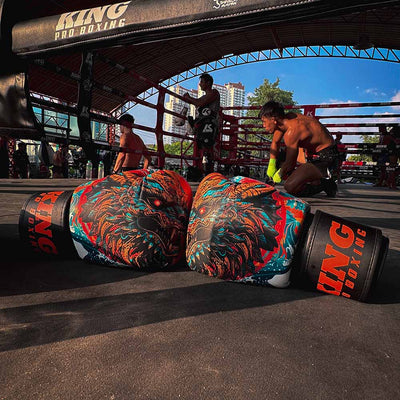
Various pieces of equipment are needed for Muay Thai training. The most important are boxing gloves and protective equipment, such as shin and instep guards, a mouthguard, and a groinguard. Elastic handwraps are used to reinforce the hands.
Although they are usually not mandatory, most practitioners wear traditional shorts during training. Check out all our competitively priced complete thai boxing sets.
Punching bags are often used during training. Special bag gloves have been developed for this purpose because regular boxing gloves can become damaged on the bag.
Every gym should also have a number of Thai pads for practicing powerful kicks. Larger kicking shields can also be used for this purpose.
View in webshop:
Collections >> Gear