Tang Soo Do is a Korean martial art and literally means “the art of the Chinese hand.” It originated from various martial arts from Korea, China, and Okinawa, among others.
These roots began with Korean Tae Kyon, Chinese Shaolin, and Japanese Shotokan. According to the World Tang Soo Do Association, it resembles a Chinese martial art because the first word, TANG, can be interpreted as a reference to the Chinese Tang dynasty.
Before the Kwans were unified under the Korean Taekwondo Association, most of the major Kwans called their style Tang Soo Do, Kong Soo Do, or Kwon Bup.
The first use of the term Tang Soo Do in history is attributed to Chung Do Kwan founder Won Kik Lee. His Kwan and the other Kwans stopped using the name Tang Soo Do after they united under the name Taekwondo.
The Moo Duk Kwan, which remained loyal to Hwang Kee, did not participate in this unification, remained independent, and continued to use the name Tang Soo Do.
Founders of Tang Soo Do
The origins of Tang Soo Do cannot be attributed to a single person. Lee Won Kuk is considered one of the first Tang Soo Do teachers in Korea. He established a dojang in Korea during the Japanese occupation.
This school was called Chung Do Kwan. He claimed that he had learned Taekkyon in the streets of Seoul and Kung Fu in China. Kee claimed that he learned the philosophy of Okinawan karate from Funakoshi’s books.
The history of the Moo Duk Kwan, which is very important to modern Tang Soo Do, can be attributed to Hwang Kee. He claimed to have learned Chinese martial arts in Manchuria. He was also influenced by Korean Taekkyon and Subak.
Belts in Tang Soo Do
Tang Soo Do uses the colored belt system introduced by Jigoro Kano and first used in Karate-Do. A notable difference is that the traditional black belt has been replaced by a dark blue belt for students who achieve their first dan.
The reason for this is that black represents “death” in Korea. Practitioners believe that achieving the next dan is another step, for which they receive a red-striped dark blue belt.
After achieving the fourth dan, one receives the title of Master Instructor. To become a grandmaster, one must perform an international act connected to the sport.
The original belt colors, as devised by Hwang Kee, are: 6th gup, green belt; 5th gup, green belt; 4th gup, green belt; 3rd gup, red belt; 2nd gup, red belt; and 1st gup, red belt.
Kata or Hyeong
There are various Tang Soo Do organizations around the world, but they all follow the same kata or hyeong.
- Gicho/Kicho heyong
- Hyong Il Bu
- Hyung Ee Bu
- Hyung Sam Bu
Taikyoku
The Kicho Hyung are notably similar to the Taikyoku kata developed by Gichin Funakoshi. The starting points are the same, as are the movements, blocks, and punches. There are many reasons to believe that Hwang Kee adapted his Korean Kicho Hyung from the Japanese kata.
Sae Gae Hyung
The World Tang Soo Do Association adapted the Kicho Hyung and added kicks to them.
- Sae Gae Hyung Il Bu
- Sae Gae Hyung Ee Bu
- Sae Gae Hyung Sam Bu
Pyong Ahn Hyung
The pyong ahn/pyung ahn hyeong are a series of five forms that resemble the pinan kata series in karate in many respects. They were developed by Itosu, a mentor of Gichin Funakoshi. These forms were developed as training forms for Kong Sang Koon.
- Pyung Ahn Cho Dan
- Pyung Ahn E Dan
- Pyung Ahn Sam Dan
- Pyung Ahn Sah Dan
- Pyunh Ahn Oh Dan
Equipment
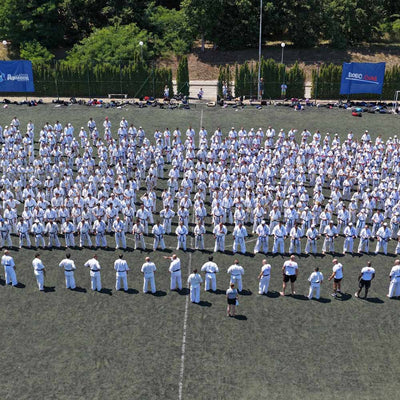
In Tang Soo Do, practitioners wear the authentic dobok, the name for the uniform. The standard dobok is completely white. For dan holders, traditional piping is added.
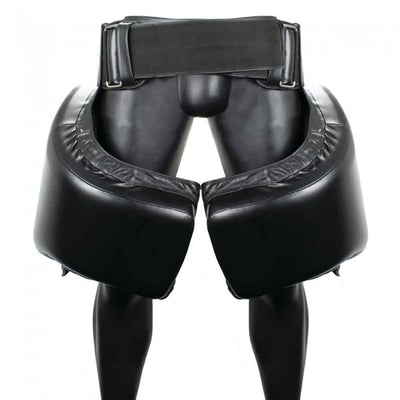
They also use so-called safety equipment, consisting of a pair of gloves and safety kicks. Headgear is also worn.
Shin guards are also sometimes used. A mouthguard is recommended, and a groinguard is mandatory for men.