Anyone who compares footage of UFC 1 with a modern UFC broadcast sees not only a different way of fighting. The clothing also tells a story. In the early years, competitors with very different combat-sports backgrounds entered the cage, and their outfits revealed it. Today, shorts are a recognizable part of a professional clothing package. Between those points lies a development in which training practice, competition rules, sponsors, and the sport's image all intertwine.
The MMA shorts did not simply become shorter, tighter, or more technical over time. Loose fight shorts and close-fitting models exist alongside each other. The main difference from the early years lies in the purpose-driven design: clothing for a sport in which you must be able to punch, kick, wrestle, and move on the ground. The history of the shorts shows how MMA grew from a meeting between disciplines into its own sports culture.
1993: at UFC 1, the fighter's background was visible
The first UFC revolved around a question that came directly from the world of combat sports: what happens when different styles face each other? That format produced not only varied techniques, but also varied clothing. Royce Gracie appeared in a gi. Other competitors chose shorts suited to their own disciplines. There was not yet a shared, recognizable MMA outfit.
In that environment, a gi was more than a visual statement. The clothing was part of the way a competitor had learned to fight. For viewers, this made the contrast between styles immediately visible: this was not a group of athletes in the same uniform, but a collection of specialists bringing their own backgrounds with them.
That is why it is too simplistic to view old footage solely as a peculiar fashion phase. The clothing shows how the sport was still defining itself. An outfit referred to jiu-jitsu, wrestling, or another background, while the shared requirements of mixed martial arts were not yet an obvious starting point for clothing design.
The familiar description of that period as fighting without rules also deserves some nuance. The contrast with the regulated sport that followed was significant, but a catchy slogan is not a complete description of the match conditions. For the history of the clothing, what matters most is that early UFC did not have the same uniform look the organization would acquire later.
From an individual discipline to trousers for the entire fight
As fighters began preparing more broadly, it also became clearer what their clothing needed to do. Trousers that are comfortable for standing combat alone do not automatically work just as well when you squat deeply, grab a leg, or turn onto your back into a new position. MMA brought these movements together in one fight and therefore in one outfit as well.
This shifted attention from recognizability to practicality. How do the trousers fit when the hip bends? How much fabric is around the thigh? How does the waistband stay secure when your opponent applies pressure? Questions like these explain why the cut and fastening of fight shorts became more important than appearance alone.
Loose shorts with a boardshort-like shape became a recognizable part of the MMA image. At the same time, the short, close-fitting models did not disappear. This is an important difference from a history in which every new style would replace the previous one: MMA developed multiple solutions for the same movement environment.
You can still see that variety today. One athlete wants slightly wider legs, while another prefers very little loose fabric. The MMA shorts label therefore says less than the actual construction. Length, room around the hips, and the type of waistband together provide a better picture of the trousers.
Competition rules and clothing contracts are not the same
The professionalization of MMA went hand in hand with the development of clearer competition rules. An important moment was the creation of the framework that became known as the Unified Rules of Mixed Martial Arts. Its development in New Jersey at the beginning of the 2000s was part of the broader transition to a regulated sport.
For clothing, an essential distinction must be made. Competition rules concern what participants may wear during the fight. An organization's clothing agreement also concerns who supplies that clothing and what the clothing package looks like. These are two different layers, even when you see them simultaneously during a broadcast.
So an allowed type of shorts does not necessarily mean a free choice of brand. An organizer can prescribe its own outfit within the permitted forms of clothing. Conversely, a UFC clothing contract does not mean that the same brand agreement automatically applies to every other MMA organization.
Anyone comparing clothing rules should therefore look at the organization in question, the applicable competition rules, and the event's conditions. A professional UFC outfit is not a universal dress code for all MMA training or competitions. The sport's development is broader than the policy of a single promoter.
The fight short as a fighter's and brand's calling card
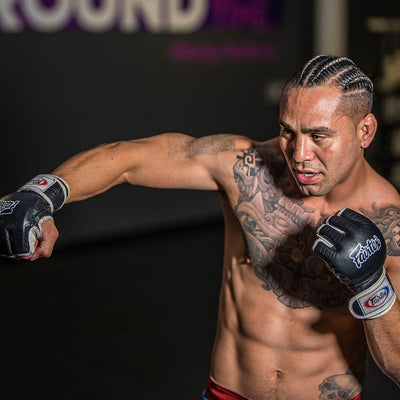
Before the UFC began using a centralized clothing package, shorts were a prominent part of a fighter's individual presentation. Brand names, sponsor logos, patterns, and colors all helped determine how someone was recognized in the cage. The trousers were both sportswear and visible space for a commercial message.
That fit a period in which the identity of MMA was also developing outside the cage. Martial arts brands built an audience with clothing that was worn not only during fights. The design of fight shorts was part of that recognizable MMA culture: sometimes understated, sometimes distinctly graphic.
With separate shorts, there is literally room for this. The legs form a large visible surface that regularly appears on screen during broadcasts. A pattern or logo can make an outfit immediately recognizable without changing anything about the techniques the fighter performs.
Design and function should therefore also be kept separate. A striking print says nothing about the amount of stretch. A simple black model can just as easily have a well-considered closure or side split. The history of MMA clothing consists of both stories: how the trousers work and what they convey.
2015: Reebok and the transition to a centralized clothing package
With the introduction of Reebok's UFC clothing package in 2015, the organization's appearance changed dramatically. Whereas individual shorts and personal sponsor displays had previously dominated much of the visual image, there was now a centrally organized presentation. It was not just a new pair of shorts, but a different way of outfitting athletes for an event.
For viewers, this made the UFC look more like a unified whole. Clothing for official occasions and clothing for the fight shared a common brand identity. From then on, the outfit was explicitly part of the organization the athlete competed in.
That change also affected the role of trousers as a sponsorship surface. With a centralized clothing package, fighters and individual clothing brands no longer filled in each item separately. This explains why the discussion about this step was not only about fit or design, but also about personal branding and sponsorship.
A specific loss amount for an individual fighter does not automatically follow from that. Separate contracts and statements would be needed for that. For the history of the clothing, the structural change is most important: the UFC shorts became part of an organization-wide package rather than solely an individual choice.
2021: Venum takes over the outfitting
In 2021, Venum took over as the UFC's clothing supplier from Reebok. This changed the brand behind the package, but the principle of centrally organized outfitting remained. Fighters received clothing developed as part of the partnership between the UFC and the supplier.
That package involves more than just the shorts worn in the cage. The UFC distinguishes between clothing for Fight Week and the Fight Night collection. This distinction helps explain why a training photo, a weigh-in, and a bout may show different clothing while still belonging to the same partnership.
The shorts themselves remain the garment in which the demands of the fight come together. The thigh must be able to move, the waist must fit snugly, and the finishing must suit a sport involving both stand-up techniques and ground work. So a different logo on the trousers tells only part of the story.
The supplier's name and the development of the garment also do not fully coincide. Loose fight shorts, short fitted models, and different leg lengths are not separate sports or historical stages that neatly follow one another. They are variants that can coexist within the modern MMA environment.
2024: the UFC announces an extension with Venum through 2029
On March 7, 2024, the UFC announced that Venum would remain its exclusive global outfitting partner through 2029. That official announcement confirms the duration of the extended partnership. So this is not a conclusion based on the clothing that happens to be visible in a recent photo, but a published agreement.
The announcement also describes how broad that partnership is. The Fight Week Gear includes clothing for training sessions and official activities, including weigh-ins and open workouts. The Fight Night collection includes fightwear and walkout clothing, such as hoodies, caps, and trousers for fighters and their corners.
For the shorts, the UFC mentions microfibre material, the construction of the waistband and side splits, among other features. These are concrete design elements. At the same time, the commercial descriptions of comfort and freedom of movement in such an announcement are the language of a clothing presentation, not proof that every athlete experiences every model in the same way.
The extension fits into the development of the UFC as a recognizable sports brand. The clothing is designed not only for the fight, but is part of a broader package of official activities, presentation and fan merchandise. The fight short is the most visible part during the match, but it is not the only product.
What changed in the construction of MMA shorts?
Alongside the major clothing contracts, there is a less conspicuous story: the construction of the trousers. It is not about one year in which everything changed, but about different ways of combining room, fit and freedom of movement. A loose leg, a side split and a stretch panel are different solutions, even though they are sometimes sold under the same heading.
Length and room around the upper thighs
A longer loose-fitting short has a different silhouette from a shorter model with a high side opening. This difference is clearly visible when the knee comes up. Length is not the only factor: the width of the leg and the position of the split also determine how the fabric falls around the leg.
The waistband and fastening
A wide elastic waistband, a drawstring and a hook-and-loop fastening are different ways to make trousers fit securely. They are visible construction details, not fixed features that every MMA model automatically has. Some shorts combine several solutions.
Stretch in the fabric or in a separate panel
A pair of trousers can have stretch in the material itself or use a separate stretch panel. Therefore, looking only at the outside is not enough to understand the entire construction. A pattern, sheen or matte finish does not in itself indicate how much the material will stretch.
The development of MMA shorts therefore cannot be summed up as a transition from bad old trousers to perfect new ones. More purpose-driven designs emerged, along with a wider range of models. What an athlete finds comfortable partly depends on the cut and the movements the trousers are used for.
The history can be seen in various modern models
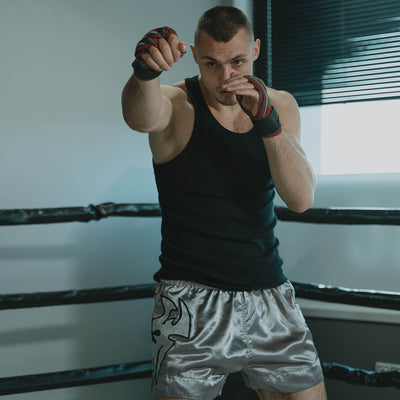
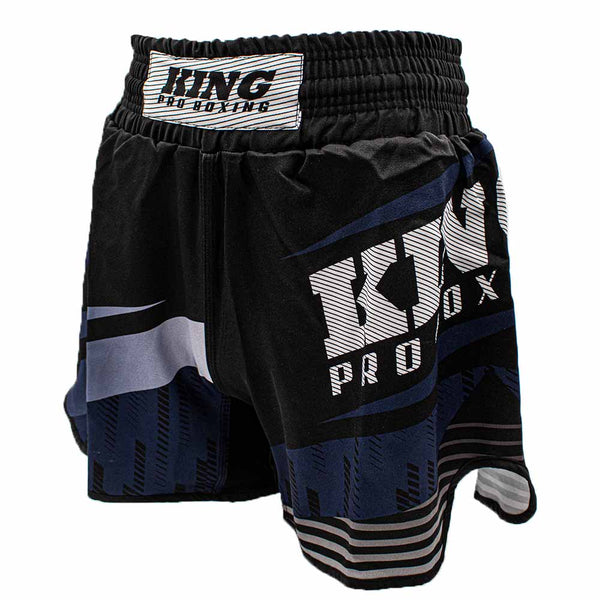
Different design directions also remain visible outside official UFC clothing. A longer, looser model with large graphic panels visually aligns with the recognizable fight-short culture. A simple short with an elastic waistband and shorter legs places the emphasis elsewhere. Neither has to be a copy of a specific historical pair of fight trousers.
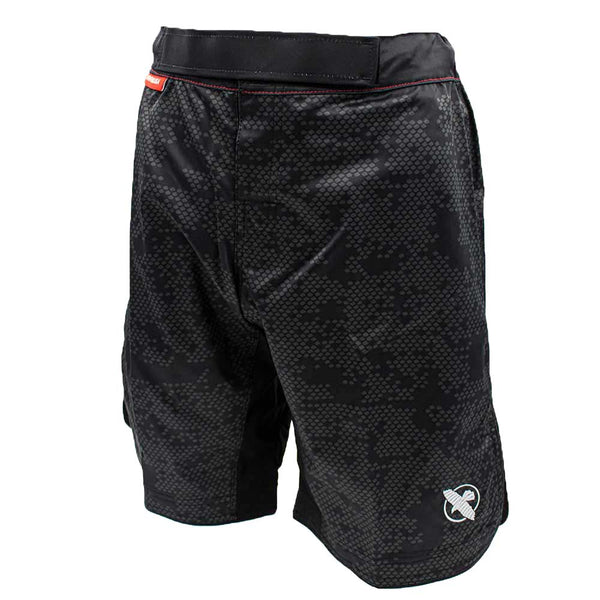
The Booster Skull, for example, shows how much room a longer short offers for a bold pattern. The Hayabusa Hexagon Black has a different appearance, with a dark pattern, a flatter-looking waistband construction, and a front closure. These differences can be assessed more concretely in the photos than through general terms such as professional or technical.
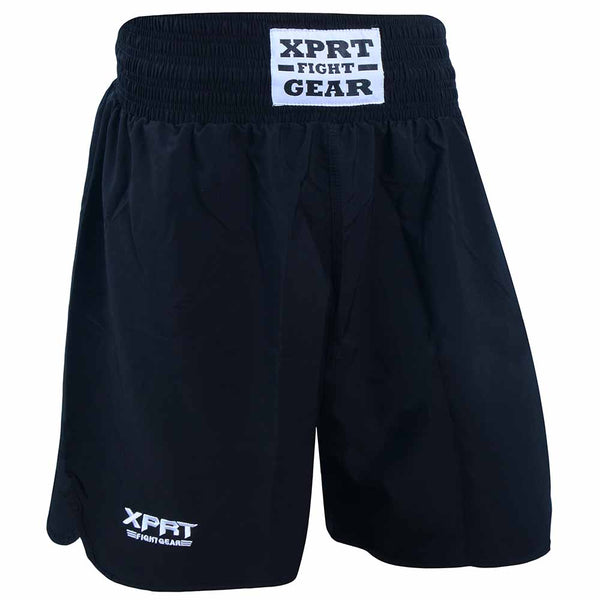
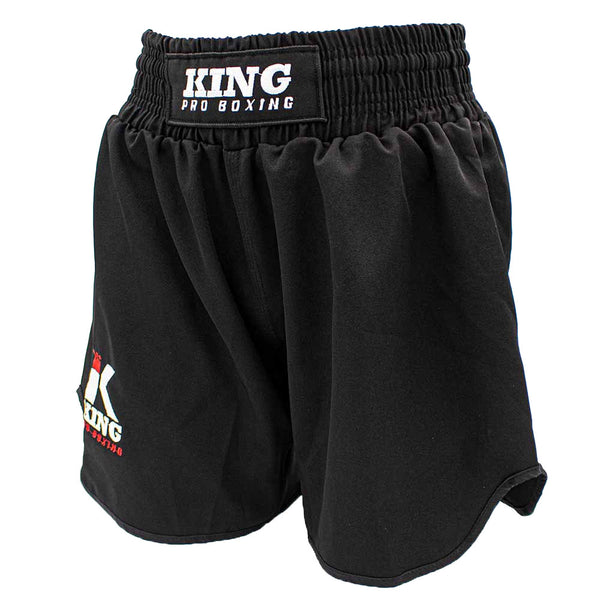
With the XPRT Hybrid 2.0 and the King Pro Boxing Stormking Basic, it is specifically the elastic waistbands and the shape of the legs that stand out. The XPRT Hybrid 2.0 is made from polyester microfiber with stretch. The Stormking Basic likewise combines stretch material with an elastic waistband and drawstring closure. These are examples of modern training clothing, not of the UFC’s official apparel agreement.
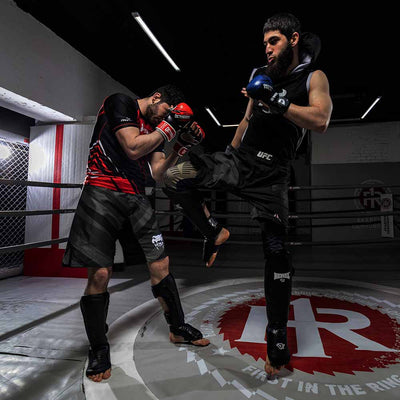
It is important not to conflate these two worlds. An MMA short in a sports shop does not have to be a UFC fight kit to be an MMA training pair of trousers. Conversely, a UFC logo on a photo does not by itself make it an image of an official UFC fight. Training, competition clothing, and fan merchandise overlap, but they are not the same.
From style recognition to an MMA identity of its own
The broad outline begins with the visible differences between disciplines. In the early UFC, clothing could almost serve as an introduction to the participant: this was the background with which someone entered the fight. As MMA developed its own training practices, clothing also emerged that referred less to a single original combat sport.
After that, the shorts became a vehicle for personal style, clothing brands, and sponsor logos. Centralized apparel packages changed that again: the outfit became more explicitly part of the organization’s presentation. The switch from Reebok to Venum and the announced extension through 2029 fit into this latest development.
Yet beneath that brand history, the same practical question remains: how do you make trousers that bring together different forms of fighting? The answers can be seen in leg length, side splits, waistbands, closures, and stretch. It is precisely the combination of sports development, design, and appearance that makes MMA shorts more than ordinary short trousers with a combat-sports logo.