I'm Tadej, 17 years old, and I'm doing a 3-month full-time internship at Fight2Win as part of my e-commerce studies. Naturally, I also train in martial arts myself. I boxed for a while at first, then switched to Thai boxing, and alongside Thai boxing I also started Brazilian Jiu Jitsu.
Thai Boxing Training
I train Thai boxing twice a week at Sportcentrum Eagle Gym.
An average training session at Eagle Gym goes as follows: when you arrive, you can change in the locker rooms, put on your cup and wrap your hands with your handwraps.
Warming Up
Before you actually start training, you obviously need to warm up. First, get moving and loosen up, alternating shadow Thai boxing with push-ups, squats and abdominal exercises such as planks, sit-ups and mountain climbers. It is important to loosen all your joints, such as your neck, shoulders and hips, by rotating them. Finally, stretch your shoulders and legs.
Sometimes we then grab a punching shield and do 25 low kicks, 25 power kicks and 25 teeps per leg. By then, you are properly warmed up.
Combinations
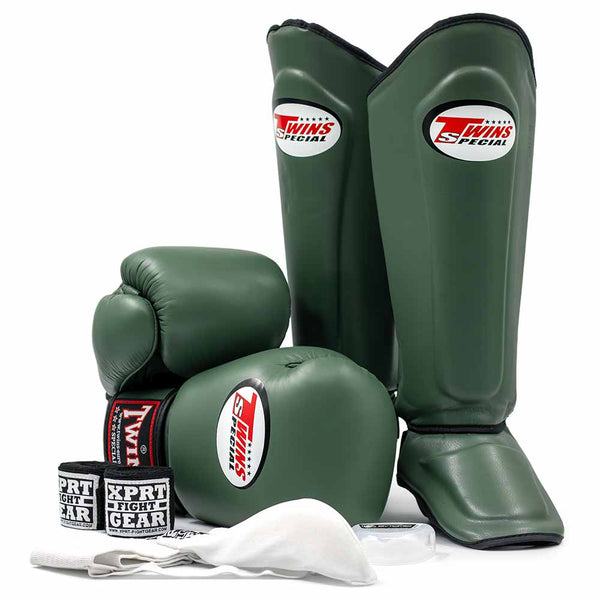
Once we are warmed up, we put on our shin guards and gloves and start working on combinations. We usually begin the first round with a jab, straight right, left hook and low kick to get our punches and kicks going, and then start the combinations for real.
We usually spend about half an hour doing different combinations, such as jab, cross, hook, stepping out during the hook, low kick, stepping out again and low kick. My favorite combination is jab, cross, switch, power kick, jab, cross, switch, hook, power kick. We do the combinations in rounds of 2 or 3 minutes.
Sparren and Extras
Then the trainer calls for mouthguards. I personally use Shock Doctor's double-braces mouthguard because I have braces on both my upper and lower teeth. Once everyone has put in their mouthguard, we start sparren, with 2-minute rounds and 30 seconds of rest. Sparren usually lasts 20–30 minutes, after which we do a short cooldown. The cooldown consists of rotating the joints and briefly stretching.
Besides my training at Eagle Gym, I do some additional small exercises that complement my Thai boxing training. I try to practice with a reflex ball for 10 minutes, 5 times a week. This is good for my hand-eye coordination.
In the meantime, I train my movement and the ability to evade punches by switching stances and applying slips, slipping and rolling.
To improve my footwork and develop extra explosive calves, I make sure to jump rope at least twice a week, usually for 3 rounds lasting between 2 and 3 minutes.
Brazilian Jiu Jitsu
I train BJJ 3 times a week at BJJ Rotterdam.
Danny, the head instructor, learned his Jiu Jitsu from grandmaster Rickson Gracie, and he tries to pass Rickson's vision on to as many people as possible, so that they can learn about and experience the power of Jiu Jitsu. That power lies mainly in problem-solving, which is what attracts me so much to Jiu Jitsu.

Before we start training, we lay out the mats, then put on our Gi, or a rash guard for No-Gi on Thursdays.
A Gi is the traditional uniform for BJJ, consisting of a heavy cotton jacket, reinforced trousers with a drawstring and a belt indicating your rank—white, blue, purple, brown or black. Traditionally, a Gi is white, but nowadays we see many different colors being used in BJJ.
After that, we warm up: jumping, butt kicks, high knees, rotating the joints and doing lunges to warm up the knees and hips. If it fits the day's training, we also warm up by running on our shoulders and doing ebi's or other important movements.
Once we are warmed up, we have an hour of technique training, during which we alternate between the following positions:
Mount: You sit on top of your opponent, who is lying on their back, with control over their upper body.
Back mount: You are behind your opponent with your legs around their waist and control over their upper body.
Side control: In this position, you lie on top of your opponent, across their chest, using your weight to maintain control.
Guard: You lie on your back with your legs around your opponent to defend or attack.
There are also variations within these positions, such as half guard, open guard and the north-south position in side control, among many others.
All positions are covered extensively in turn: first, the trainer explains what we are going to do, and then demonstrates how to do it.
You then practice these positions yourself with a training partner while the trainer walks around to help. Every so often, he gives the whole class some additional details that you can then apply.
After the hour of technique training, we can test ourselves during sparren, with 6-minute rounds and 30 seconds of rest between rounds to switch partners.
During sparren, you and your sparring partner can choose which position to start in, often a position that one of you still struggles with or would like to work on.
After sparren, we do a short cooldown with movements such as standing rock climbers, rotating the joints again and focusing on our breathing.
Gym
Before I started training Thai boxing and BJJ, I went to the gym 5 times a week. At the gym, I mainly did exercises to build muscle. Examples include bench press, hamstring curls, barbell rows, leg press and various other exercises for my arms and shoulders.
During the 2 years when my focus was entirely on the gym, I gained around 17 kg. This was necessary. The only downside is that training exclusively at the gym, without doing mobility exercises and/or stretching, can leave you with short and stiff muscles.
Now I approach my gym training differently: I still train with weights twice a week. I still focus on strength, but I keep BJJ and Thai boxing in mind.
Now I do more exercises such as push-ups, pull-ups, medicine ball slams and cable rows. Although it is not popular in the martial arts world, I only do 2 sets per exercise if the exercise is not specifically for muscular endurance.
For me, 2 sets are enough to make progress without overloading my entire body; I do make sure that I reach failure or genuinely cannot do any more by the end of my set.