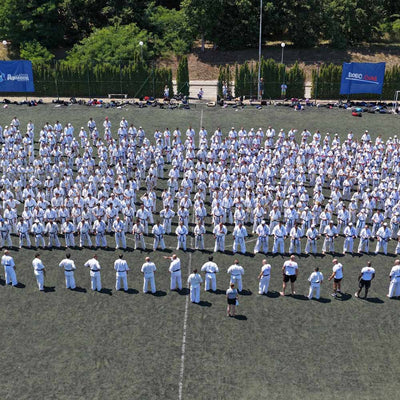
Most (though by no means all) combat sports and martial arts originate in Asia. China, Korea, and Japan in particular have a long history of self-defense systems. Read more about the origins of Taekwondo, Karate, Judo, Kung Fu, and many other systems.
Aikido (Japan)
The term Aikido literally means “the way of harmony with Ki,” but there are many other possible interpretations. It is a Japanese martial art developed by Morihei Ueshiba. Read more
Eskrima (Philippines)
Eskrima, Kali, and Arnis are collective names for Filipino martial arts. These arts originated centuries ago and have continuously evolved to serve their purpose in (tribal) warfare. Through Eskrima, the eskrimador learns armed ... read more
Han Mu Do (Korea)
Han Mu Do, founded by He-Young Kimm, is a martial art consisting of hand techniques, weapons training, and martial arts philosophy. Kimm integrated the techniques and philosophies of various Korean martial arts, most of ... read more
Hapkido (Korea)
Hapkido is a Korean martial art. It is a form of self-defense that uses joint locks, pressure points, throws, kicks, and punches. Hapkido practitioners train to counter the techniques of other martial arts. ... read more
Hwarang Do (Korea)
The Korean martial art Hwarang Do was developed by grandmaster Lee Joo Bang. Lee Joo Bang practiced Hapkido but developed his own style and named it Hwarang Do. After he moved to the United States, he ... read more
Jeet Kune Do
The name of the martial art Jeet Kune Do, developed by Bruce Lee, literally translates as “the way of the intercepting fist.” Contrary to what many people think, Jeet Kune Do is not a sport, but a ... read more
Jiu-Jitsu (Japan)
Jiu-jitsu literally means the “art of gentleness,” but can better be described as “flexible technique.” It is a collective term for Japanese martial arts styles that include armed and unarmed techniques. Jiu-jitsu... read more
Judo (Japan)
Judo can literally be translated as “the gentle way.” It is a Japanese martial art that originated at the end of the 19th century. The most important aspect is the competitive element, in which the goal is to... read more
Karate-do (Okinawa – Japan)
Karate, more fully known as Karate-do, is a martial art originating in the province of Okinawa, which now belongs to Japan. Karate is primarily a standing martial art emphasizing punching techniques, kicking techniques, knee-... read more
Kempo (China)
The Chinese characters representing kempo or kenpo are pronounced Chuan (fist) Fa (way or method). The Japanese, who use the Chinese characters, translate them as Ken (sword or fist) and Ho ... read more
Kendo (Japan)
Kendo, meaning ‘Way of the Sword’, is a modern Japanese martial art involving swordsmanship, based on traditional Japanese Kenjutsu. Kendo is a physically and mentally demanding activity that upholds the standards and values of ... read more
Kickboxing (Japan and the United States)
Kickboxing is a martial art in which both the hands and legs may be used. The sport originated in Japan and the United States, where it became popular in the early 1970s. Kickboxing in... read more
Kobudo (Japan)
Kobudo is the collective name for the more modern (after around 1900) forms of the classical Japanese martial art from the island of Okinawa. Contrary to popular belief, the weapons used in Kobudo ... read more
Krav Maga (Israel)
Krav Maga is a self-defense art originating in Israel. The founder of the movement is the Czech Imrich Sde-Or, commonly known as Imi. Imi encountered antisemitism at an early age in his native Czechoslovakia... read more
Kuk Sool Won (Korea)
Kuk Sool Won is a Korean martial art system developed by In Hyuk Suh (the Kuk Sa Nim or Grandmaster). The name Kuk Sool Won means ‘National Martial Art Association’ and is often abbreviated to ... read more
Kung Fu (China)
Kung Fu and Wushu are two popular terms that have become synonymous with Chinese martial arts. However, the two Chinese terms have very different meanings. Wushu can be interpreted in many different ways ... read more
K-1 (Japan)
K-1 is a combat sport that combines techniques from thai boxing, taekwondo, karate, kung fu, kickboxing, and traditional boxing, among others. The ‘K’ stands for karate, kung fu, and kickboxing. The term K-1 is derived from F-1 or .... read more
Muay Thai (Thailand)
Muay Thai, better known as thai boxing, has been practiced in Thailand for centuries. This martial art is very popular in Thailand and far beyond. Muay Thai as it is practiced today is somewhat derived from the ... read more
Ninjutsu (Japan)
Ninjutsu, or ‘the art of concealment’, is a Japanese martial art developed by inhabitants of the mountainous regions of the former province of Iga (present-day Mie) and Kōka (in Shiga) based on their knowledge of hunting and fighting techniques... read more
Nunchaku-do (China and Japan)
Nunchaku-do is a combat sport using nunchaku, two sticks connected by a rope or chain. The origin of this martial art is not known exactly. The nunchaku was probably originally an agricultural tool... read more
Pencak Silat (Indonesia)
Pencak Silat is the collective name for traditional Indonesian martial arts. Different styles have traditionally developed in each region, often imitating local animals. In Indonesia, Pencak Silat is strongly intertwined with mental and spiritual elements, with physical... read more
Sambo (Russia)
Sambo is a Russian martial art also known as Sombo or Cambo. It is a modern martial art and self-defense system that has been recognized as an official sport since 1938. The word Sambo stands for...read more
Sanda (China)
Sanda is the sporting side of san shou, with strict rules governing which techniques may be used. Sanda is also known as Chinese kickboxing. San shou is a form of... read more
Sumo (Japan)
Sumo, or sumo wrestling, is a traditional Japanese wrestling sport usually practiced by very heavy men. The wrestling match takes place in a circular area of a clay surface and is accompanied by many rituals. The Japanese... read more
Systema (Russia)
Systema is a Russian martial art. It is not a sport. There are no prohibited techniques; anything is allowed, and it has no competition or belt system like those found in, for example, karate, jiu-jitsu, judo or aikido. There are... read more
Taekkyon (Korea)
Taekkyon is an ancient form of unarmed self-defense from Korea. The name Taekkyon is first mentioned in the book Manmulbo, published around 1790 by Lee, Sung-Ji. Before that, it was known as... read more
Taekwondo (Korea)
Taekwondo (sometimes written as taekwon-do or tae kwon do) is a Korean martial art and also the national sport of South Korea. Looking at the worldwide number of practitioners, it is clear that taekwondo’s... read more
Tai Chi (China)
Tai Chi is a Chinese movement art focused on promoting physical health and mental well-being. Tai Chi helps keep the muscles and joints flexible. It also promotes good posture. If someone says that... read more
Tang Soo Do (Korea)
Tang Soo Do is a Korean martial art and literally means “the art of the Chinese hand”; it originated from various martial arts from Korea, China and Okinawa, among others. These roots began in the... read more
Viet Vo Dao (Vietnam)
Viet Vo Dao is the philosophy behind many Vietnamese martial arts. – Viet is derived from the country's name, Vietnam – Vo means martial art – Dao is the way, the path that someone takes, the... read more
Wing Chun (China)
Wing Chun is a Chinese martial art specializing in close-range combat. Wing Chun was originally passed on orally from teacher to student rather than through written documentation. As a result, it is difficult to... read more
Wushu (China)
Wushu, also known as modern wushu, is a performance style derived from Kung Fu. The sport was developed in China after 1949 in an attempt to create a traditional Chinese... read more
Yagli Gures (Turkey)
Yagli Gures is Turkey's national sport. It is commonly known as Turkish wrestling or oil wrestling because the wrestlers coat themselves in olive oil. The wrestlers are called pehlivan, meaning ‘hero’ or ‘champion’. They... read more