Wing Chun (Cantonese) or Yong Chun (Mandarin) is a Southern Chinese martial art for close-range combat. Many schools emphasize the centerline, direct hand techniques, simultaneous attack and defense, and tactile partner exercises such as chi sau. Its origins and lineages are not fully documented consistently.
Origin
China
Discover more
01. / Overview
Overview
What is Wing Chun?
Wing Chun, also written as Ving Tsun, Wing Tsun, or Yong Chun, is a southern Chinese kung fu style generally associated with close-range combat. Many lineages emphasize economical movement, centerline control, direct hand techniques, simultaneous attack and defense, and sensing pressure through contact.
Wing Chun is not a completely uniform system. Schools differ in forms, weapons, terminology, training methods, historical explanations, and the balance between traditional practice, self-defense, and sparren.
The definitive origin of Wing Chun has not been established. The style is generally associated with the development of southern Chinese martial arts, but the available documentation is limited, and later oral transmission plays a major role.
The well-known story of the Buddhist nun Ng Mui, Yim Wing-chun, and a fight between a snake and a crane is an important origin legend in some lineages. The story cannot simply be presented as a verifiable biography or founding history.
Lineages
There are multiple Wing Chun lineages with their own genealogies and accounts of their origins. Commonly mentioned branches include the Ip Man, Yuen Kay-shan, Gu Lao, Nanyang/Cao Dean, Pan Nam, Pao Fa Lien, Hung Suen/Hung Gu Biu, and Jee Shim/Weng Chun lineages.
The history of the same teacher may be told differently by branch. Secrecy, oral transmission, war, migration, and modern marketing have contributed to the blending of documented history and legend.
Leung Jan and Ip Man
For the nineteenth and twentieth centuries, Leung Jan in Foshan and the transmission line to Chan Wah-shun and Ip Man are among those mentioned. Ip Man subsequently became one of the most important disseminators of a Wing Chun lineage in Hong Kong and beyond. This makes his line influential, but not the only Wing Chun tradition.
Spread in Hong Kong and worldwide
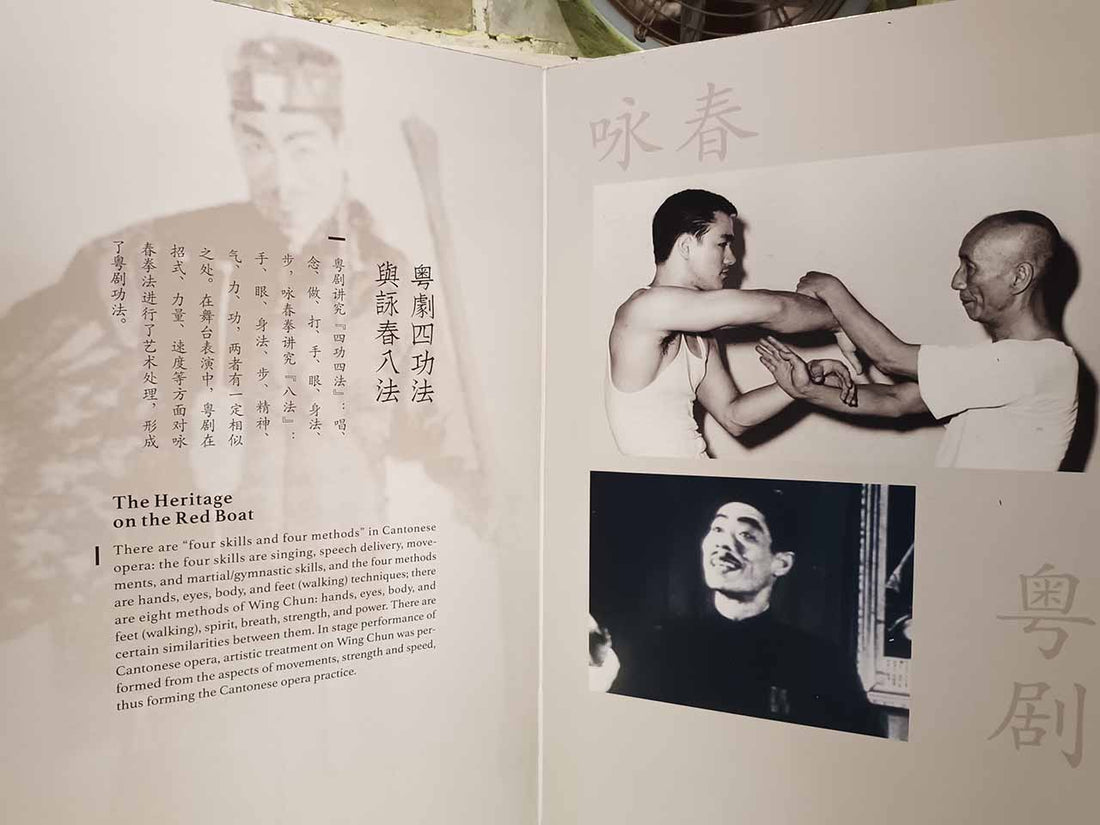
After moving to Hong Kong in 1949, Ip Man began teaching publicly. Students such as Wong Shun-leung, Leung Sheung, Chu Shong-tin, and Bruce Lee contributed to the recognition of his lineage. The Ving Tsun Athletic Association was founded in 1967 by Ip Man and seven senior students.
Bruce Lee trained under Ip Man before moving to the United States. Wing Chun influenced his later ideas, but Jeet Kune Do did not become a simple synonym for Wing Chun. Through teaching, migration, associations, film, and popular culture, multiple lineages spread internationally.
Name and romanization
詠春拳 is usually called Yong Chun Quan in Mandarin and romanized in various ways in Cantonese contexts. Wing Chun is the best-known general spelling; variants such as Ving Tsun, Wing Tsun, Wing Tjun, and Weng Chun may indicate a school, lineage, or personal preference.
The spelling alone does not prove a complete teacher-student lineage. Transfer records, independently corroborated sources, and the history of the organization concerned are needed for that. 詠春 and 永春 may also have different characters and meanings, even when they look similar in Western spelling.
Wing Chun in film and media
Wing Chun appears in films such as Warriors Two, The Prodigal Son, Wing Chun, the Ip Man series, The Grandmaster, and Master Z: Ip Man Legacy. The Ip Man films starring Donnie Yen greatly increased the style’s international visibility. However, films combine historical figures and lineages with fiction, dramatization, and choreography.
Bruce Lee, Bangkok Dangerous, Sherlock Holmes, video games such as Tekken 7, and other productions have also introduced Wing Chun elements to a broad audience. A film or game portrayal is not a complete technical or historical description of Wing Chun.
The EWTO–Gracie rivalry
In the late twentieth century, a widely discussed rivalry emerged in the international martial arts media surrounding Emin Boztepe, European Wing Tsun networks, and the Gracie family. Accounts of a confrontation with William Cheung, open challenges to Rickson or Royce Gracie, agreed conditions, and the reasons why a fight did not take place are disputed among themselves and often originate from the parties involved, interviews, forums, or promotional sources.
There is no confirmed official match between Boztepe and a Gracie that can serve as decisive comparative evidence. The episode is therefore described as an example of marketing, lineage politics, and media hype, not as evidence that Wing Tsun or Brazilian jiu-jitsu as a whole is superior.
Learn Wing Chun
Anyone looking to learn Wing Chun would do well to ask which lineage and training goals a school follows, how much partner work and controlled sparring is included, and how safety is managed. Chi sau, forms, and self-defense training each serve a different purpose.
A trial class can help you assess the atmosphere, teaching methods, and physical demands. For realistic self-defense expectations, distance, communication, de-escalation, fitness, and scenarios beyond fixed forms are also important.
Source criticism
Wing Chun history consists of a combination of oral tradition, organizational archives, lineage records, interviews, popular media, and modern marketing. A careful account makes clear which information is widely shared, which claim comes from a single lineage, and which details cannot be independently confirmed.
03. / Development
Development
Wooden Dummy and Weapons
Muk Yan Jong is wooden dummy training. The dummy can help practise structure, angles, footwork, distance, and movement sequences. The often-cited count of 108 movements and the precise form vary by lineage.
Baat Jaam Dou refers to a form with butterfly knives. Luk Dim Bun Gwan is the long-pole form, also called Dragon Pole in some schools. The technical principles, lengths, and transmission stories vary by branch. Weapon forms are trained only under expert supervision and with suitable practice equipment.
Features
Many schools use a relatively compact stance, protective arm positions, and direct hand movements. The terms centerline, wu sau, relaxation, and economical movement have a technical meaning within the relevant school, but their exact application is not the same everywhere.
Claims that Wing Chun automatically takes on the strength of every opponent or is effective in every situation are marketing or interpretive claims, not general conclusions supported by sports science.
Wing Chun in the Netherlands
Dutch sources link the introduction of an important Wing Chun lineage to Wong Kiu and The Hague in 1974. In that account, Chen Chiu is mentioned as the person who brought Wong Kiu to the Netherlands and as a co-founder of an early school on Spui. Names of early students mentioned include Henk Roelofsen, V. Abbink, W. Bont, R. Perreijn, G.K. Khoe, G. Taytelbaum, and Robert Vogel.
The Netherlands has several organizations and school networks, including the Dutch Wing Chun Federation, Wing Chun Bond Nederland, and the Associatie Wing-Chun Kung-Fu. The Dutch history is not limited to a single organization or lineage.
Schools and courses are mentioned in The Hague, Rotterdam, Amsterdam and the surrounding area, and Delft, among other places. Locations, instructors, trial lessons, affiliated schools, and current claims about size or succession should be verified directly with the relevant organization.
Lineage claims in the Netherlands
The NWCF and related sources name D. Wachtberger as a successor within the Wong Kiu lineage. This is a lineage and organizational claim, not an uncontested nationwide authority over all Wing Chun in the Netherlands. Claims about being the “oldest,” “largest,” “official successor,” or having an “unchanged style” are also attributed to the source.
04. / Training
Training
Forms and training
Many Wing Chun systems use three unarmed core forms: Siu Nim Tau, Chum Kiu, and Biu Jee. They also include a wooden dummy form and weapons forms with the long pole and butterfly knives. Not every lineage uses exactly the same names, order, execution, or interpretation.
Siu Nim Tau is often associated with basic structure, stance, balance, and hand technique. In many schools, Chum Kiu places greater emphasis on turning, stepping, distance, and regaining position. In different lineages, Biu Jee is regarded as an advanced form involving emergency situations and greater freedom of movement. These functions are not universal definitions.
Sensitivity exercises
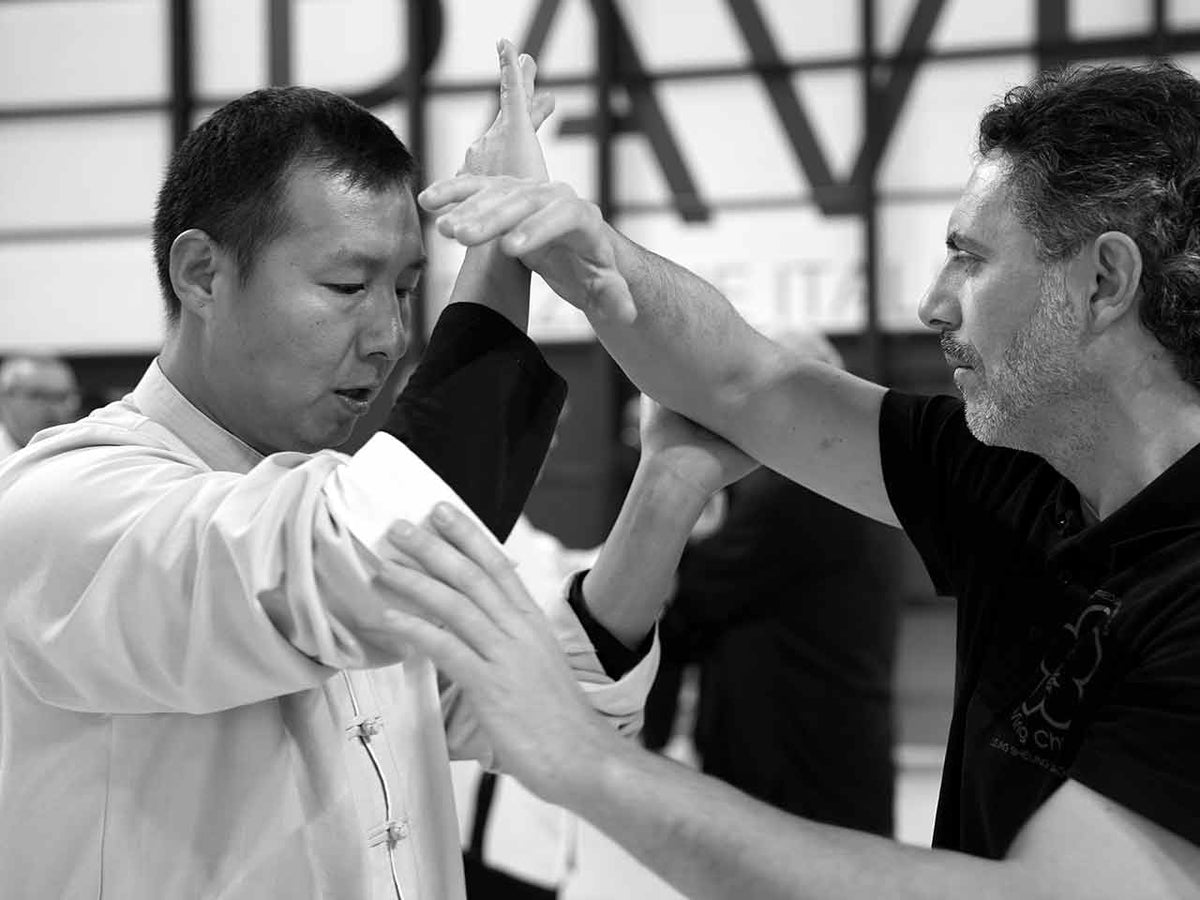
Chi sau, “sticky hands,” is a partner exercise that uses forearm contact to learn to perceive timing, pressure, relaxation, and changes in movement. Daan chi sau, Luk sau, and Chi geuk are variants or supplementary exercises found in some lineages.
Chi sau is not automatic fighting and is not a substitute for controlled sparring. The exercise can help with contact and timing, but transferring these skills to an unpredictable situation requires additional training and safe supervision.
Wing Chun does not have a globally standardized competition uniform or mandatory ranking system. For modern training, comfortable clothing, a suitable floor, and, depending on the type of class, pads, gloves, mouthguards, and other protective equipment are used.
A wooden dummy is a training aid, not a perfect replica of a living opponent. Butterfly knives, staffs, and other weapons have no place in unsupervised training; the legal status of weapons varies by country and region.
05. / Fighters
Fighters
Loading...
The data could not be loaded.
No results found for this sport.
06. / Legends
Legends
Loading...
The data could not be loaded.
No results found for this sport.
07. / Trainers
Trainers
Loading...
The data could not be loaded.
No results found for this sport.
08. / Masters
Masters
Loading...
The data could not be loaded.
No results found for this sport.
09. / Founders
Founders
Loading...
The data could not be loaded.
No results found for this sport.
10. / Promoters
Promoters
Loading...
The data could not be loaded.
No results found for this sport.
11. / Gyms and training locations
Gyms and training locations
Loading...
The data could not be loaded.
No results found for this sport.
12. / Venues
Venues
Loading...
The data could not be loaded.
No results found for this sport.
13. / Iconic locations
Iconic locations
Loading...
The data could not be loaded.
No results found for this sport.
14. / Upcoming events
Upcoming events
Loading...
The data could not be loaded.
No results found for this sport.
15. / Historical events
Historical events
Loading...
The data could not be loaded.
No results found for this sport.
16. / Organizations
Organizations
Loading...
The data could not be loaded.
No results found for this sport.
18. / More about this sport
More about this sport
No results found for this sport.
Improve FightBase
Do you see an error?
+
Is information missing or is something incorrect? Send us a correction or addition.

 China
China