Okinawan roots: te and tōde
In Okinawa, an indigenous fighting tradition already existed that was called te or tī . From the late Middle Ages onward, intensive contact with China developed. Merchants, immigrants, envoys, and students brought knowledge from Fujian and other parts of China. These exchanges gave rise to traditions that were later described under names such as tōde and Okinawa-te .
There is no single account of the precise origins of karate. Theories refer to mēkata, Chinese martial arts via Kume and trade and tribute missions, and development within the Ryukyuan samurai and civil servant class. Researchers take a nuanced view of the influence of historical regulations concerning weapons.
Regional traditions and important masters
The early history is often summarized as Shuri-te, Naha-te, and Tomari-te. Shuri-te and Tomari-te form the basis of many Shōrin-ryū and Shotokan traditions, while Naha-te became an important source for Gōjū-ryū. Kanga Sakugawa, Matsumura Sōkon, Kanryō Higaonna, Chōjun Miyagi, and Kanbun Uechi represent different links in this development.
Ankō Itosu helped introduce karate 1905 into Okinawan education and developed the Pinan kata for beginners. His students later formed a large part of modern karate history.
The name karate-dō and modernization in Japan
The written form changed from 唐手, ‘Tang hand’, to 空手, ‘empty hand’. The suffix dō means ‘way’ or ‘path’ and emphasizes that karate is not only about fighting technique, but also about personal development and self-knowledge.
Gichin Funakoshi presented karate in Tokyo in 1922. His teaching was later associated with Shotokan. Motobu Chōki emphasized practical application and kumite. Kenwa Mabuni, Chōjun Miyagi, Hironori Ōtsuka, and Kanbun Uechi also brought Okinawan traditions to Japan.
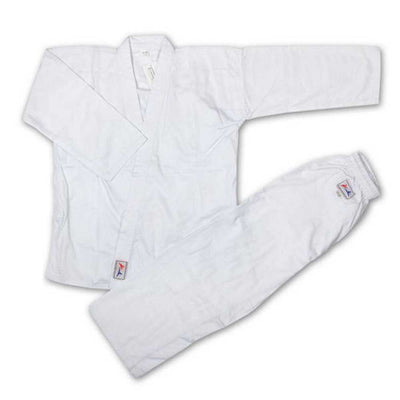
Uniforms, colored belts, and the kyū-dan ranking system were adopted from the broader budō culture. Initially, the emphasis was strongly on kata; later, teachers developed various forms of prearranged and free kumite.
Philosophy and styles
Funakoshi emphasized humility, courtesy, and self-control. The principle ‘karate ni sente nashi’, often translated as ‘there is no first attack in karate’, sums up this defensive attitude. The four major Japanese styles mentioned in many international competition contexts are Gōjū-ryū, Shitō-ryū, Shōtōkan, and Wadō-ryū. In addition, there are Shōrin-ryū, Uechi-ryū, Isshin-ryū, Motobu-ryū, and Kyokushin.