A mouthguard is small enough to almost disappear among your gloves and handwraps. Yet that piece of equipment involves a whole world of material choices, fit and product development. Shock Doctor made that its specialty. From Minnesota, a company focused on mouthguards grew into a brand whose name also appears on groinguards, compression clothing and other protective sports gear.
What makes Shock Doctor interesting is the link between a recognizable sports brand and a very specific design challenge: how do you make protection that stays comfortably in place during sport? That story runs from E-Z Gard and the early 1990s to Gel Max, mouthguards for people with braces and multilayer construction. Along the way, independent research has also tested specific Shock Doctor models.
A major brand built around a small piece of equipment
With boxing gloves, you can immediately see differences in shape, padding and fastening. With a mouthguard, those differences are less obvious. Yet a mouthguard also has an inside, an outside, a certain thickness and a way it fits around the teeth. A soft contact surface and a supportive structure do not necessarily serve the same purpose.
That distinction helps explain Shock Doctor. The brand built its identity not around a single combat sport or a famous boxer, but around protection for contact-sport athletes. Hockey, American football and other team sports are as much a part of its background as boxing and kickboxing. The common challenge is making a small piece of equipment practical to use during real movement.
Fit and comfort are essential parts of the design. A mouthguard needs to do more than look convincing in a product photo. It also needs to fit the wearer’s mouth, how it will be used, and any orthodontic appliances. That combination of construction and everyday wear is the thread running through the brand’s history.
Minnesota origins and six key milestones
The company’s history goes back to E-Z Gard Industries in Minnesota. Jon Kittelsen founded E-Z Gard and launched Shock Doctor as a mouthguard brand. Later company sources cite 1992 as the founding year of the company behind the brand’s modern history. The official Shock Doctor timeline marks 1993 as the year its first technically engineered mouthguard went on sale.
That first phase therefore centered on one clear specialty. The later expansion shows how a mouthguard brand increasingly became a protective gear brand. These six milestones outline the main story; further on, we look at the design choices and research behind that development.
- 1992 and 1993: the foundation and first sales. E-Z Gard marks the starting point in Minnesota; the official brand timeline lists 1993 as the year of the first sales of its technically engineered mouthguard.
- 2000: Shock Doctor becomes the company name too. The company adopts the name that had already made its mouthguards recognizable.
- 2002: the original Gel Max appears. The model takes an important place in the development of the brand's multilayer sports mouthguards.
- 2003: a dedicated option for athletes with braces. According to its brand timeline, Shock Doctor introduces a mouthguard designed for braces.
- 2004 and 2005: protection beyond the mouth. The Ultra Carbon Flex Cup is followed by compression shorts and padded sliding shorts, among other products.
- 2015: a broader family of sports brands. Shock Doctor and McDavid come together under United Sports Brands, along with Cutters and XO in the group announced at the time.
When the product name becomes the company name
The name change in 2000 was more than an administrative detail. E-Z Gard was the company; Shock Doctor was the name athletes saw on the product. When the company changed its name to Shock Doctor, Inc., those two identities came together. It is a recognizable milestone in a specialist's growth: the brand becomes the face of the entire company.
A later report in Twin Cities Business describes how visible differences played a role in that growth. Product development, packaging and presentation had to make the differences between mouthguards clear in a store full of similar equipment. It was not just about a different color, but also about fit and a lower, less bulky profile.
The story thus shows two sides of the same brand. The technical side is about materials and construction. The commercial side is about an athlete who wants to understand what they are holding when they see it in a store. Shock Doctor developed at the intersection of those two worlds.
Gel Max: the multilayer concept becomes recognizable
The original Gel Max from 2002 gave that design approach a clear name. The current Gel Max combines a moldable Gel-Fit inner layer with a supportive Exoskeletal Shock Frame. The soft inner layer and the outer structure each have their own role: fitting around the teeth and supporting the shape of the mouthguard.
With a moldable mouthguard, the shape you wear only takes form after fitting. What you take out of the packaging is not exactly the same as what you wear during training. The thickness and distribution of the material can change during molding. That makes the instructions for the specific model part of the product, not merely an insert you can skip.
The name Gel Max is therefore a useful starting point for discussing its development. It connects a recognizable retail model to a broader idea: combining different materials rather than expecting a single uniform plastic to provide every property. The current version shown illustrates that product family, not the exact appearance of the first model from 2002.
What a patent reveals about the design concept
The same combination of components also appears in the patent record. One example is US patent 8607798, granted in 2013, which names Jay N. Turkbas and Daniel J. Brett as inventors and Shock Doctor as the original assignee. It describes a custom-made mouthguard with thermoplastic layers and an impact shield positioned between them.
In the construction described, a first layer is formed over a model of the teeth. A preformed shield is then positioned, and a second layer is placed over it. The shield is thus partially enclosed between the layers. The description mentions combinations of EVA and thermoplastic polyurethane, as well as an elastic framework.
That is interesting because it makes the development tangible. A mouthguard here is more than just its outer shape: the position of a component and the bond between layers are deliberately designed. This patent concerns a specific construction for a custom-made mouthguard. It offers a glimpse into the direction of technical development, not a blueprint for every current Shock Doctor retail model.
Gel Max under the hockey ball: independent impact research
Alongside the design documentation, there is research in which a retail model was tested in an experimental setup. Van Vliet and colleagues published a laboratory study in 2020 on the maximum impact height of different hockey mouthguards. They compared Shock Doctor Gel Max with Dita, SISU, Stag and a custom-made Elysee.
A hockey ball was dropped from various heights onto artificial dental models. The researchers used both plaster and PMMA, a type of plastic. This allowed them to examine when fractures occurred and how the results varied with the model material. Each condition was tested ten times.
On the plaster model, Gel Max achieved the highest median drop height before a fracture occurred: 0.68 meters, compared with 0.23 meters without a mouthguard. The difference from the other mouthguards tested was statistically significant. On PMMA, Gel Max reached 6.20 meters, compared with 2.00 meters without a mouthguard. In that setup, Gel Max did not differ significantly from Dita or the custom-made Elysee.
This is a concrete, favorable result for the Gel Max tested. At the same time, it shows why a sound explanation needs to account for the test setup: a dry artificial set of teeth struck by a falling hockey ball is different from a living mouth during boxing. The study shows how this model performed in this comparison, without turning that into a general protection percentage.
Braces wearers get a dedicated line of development
According to its brand timeline, Shock Doctor introduced a mouthguard suitable for braces in 2003. That was a significant addition. With fixed braces, it is not just a matter of making room for the teeth, but also for brackets and the surrounding soft tissues, while accommodating changes during orthodontic treatment.
This also changes the challenge for the designer. How do you leave enough room for the braces? How does the mouthguard remain usable as tooth positions change? And how do you combine that space with stability during sport? A standard moldable mouthguard and a model for braces are therefore distinct approaches to development.
In the current collection, this specialization is reflected in the Braces models. The transparent blue version shown has a roomier shape. The exact model’s instructions remain the guide for use: a mouthguard for braces is not necessarily designed to be fitted using the same heating procedure as a Gel Max.
Fit and comfort are also research questions
The existence of special models makes their performance worth examining separately. Harrington and colleagues compared orthodontic mouthguards on a dental model with fixed braces. Their study, published in a 2022 journal issue, included the Shock Doctor Ultra Braces and Instant-Fit Braces, among others.
Those two models shifted during the impacts and therefore could not be included in the reliable comparison of peak loads. The same applied to the OPRO Bronze model tested. Other models stayed in place better in this test. The result highlights a practical design consideration: a guard’s position matters when comparing how forces are transmitted.
In a separate randomized study, Kalra and colleagues examined what it was like to wear the guards during sport. Thirty young people with braces started the study; 24 completed all three periods. They tried a custom-fitted mouthguard, OPRO Gold Braces, and a pre-formed Shock Doctor Single Brace in succession. Most participants played rugby or hockey.
The custom-fitted and moldable versions scored better than the tested pre-formed Shock Doctor in several areas. Ultimately, thirteen participants chose the custom-fitted mouthguard, seven chose OPRO, and four chose Shock Doctor. This was about comfort and preference, not a comparison of injuries sustained. Alongside the Gel Max impact test, it adds substance to the scientific picture: material construction, stability, and comfort when worn are different questions.
From mouth protection to groin protection
With the Ultra Carbon Flex Cup, Shock Doctor moved beyond its original specialty in 2004. The groin area obviously requires a different shape from the mouth, but the design principles are similar. A protective component needs to work with surfaces that fit against the body and with a system that holds it in place.
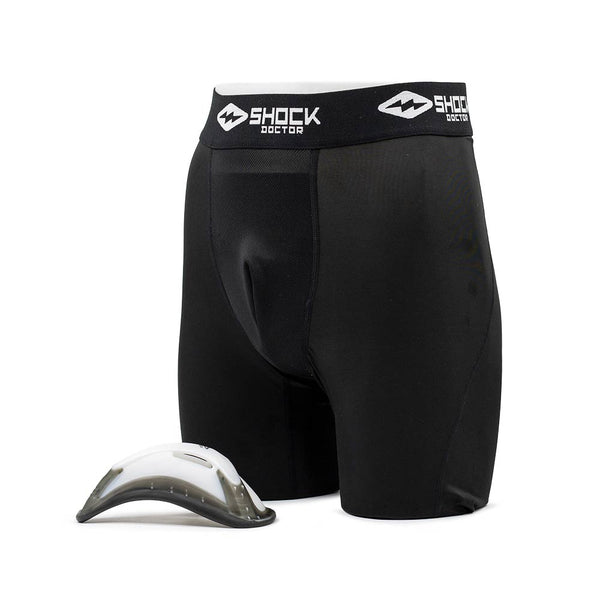
The components are easy to see in a cup. The molded shell sits in a holder made for it. The edge finish and anatomical shape affect how the whole assembly feels during movement. A jockstrap and compression shorts with a cup pocket offer different ways to wear the cup.
In today’s Shock Doctor collection, this direction is reflected in separate cups with supporters and in combinations with shorts. The Ultra and Core Bioflex in the photos are current examples. They show how the brand has expanded, without suggesting that they are unchanged versions of the products introduced in 2004 and 2005.
A protective gear brand for more than one sport
The move into compression shorts and padded sliding shorts followed in 2005. Later, other product groups also became part of the brand’s history: Gel Nano in 2007, custom-fitted mouth protection and ShockSkin apparel around 2010, and sports therapy products in 2011. Shock Doctor thus expanded its range beyond a single small piece of equipment.
That explains why the brand is not exclusively identified with boxing or kickboxing. The same name appears across different sports, while each application calls for its own design and use. A young hockey player with braces has different needs from an adult martial artist who combines a cup with compression shorts.
For the brand’s history, that shift is what matters most: its knowledge of protective gear and attention to how it feels to wear became part of a broader product identity. The mouthguard remained a recognizable foundation, but it no longer defined the limits of the range.
McDavid and the creation of United Sports Brands
In 2015, Shock Doctor and McDavid joined forces. In August of that year, the umbrella name United Sports Brands was announced. The group described at the time also included Cutters and XO. This gave the original mouthguard specialist a place within a broader family of sports brands.
The names retained their own distinct identities. United Sports Brands was the group name; Shock Doctor remained the brand on its own products. For athletes, that brand name is still tied to specific gear, even as the company behind it has grown beyond the original Minnesota business.
The official Shock Doctor timeline also mentions the Max AirFlow Lip Guard and the move of the group’s headquarters to Fountain Valley in 2016. The story thus runs from specialist beginnings to an international sports market. Meanwhile, the product need that started it all remains easy to recognize.
An enduring area of expertise
The strength of Shock Doctor’s history lies in how it all fits together. Its origins with E-Z Gard, the name change in 2000, Gel Max, mouthguards for braces and groin protection are not isolated developments. They show how one area of expertise grew into a broader approach to sports protection.
The research adds substance to that story. Gel Max performed well in the impact test described in the hockey study. Research into models for athletes with braces shows how important stability and comfort are, too. Together, these studies paint a much more interesting picture than a blanket claim that one brand is simply the best.
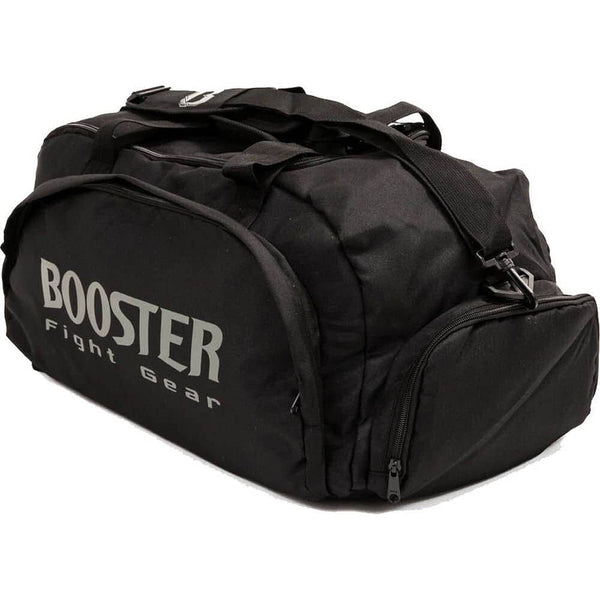
For a martial artist, it ultimately comes together in the gear for the next training session: a well-fitting mouthguard, a suitable groinguard and a practical way to carry it all. Behind these everyday products, Shock Doctor has a history of designing, fitting and continually improving its gear.