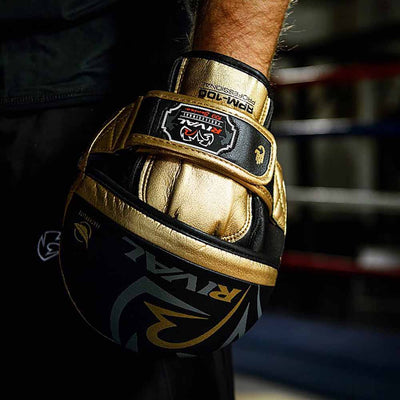
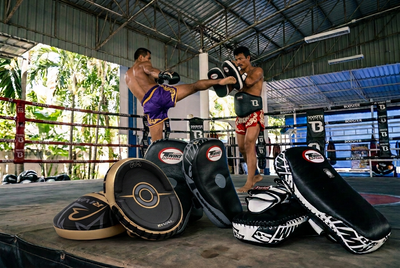
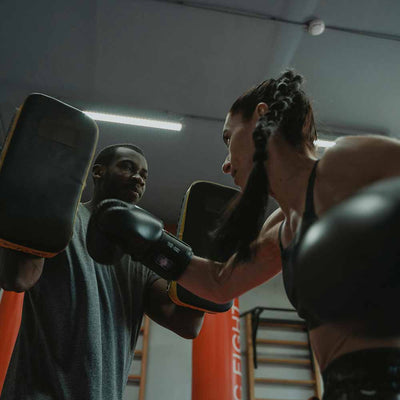
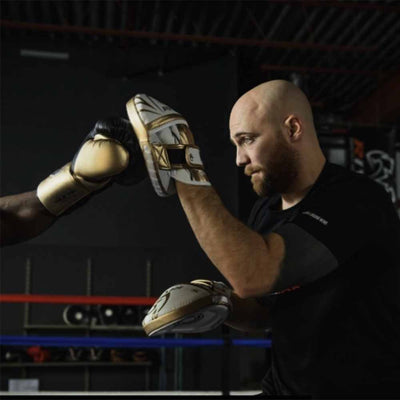
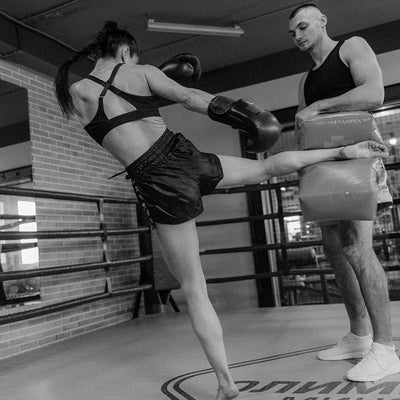
A trainer with punching mitts and a belly pad can keep a combination flowing from the hands to the body. The athlete does not have to keep waiting for another pad to be put in place. That makes a wearable target useful for boxing, kickboxing and Muay Thai: you practise distance, placement and transitions between techniques while the trainer continues to coach.
There is a suitable design for every way of training. A compact belly pad gives you a low, easily reached torso target; a larger coach vest adds a higher front and wider side panels. Separate thigh guards expand your combinations with low kicks, while a combined system brings those targets together. There are also lightweight shirt-style rib protectors with their own fit and purpose.
In this guide, we look at the different designs, specific models and everyday use. What do you wear, where do you take hits and how does the equipment fit the drills you teach? A good choice starts not with the biggest armor, but with a clear idea of your training.
Belly pad, torso protector or body armor?
Belly pad is often used as a general term for protection a trainer wears around the torso. There are significant differences within this category. The classic belly pad is a wide, padded belt around the midsection. The arms and upper chest remain free. A torso protector typically extends higher and is often held in place by belts over the shoulders and around the back.
Body protector, coach vest and body armor are names for larger torso protectors. They provide a generously padded front and, depending on the model, wide side panels. This lets you offer several body targets while keeping your hands free for the pads. The height and the cutouts around the arms determine which model suits your coaching style.
Thigh guards let you add kicks to a lower target. A combined belly and leg protection system is useful for continuous combinations, while a shirt-style rib protector is lightweight and fits close to the body. Pay attention to the design: the Booster XTREM, for example, has a taller torso section and shoulder straps, making it one of the larger torso protectors.
Cushioning, comfort and more options during pad training
A belly pad absorbs impact with a shaped, padded construction. The padding compresses and deforms when struck, cushioning the contact. That makes it valuable for trainers who want to include body punches, knees and suitable kicking drills in their pad sessions. It gives you a target you can position with your own movements.
At Fight2Win, we've put the Rival Body Protector through rigorous testing ourselves and experienced how effectively its padding absorbs impact. That hands-on experience is an important part of our advice. We look at how the material performs when worn and used: how the padding feels, how well the protector stays in place and how comfortable it is to coach in.
Research and targets for body work
Research also illustrates the cushioning principle. In 2026, Chae and colleagues measured incoming and transmitted force on a taekwondo protector using sensors on both sides. The transmitted force was lower than the incoming force. The study thus shows how a protector absorbs a strike. Those results relate to the taekwondo protector and test setup used; our discussion of the models focuses on the construction and practical features of the trainers' protectors.
A wearable body target also makes combinations more interesting. You can flow from punches on punching mitts to body shots, switch between high and low targets, and work on distance and placement. Your hands remain free for the next pad, a cue or a new combination.
This brings protection and coaching together. The athlete can train with focus and confidence while you present clear targets and guide the technique. Agree on the contact areas and adjust the level of contact together to suit the drill. You can then build up the pace, combinations and intensity deliberately.
Compact belly pads: the classic belly pad
A compact belly pad is worth considering when you want to add a clear target around the abdomen to punching mitts or Thai pads. It covers less of the body than a full vest. When trying one on, check the position of the top edge, the width around the sides and the room you have to raise a knee. A shorter model can feel different from a wider pad, even if both are adjustable.
Twins BP2
The Twins BP2 has a wide, contoured front and prominent side panels. You adjust it with a wide hook-and-loop closure. The outer layer is described as skintex. This is a clear example of a classic belly pad for trainers who want to combine a lower body target with punching mitts or Thai pads.
The stated external dimensions are 53 cm wide, 36 cm high and 6 cm thick. They describe the product, not the waist circumference it fits. The curve and closure also affect how the pad fits around your body. Check whether the side panels stay in a useful position when you turn and change stance.
Comparing the compact Winning and King Pro models
Winning Compact Protector
The Winning Compact Protector also has a low wraparound design, with a shaped front and an adjustable buckle fastening. The outer layer is skintex. Its proportions of width, height and thickness differ from those of the Twins BP2: the stated dimensions are 43 cm wide, 31 cm high and 9 cm thick.
Its different proportions of width, height and thickness give the Winning Compact a distinct feel when worn. The more compact front and adjustable buckle fastening are practical features when you want a low torso target that is quick to put on. Pay particular attention to how the model fits around your waist and how much freedom you have when stepping and raising your knees.
King Pro Boxing BP
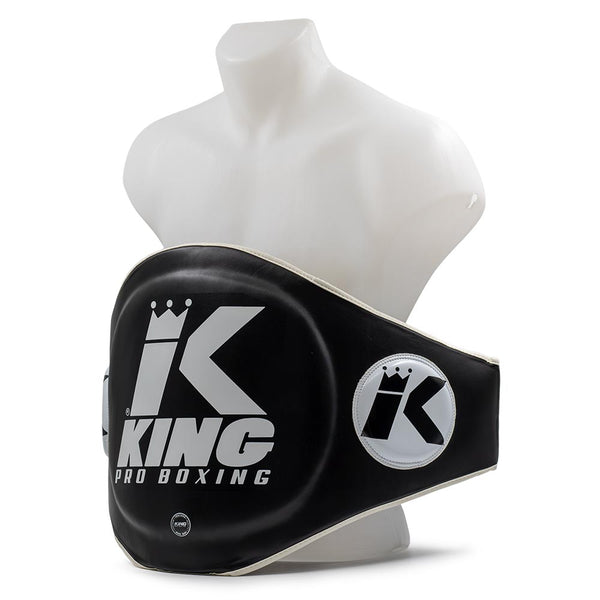
The King Pro Boxing BP is a skintex belly pad with a hook-and-loop fastening and a clearly shaped front section. The stated external dimensions are 50 cm wide, 36 cm high and 7 cm thick. It is a third version in the same range, not another name for a large coach vest.
For a trainer, choosing between these models comes down to fit and the target you want to present. Check how the sides wrap around your torso, how easily you can reach the fastening and whether the protector stays in place as you move. The brand is part of the choice, but it does not replace that practical assessment.
Larger torso protectors and coach vests
A larger vest extends higher up the torso and can cover more of the sides. Shoulder straps help set the height of the protector; the straps around the torso secure the fit. That makes it feel different to wear than a separate belly pad. You notice it when holding out punching mitts, turning your upper body and stepping forward or sideways.
The higher front and wider side panels give you more options for presenting body targets. Markings help the athlete place their strikes. The shoulder straps let you adjust the height so the protector lines up well with the punches and other techniques you use in your sessions.
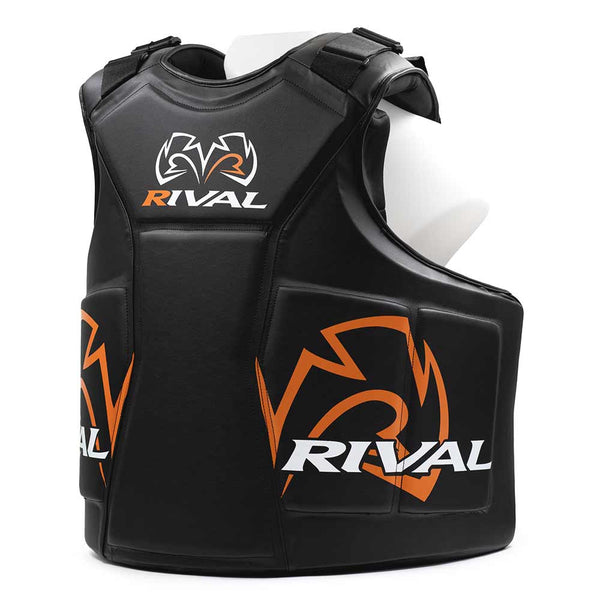
Rival Body Protector
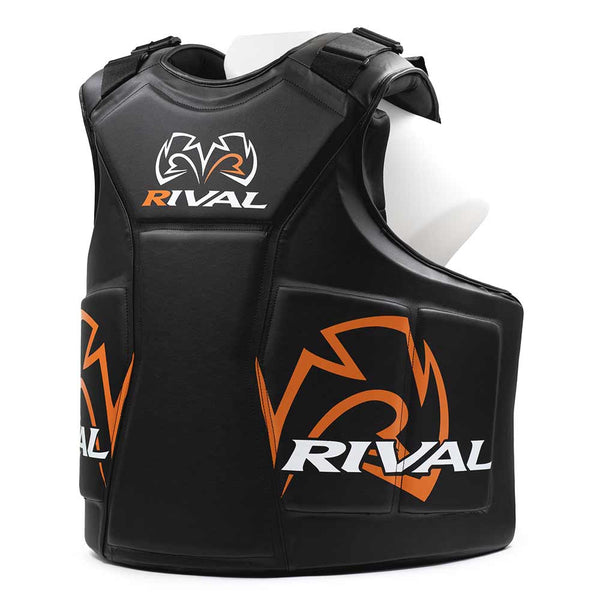
The Rival Body Protector has a high torso section, wide padded side panels and adjustable straps. The outer layer is polyurethane. In practice, this is distinctly different from a compact belly pad: you wear a larger protector around your torso and over your shoulders.
The stated weight is 3.8 kg. This makes it a substantial trainer body protector. The adjustments across the shoulders and torso help distribute the weight. For trainers looking for a large torso target and doing intensive pad work, the generous padding and how it feels to wear are the features to assess.
Everlast Coach Vest
The Everlast Coach Vest has a higher front, shoulder straps and separately shaped side panels. The material specifications list leather; the stated weight is 1.7 kg. The distinct panels give you reference points for agreeing on precise targets with the athlete.
When trying it on, check not just the front but also the space under your arms and the fit when you raise both hands. A vest that fits well with your arms relaxed may feel different when you hold up a hand pad. That's a more useful practical check than looking only at the thickness of the front.
Booster XTREM
Based on its construction, the Booster XTREM is one of the larger torso protectors: it has shoulder straps, a higher front target area and padded sides. Calling it a belly pad may therefore make it sound more compact than it actually is. The outer layer is skintex, and its listed weight is 1.7 kg.
The listed external dimensions for this model are 50 cm wide, 43 cm high and 7 cm thick. Compare its height with that of a low belly pad. The difference helps explain why the top edge and arm openings play a bigger role in how it fits.
More coaching vests: padding, shape and adjustability
Super Pro Professional Gladiator
The Super Pro Professional Gladiator has shoulder straps, a large front target area and contoured side targets. The outer layer is described as PU or skintex; its listed weight is 1.6 kg. This gives the vest a different construction from compact belly pads, even though it is sold as a belly pad.
The product description specifies four layers of padding with a thickness of 10 cm. That describes the padding, not the vest's overall dimensions or a measurement for your torso. Focus on the position of the target areas and how the rear belts keep everything in place as you move.
Winning Super Protector
The Winning Super Protector has a tall, contoured torso section with an adjustable belt system at the back. The material specifications list synthetic leather; its listed weight is 2 kg. Its construction is clearly different from the Winning Compact Protector, which sits lower around the midsection.
That difference matters more than the shared brand. Do you want a low belly pad or a larger protector that extends higher? With this model, check how the arm openings, height and adjustments suit the way you hold pads.
Cleto Reyes Heavy Duty
The Cleto Reyes Heavy Duty has a leather exterior, a high front and marked target areas on the front and sides. Its listed weight is 1.8 kg. The adjustable belt system also affects how it fits around your torso.
The leather exterior and adjustable belt system give the Cleto Reyes Heavy Duty a distinctive feel. Compare the finish, how it feels to wear and the position of the targets. With proper leather care, you can keep the exterior in good condition during regular use.
Abdomen and upper legs together: a combined system
A combined system is useful when you want drills to flow from high to low. You can offer not only punching mitts and a torso target, but also separate targets at the thighs. This requires adjusting the components so they do not get in each other’s way as you walk, turn and change stance.
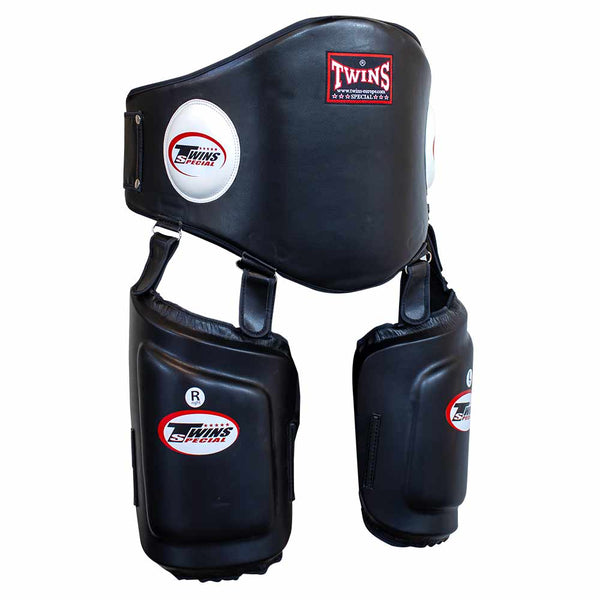
Twins BPLK
The Twins BPLK consists of a belly section with detachable thigh sections. The leg sections attach to the belly section with rings and are secured further with hook-and-loop fasteners. This means you can also use the belly section without the leg sections. That is the key difference from a separate belly pad paired with a separately purchased pair of leg protecors.
Adjusting targets for continuous combinations
With the belly and thigh sections together, you can offer punch, knee and kick targets in a single drill. Adjust the leg sections to the desired height and check your range of motion while taking a few steps and changing stance. This prepares the system for fluid combinations from high to low.
A weight of 1.3 kg is listed for the BPLK, but it is unclear whether this refers to the complete system. So do not use this figure as a direct weight comparison with a separate belly pad or a pair of separate leg protecors. The connectable design and the overall fit are the most useful factors when making your choice.
Separate thigh protectors as an add-on
Separate thigh protectors give you padded targets for low kicks and other agreed drills targeting the thighs. They are a practical addition to a belly pad or coach vest. The athlete aims at the marked area while you guide the rest of the combination with your punching mitts.
King Pro Boxing TP
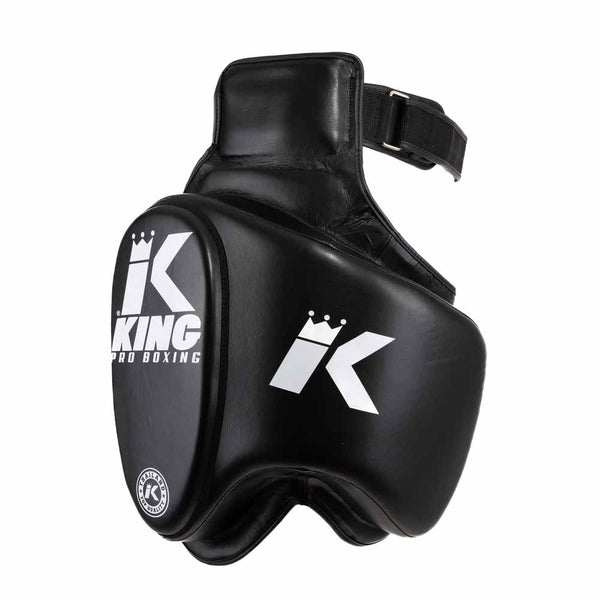
The King Pro Boxing TP has shaped thigh sections with clear markings and adjustable belts. The outer layer is polyurethane. This design is intended to add a separate thigh target to your training, alongside any protection you may already wear around your torso.
Try the full setup on with your usual training clothes and check its position when stepping forward, stepping sideways and changing stance. The sections should not keep twisting or hang so low that they restrict your knee movement. The target area should remain clear to both trainer and athlete.
Separate leg protecors: adjustment and padding
Super Pro Professional Centurion
The Super Pro Professional Centurion also has separate padded leg sections with adjustable fastenings. The product description lists a PU outer layer, four layers of padding and marked targets. It is a separate model alongside the Super Pro Gladiator for the torso, not a standard component included with it.
The stated padding thickness of 10 cm is not a leg circumference or a complete product measurement. For the listed weights of these separate systems, it is also not explicitly stated whether they refer to one item or a pair. Don’t let a number without that context determine your choice. You can assess the fit, target position and freedom of movement more directly.
A shirt-style rib protector is a different type
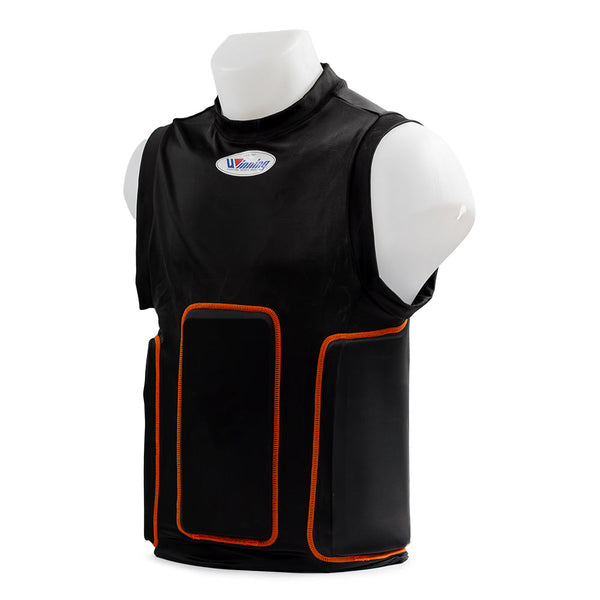
You pull the Winning RIB-3 on over your upper body like a shirt. It has padded sections and is available in M, L and XL. The listed materials are polyester and polyurethane; its stated weight is approximately 200 grams. That’s a very different design from a thick body protector with adjustable straps.
The lightweight shirt design of the RIB-3 fits close to the body and feels very different to wear from a large coach vest. Choose this model for its specific use and fit. If you want to provide large, thickly padded torso targets during pad work, look at the belly pads and body protectors.
The RIB-3 comes in sizes M, L and XL. Use its size chart to choose yours. Unlike the adjustable waist and shoulder straps of one-size body protectors, this shirt-style model uses clothing sizes and has a close fit.
Highly adjustable: a good fit for almost every trainer
The one-size belly pads and coach vests in our range are highly adjustable, so they fit almost every adult trainer. Use the straps, hook-and-loop fastenings or buckles to adjust the fit to your body and training clothes. This also makes them practical for gyms where several trainers share the same equipment.
With a compact belly pad, you mainly adjust the strap around your waist. With a coach vest, you can also use the shoulder straps to adjust the height of the front. Position the padded areas, fasten the straps and distribute the tension comfortably across your torso. Aim for a secure fit with enough room to breathe and move freely.
Raise your hands as if holding pads, take a few steps and switch stances. You’ll immediately feel how the protector moves with you. A small adjustment to a strap is often enough to make the fit more comfortable. If needed, ask a training partner to help with the rear fastenings.
The main differences between models come down to your preference for height, width, padding and how they feel to wear. A lower pad leaves more room around your upper body; a taller vest provides larger torso targets. The wide range of adjustment helps you fit your chosen design to your body.
Dimensions and weight as a practical guide
The outer dimensions show how large the front of a protector is. Width and height help you compare the models side by side; the stated thickness provides additional information about the construction. The adjustable belts then let you fit it around your body.
Weight is particularly relevant to how the protector feels when worn. A generously sized body protector feels different from a compact belly pad. Also consider how the weight is distributed across the shoulders and torso, and how much freedom of movement you have when presenting your pads. Together, these features give you a good idea of how a model feels during a session.
The tables show product dimensions and weights where it is clear what they refer to. For the Twins BPLK and the separate leg protection systems, it is unclear whether the stated weight is per item, pair or set. We therefore compare those models mainly by how they connect, how they adjust and how they are used. This keeps the buying guide practical and easy to follow.
Combining with punching mitts, Thai pads and kicking shields
A belly pad leaves the trainer’s hands free for other targets. With compact punching mitts, you can have punching combinations lead into an agreed-upon body shot. The athlete practices not just the sequence, but also the distance between a handheld target and a target on the torso.
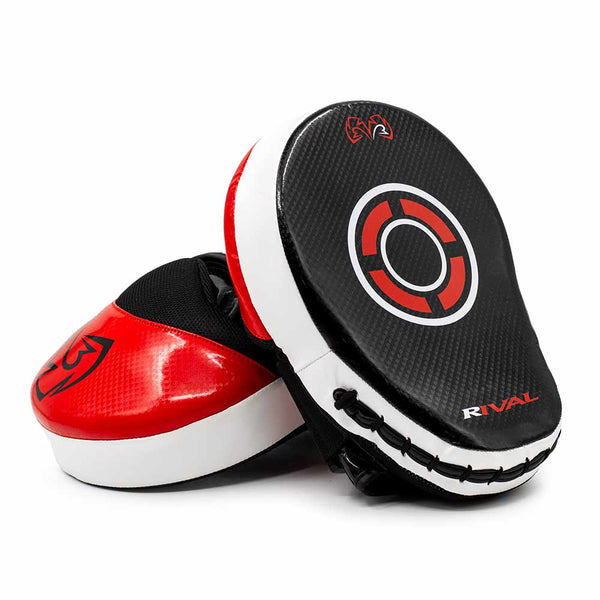
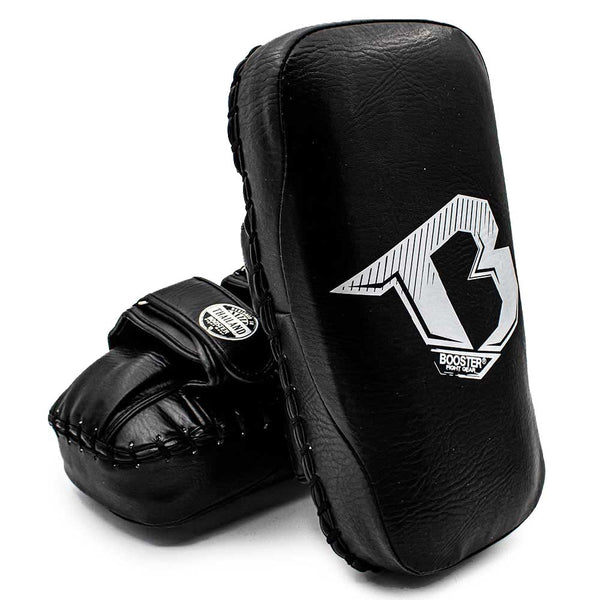
Thai pads have a different design, with a handle and forearm strap. They let you offer suitable punching, kicking and knee-strike drills. Combining them with a belly pad is common in Muay Thai, but each piece has its own purpose. Agree on which techniques go to the pads and which go to the belly pad.
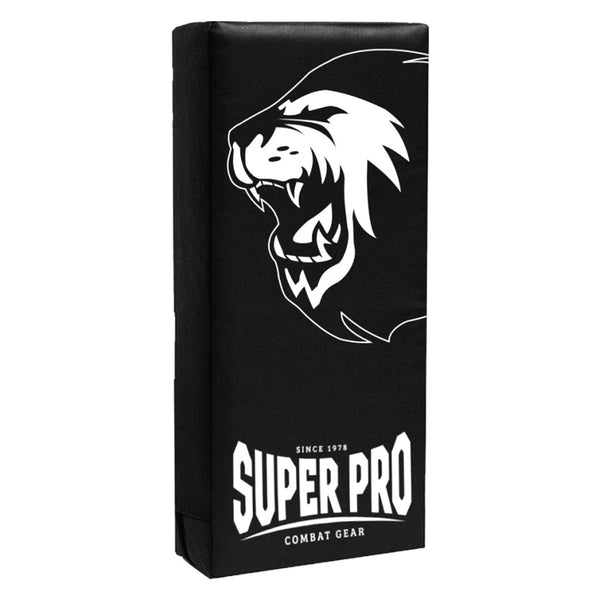
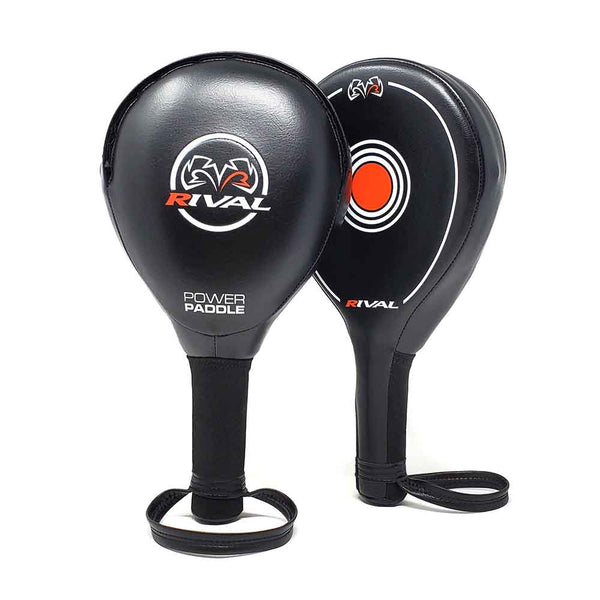
A large kicking shield is another separate, handheld target. It is useful for drills where you want to offer a larger target without having the technique land on your torso. Paddles add another type of handheld target. This lets you build a training setup around different drills, rather than assuming one body protector replaces all the separate pads.
Boxing: from a set combination to a clear choice
A belly pad works well in boxing when you deliberately practice the transition from head height to body level. For example, start with a straight punch to one punching mitt, a second punch to the other punching mitt, and then one agreed-upon body shot. The athlete learns not just the sequence, but also how their position after the first two punches affects the third technique.
Look at placement first. Does the body shot land on the designated area? Does the athlete stay balanced, or do they lunge after the punch? Does the other hand return to a useful guard position? The sound of impact alone does not tell you whether the technique was performed well. You want to see what happens before and after contact.
Once the set sequence is clear, you can add a simple choice. For example, agree on two possible endings: a body punch to one designated area, or a step out of the combination if that target is not presented. Keep the possible outcomes easy to recognize. The point is to respond to a clear cue, not to hit the trainer unexpectedly in a spot of your own choosing.
This is a practical Fight2Win drill progression for working specifically on the transition from high to low. Start with a clear task, then add a choice. This combines technical repetition with responding to what the trainer presents. In sparren, the athlete then practices those choices against an opponent who reacts.
Alternate short sequences with feedback. Give one specific cue, repeat the drill and see how the execution changes. With a body pad worn by the trainer, you can include the body punch directly in the same combination. That makes your coaching clear and keeps the training active.
Kickboxing and Muay Thai: target, distance and kick direction
Kickboxing and Muay Thai bring together different techniques and target heights. Punching mitts, Thai pads, a belly pad and thigh guards each provide a different kind of target. The value of this combination lies not only in being able to perform more techniques in succession, but also in learning to recognize where one technique ends and how to move on from there.
A 2024 literature review by Corcoran and colleagues brought together 88 studies on kicking movements and impact. The size and distance of the target affect how a technique is performed. This fits well with training practice: by deliberately adjusting the target position, you can work specifically on distance, placement and transitions between techniques. The review covers different techniques and measurement setups, providing a broad biomechanical framework.
Use the large belly pad to provide a clear target area. Let the athlete find the placement first, then add speed. The markings and shape of the padding help you guide the technique precisely. That way, a large, easy-to-reach target also becomes a precise technical task.
A roundhouse kick and a more pushing kick each have their own movement pattern. Choose the target and position that suit the technique. A suitable belly pad, Thai pads and a kicking shield complement each other: you can give each drill the contact area and room to move that you need.
For knee techniques, also agree on distance, direction and the intended target area. For thigh targets, explicitly identify what is not a target: the knee, fastenings and exposed gaps. The trainer should be able to stay in position and coach without constantly pulling a piece of equipment back during the sequence.
Add new targets one at a time. Don't change the sequence, stance, pace, and impact all at once. By changing one element, you can better see why a strike lands well or poorly. This keeps training technically engaging and makes feedback much more specific.
More ways to coach actively and with purpose
With a worn body protector, you can keep moving as a trainer while offering multiple targets. Your hands guide the pad work, while the protector absorbs body punches. That gives you room to work on technique, placement, reactions, and conditioning within the same combination.
Decide in advance what to focus on. For accuracy, present a clear target area and look for consistency. For a high-to-low transition, pay attention to distance and balance. To train reactions, add two recognizable options. For conditioning-focused pad work, also manage round length and rest periods. This way, you can use the same equipment to support different training goals.
Usher and Babraj followed ten male professional boxers during bag work, pad work, and sparren. The sessions consisted of six three-minute rounds with one minute of rest. They measured heart rate and muscle oxygenation in the thighs. During sparren, the boxers threw considerably fewer punches, while key patterns in muscle oxygenation were similar.
That highlights how actively the legs work too. Moving, choosing a position, and launching the combination are all part of the task. So look at footwork and balance as well as punches. The research summary outlines the specific setup; in training, you can turn that insight into a complete movement drill.
A simple Fight2Win progression starts with a demonstration and a manageable sequence. Then repeat the task with one specific point of focus. Next, add a stance switch or a choice agreed on in advance. This lets the drill develop with the athlete while you build technical quality and intensity together.
Give the sequence a clear beginning and end. The trainer is ready, the athlete knows the task, and both recognize when to stop. Use the break for feedback or a small adjustment to the fit. Then you can continue straight away with a clear task.
Building up intense pad work with a well-structured drill
Good trainer protection is designed to absorb contact during pad work. With the right protector and clear agreements, you can train hard and with purpose. Build up a new combination technically first, then increase the pace and contact so the trainer and athlete can find a rhythm that works well for both.
Finlay and colleagues compared pad and heavy bag protocols of three three-minute rounds in fourteen male elite amateur boxers. According to the published abstract, the pad protocol produced higher heart rate and oxygen uptake, while measures of movement load were higher for the heavy bag protocol. Within a structured protocol, pad work can therefore provide a substantial conditioning stimulus, with a movement pattern distinct from heavy bag training.
You can make the exercise more demanding with more frequent punches, more footwork, longer combinations or an extra target. Choose the change that suits the session. For the trainer, a well-adjusted body protector and clearly positioned targets are the foundation for keeping up that active coaching comfortably.
Agree on the level of contact together and keep your technique sound. Stop if you experience pain, shortness of breath, dizziness or other symptoms. If the protector shifts, check the fit and resume the exercise once everything is in place. This keeps your coaching clear and lets the equipment do its job.
Outer material, padding and closures as a whole
This product category includes both synthetic outer layers, such as PU and skintex, and leather versions. The outer layer gives each model its own feel and care routine. Together with the padding, shape and fastening system, it determines the product’s character. So assess the product as a whole: from the finish of the front to where the belts attach.
Check the seams around the areas that take the most impact and where the belts attach. A wide hook-and-loop closure needs clean surfaces that fasten securely together. For buckles and belts, check the condition of the mounting material and make sure the belts do not loosen on their own as you move.
Comfort often comes down to details like these. An edge may feel comfortable or get in the way when you hold a pad high. A strap may sit well when you stand upright but pull differently when you turn. So assess the whole product against the movements you actually make as a trainer.
Care after training
Let the protector air out thoroughly after every session. Wipe the inside and outside with a clean, dry cloth and let it dry completely before storing it. If the outside is visibly dirty, gently spot-clean it with a soft, slightly damp cloth, then dry it. Do not leave it damp at the bottom of a closed gym bag.
A padded trainer body protector should not go in the washing machine or dryer, and should not be submerged. Store it in a cool, dry place with natural ventilation. Do not force it into a folded position under heavy items or place it on a heat source to get it ready for the next session sooner.
Do not use care sprays to clean the outer material. A leather outer layer needs suitable care designed for that material; do not automatically apply a leather product to every synthetic or textile section. For a shirt model such as the RIB-3, check its specific care instructions separately rather than simply following the routine for a padded coaching vest.
While cleaning, check the seams, belts, fastenings and shape of the padding. A loose fastening or an area that remains deformed needs attention before you use it for contact again. Maintenance is also a good time to inspect the equipment for the next training session.
Which design fits your training routine?
Start with the drills you teach most often. For a lower torso target alongside punching mitts or Thai pads, look at a classic belly pad. If you want a taller, continuous torso section with shoulder straps, compare coaching vests and torso protectors by their actual shape and fit.
For agreed-upon thigh targets, you can add a separate system. If you want that function together with an attachable belly section, the design of the Twins BPLK is relevant. Assess a shirt-style rib protector as a separate type, with its own sizing and a different purpose from the thick armor worn by a pad trainer.
Next, consider comfort, fit, material and maintenance. When choosing torso protection, try it on with your usual punching mitts or Thai pads: you want to know how your arms move while wearing everything together. That way, you compare products as you will use them, rather than relying on specifications alone.
Conclusion: protection that gives you more training options
A belly pad is a valuable addition to a trainer’s equipment. Its padding absorbs impact and gives you a wearable target for body punches and other suitable techniques. You can combine high and low targets, keep moving and leave your hands free for pad work.
The wide range of adjustment makes the one-size models suitable for almost any adult trainer. Then choose the design that fits your sessions: a low belly pad, a roomy coaching vest, separate thigh pads or a combined system. Height, target area, comfort and fit are the best places to start.
With a well-chosen protector and clear drills, you can train with both technical precision and intensity. Our hands-on experience with models such as Rival and the research discussed help you assess the equipment and training in depth. Use those insights to help your athletes train with confidence and make your coaching more versatile.