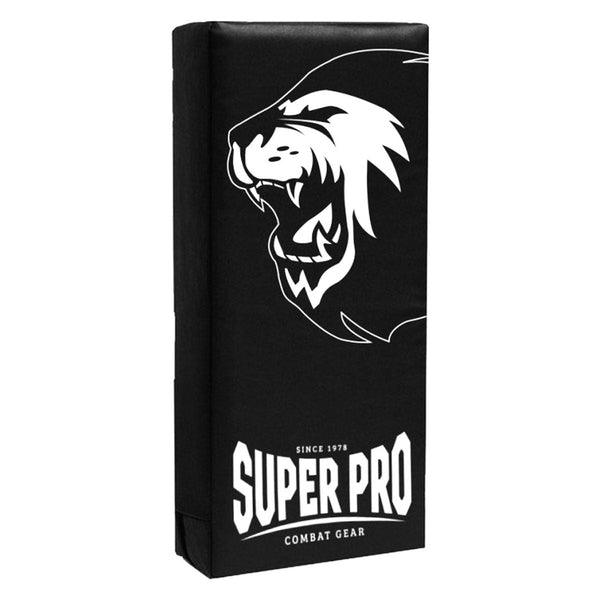
Punching mitts or Thai pads? If you mainly want to practise punch combinations, you will often end up choosing compact punching mitts. For a kickboxing session in which punches, kicks and knees follow one another, Thai pads are the more obvious choice. But that is not the end of the decision. Larger hybrid punching mitts also exist, such as Twins PML21, Booster BPM2 and King Pro Boxing Revo Hybrid, which are deliberately positioned between the two categories.
The difference is not simply about speed versus power. You can work on timing with Thai pads and train powerful punches with suitable punching mitts. More important are the striking surface, the fastening and the way the holder can position the equipment. The pads should suit both the exercise and the person holding them.
In this guide, we compare compact punching mitts, Thai pads with forearm fastening and hybrid models. We look at the practical differences for boxing, kickboxing and Muay Thai, with current examples from XPRT, Rival, Winning, Hayabusa, Twins, Booster, Fairtex and King Pro Boxing. This way, you can make a targeted choice without assuming that every larger pad is automatically better or more versatile.
Three pad types, three different starting points
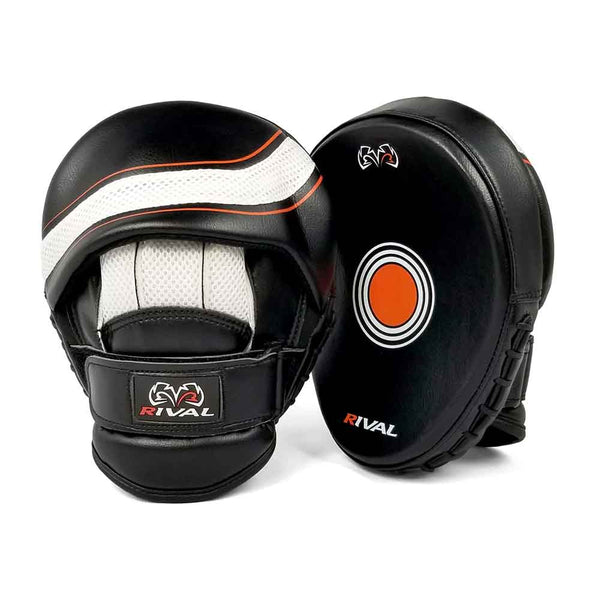
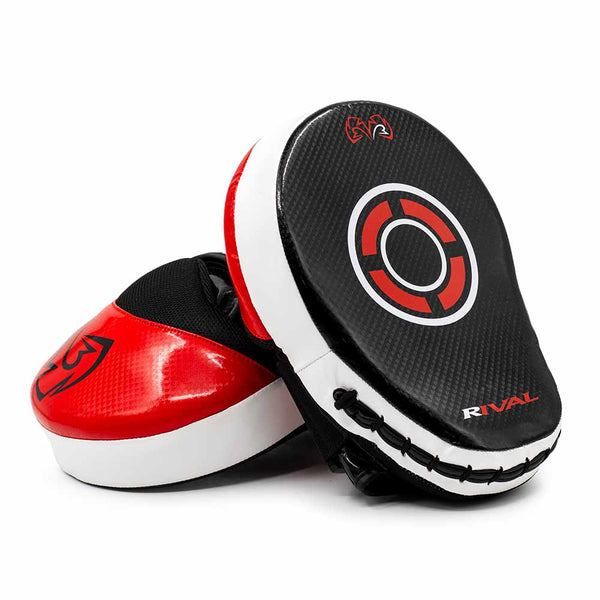
With compact punching mitts, you slide your hand into a compartment behind the striking surface. The pad therefore follows the position of your hand. This is useful when you want to call out a jab, cross or hook in alternation while moving the target in between. You will also come across the names focus mitts and focus pads.
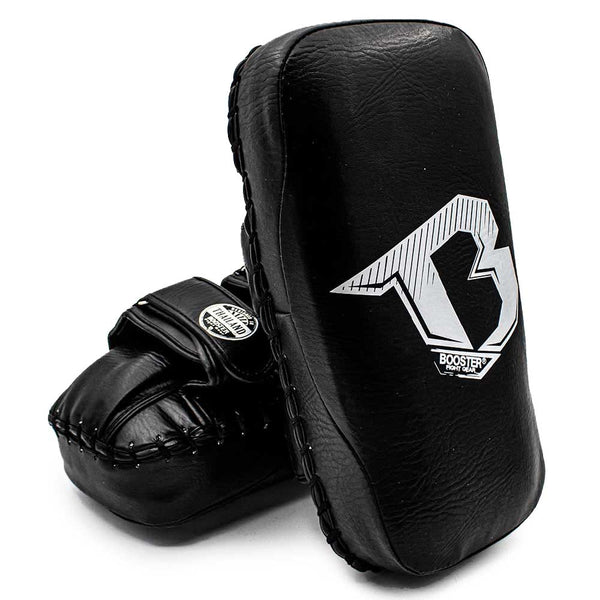
Thai pads are usually elongated pads with a handle and fastening around the forearm. They offer a different surface and a different way of holding them. This makes them suitable for exercises that combine kicks and punches, provided the specific model is designed for that level of impact.
Hybrid pads combine a larger striking surface with a hand compartment and adjustable closure. So you are not simply holding a small Thai pad. It is a distinct in-between design, useful when you want to alternate punching with the kicks and knee techniques for which the model is intended.
The boundaries are not always clear-cut. A product may be listed in the punching mitts category while still being intended as a hybrid model for mixed training. So look beyond the category: read what the model can do and check how it is constructed at the back.
What makes compact punching mitts comfortable for boxing training
In boxing training, a clear, focused target is often more important than the largest possible surface. The trainer calls out a punch, moves the target and makes the athlete react. Between combinations, you can work on footwork, distance and returning to the guard.
A compact hand pad can be positioned relatively precisely. The holder can offer different punching angles without constantly moving a long pad on the forearm. How easily this can be done depends on the shape, hand compartment and weight of the complete model.
A small pad is not automatically the best choice. The smaller target requires control from both sides. The athlete must be able to aim, and the holder must present the striking surface predictably. If that is not yet possible, working more calmly is more useful than trying to perform the combination faster.
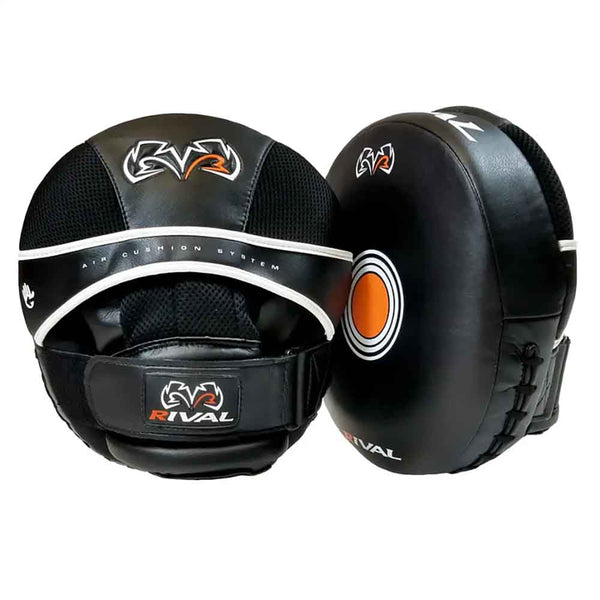
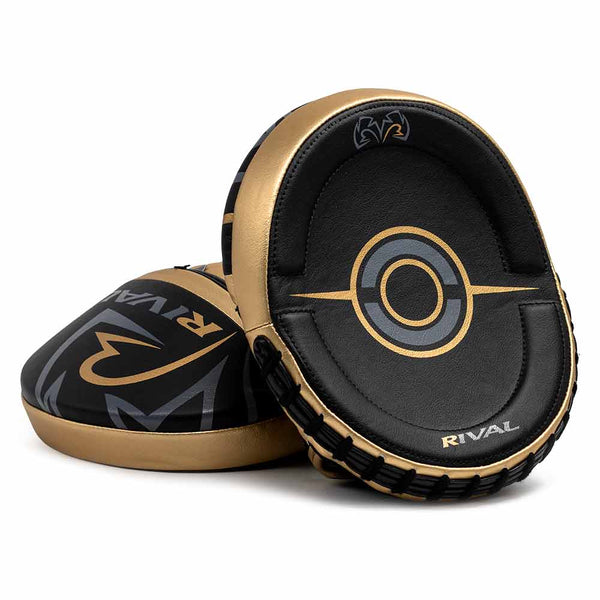
Models such as XPRT V4 Strikeforce, Hayabusa PTS3 and Rival RPM100 offer different interpretations of this type of pad. They share the hand-pad principle, but each has its own shape and setup. So your choice is not based solely on the size of the striking surface.
Thai pads: room for punches, kicks and combinations
You often see Thai pads in kickboxing and Muay Thai. Their elongated striking surface and forearm attachment offer options for mixed exercises. You can have punches followed by a kick or work on a combination in which the distance changes.
That does not mean every model is automatically suitable for every technique or maximum intensity. Booster Pao, for example, is offered as an entry-level model for beginners who do not kick hard. That is a different usage limit from what you might expect when placing all Thai pads under one heading.
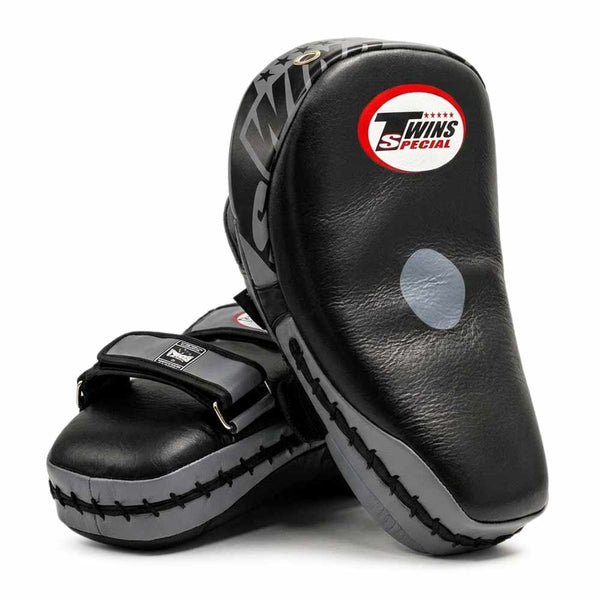
Twins TKP features leather, a slightly curved shape, handles and hook-and-loop fastening around the forearm. Fairtex FXB-KP combines synthetic leather with two forearm straps and a grip bar. Both are Thai pads, but their construction and the feel for the holder differ.
You can also work technically and calmly with Thai pads. Their size is not an invitation to perform every repetition as hard as possible. A well-executed combination starts with an appropriate pace and a holder who can present the intended targets.
Hybrid pads: the middle ground you should not overlook
Hybrid pads are useful for trainers who do not want to switch equipment after every round. They offer more surface area than a compact focus mitt while still using a hand compartment. This allows you to alternate punches with kicks and knees within the model's intended applications.
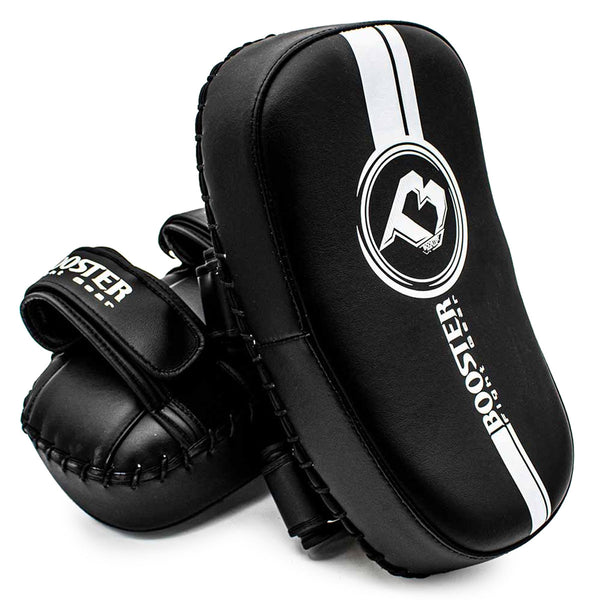
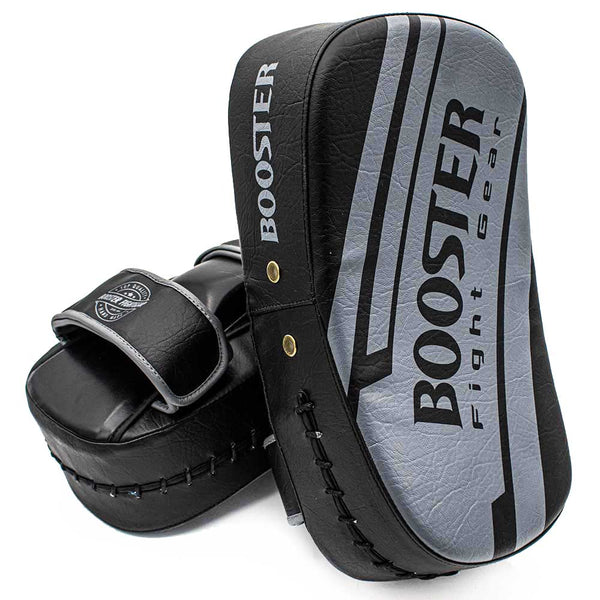
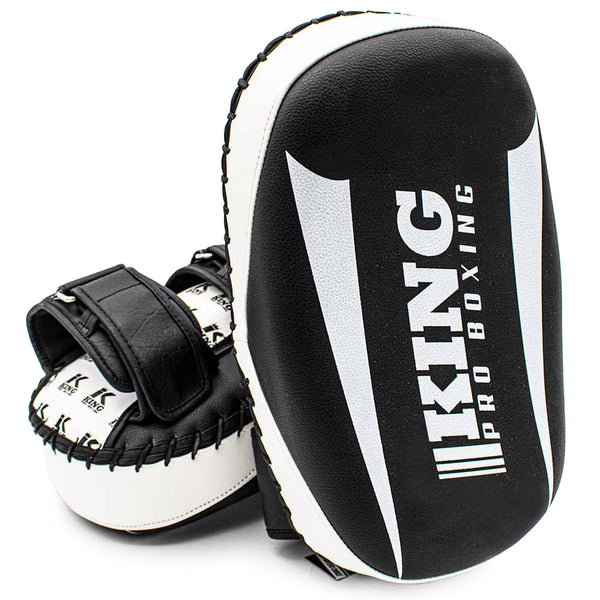
Three clear examples are Twins PML21, Booster BPM2 Carbon Black and King Pro Boxing Revo Hybrid. All three are offered for mixed training. Their larger construction makes them a choice in their own right, not merely a larger version within the compact punching mitts.
The downside is that bigger does not mean equally agile. A hybrid pad may feel different during rapid target changes than a small focus mitt. Conversely, it does not automatically have the same fastening or striking surface as a Thai pad with forearm attachment. These are trade-offs, not design flaws.
A hybrid model can combine many exercises, but it does not automatically replace every specialist pad. For precise, compact punching work or a specific kicking session, you may still prefer a different design. You choose a convenient middle ground when it suits your training, not because ‘all-round’ would remove every limitation.
Striking surface and curve: why shape matters
A curved striking surface can fit comfortably with the way a punch lands on the pad. It also changes how the target looks and how the holder presents it. But a curve does not do the holding for you: the direction and position must suit the exercise.
XPRT Strikeforce has a curved striking surface and a clear target dot. Winning CM-10 Curved is a lightweight, curved coaching mitt. Twins TKP and Booster XP have a slightly curved Thai pad profile. So the same description, ‘curved’, appears with different constructions.
With hybrid pads, you see a larger striking surface with space around the target. Twins PML21 has an elongated profile, while the back still functions as a punching mitt. That makes it useful to consider the front and back together.
A target dot is a visual aid, not proof that every technique must land at exactly the same point and from the same angle. Let the trainer determine which execution and pad position suit the exercise. Shape is part of the choice, not a replacement for instruction.
Hand compartment, wrist strap and forearm straps
The front often draws your attention first, but the back determines how you work with the equipment. Put your hand in the pad and check whether you have a natural grip. You want to be able to guide the striking surface without the pad constantly rotating or your fingers sitting uncomfortably.
Punching mitts come with various solutions. Rival RPM100 has a separately shaped compartment for the left and right hand and an angled hook-and-loop closure. King Pro Boxing Revo 2 uses an adjustable wrist strap; the original Revo, by contrast, is offered with an extra-long shaft. That difference may be more important to the holder than the color.
With Thai pads, look at the grip and the straps around the forearm. The Fairtex FXB-KP has two hook-and-loop straps. On the back of the Twins TKP, you can likewise see how the grip and forearm attachment are distributed along the length of the pad.
A fastening should fit without pinching. More or wider straps do not guarantee a good fit for every arm size. Try the adjustment, check how the mitt stays in place during gentle movements and take the time to make both arms comfortable to use.
Padding and weight: also consider the holder
Pad training is not just strenuous for the athlete. The holder moves the equipment, keeps the targets available and absorbs repeated impacts. A mitt that looks impressive on paper can therefore still be uncomfortable to use when the size or grip is unsuitable.
The padding and weight are part of the complete construction. Rival RPM100 uses Feather Lite layered foam and microfibre. Hayabusa PTS3 is described as having latex foam and a reinforced back. King Revo KP uses skintex with multilayer foam padding.
You cannot derive a fixed ranking for shock absorption from those material names. Nor does a photo of a thick side profile prove how much impact the holder will experience. The intended use, the condition of the equipment and the way it is held all remain relevant.
While comparing, feel how easily you can position the mitts. The most comfortable model is not necessarily the lightest or heaviest. You are looking for something that remains practical for the planned exercises, with an adjustment that allows you to work in a controlled manner.
Compact models: XPRT, Hayabusa, Rival and Winning
XPRT V4 Strikeforce: a focused punching target
Strikeforce combines a curved striking surface, target dot, and integrated hand compartment with padding at the wrist and palm. It is a model for punch combinations, with a compact construction that is easy to carry. On the back, you can see the hand entry and the rounded section below the wrist.
For a first pair, that is a logical model to use as a reference and compare. Keep the choice focused on the intended punching work; the name punching mitt does not automatically make it suitable for hard kicks.
Hayabusa PTS3: pear shape and adjustable strap
The PTS3 has a pear shape, latex foam, a reinforced back, mesh ventilation, and a hook-and-loop wrist strap. A more compact PTS3 Micro is also available. Compare which size is comfortable to guide and which opening suits your hand, rather than assuming Micro is better for every purpose.
Rival RPM100: left and right shaped separately
The RPM100 has a pre-curved shape, Feather Lite layered foam, microfibre, Nash lining, and an angled closure. The separate left- and right-hand compartments are a clear difference to feel while trying it on. We do not treat product names or terms such as “indestructible” as a guarantee against wear.
Winning CM-5 and CM-10: two compact coaching mitts
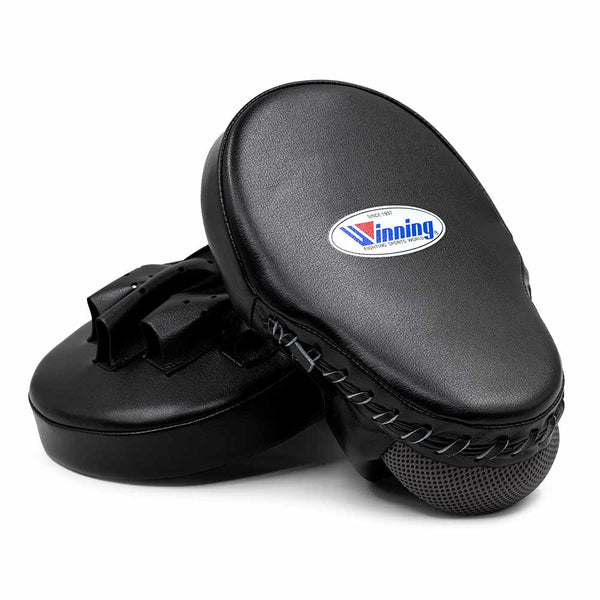
The CM-5 Oval is a compact micro design; the CM-10 Curved has a slight curve and is described as having a Cuban coaching style. Both have finger recesses and perforation holes. Those who primarily hold pads for technical punching can compare them with other compact models based on hand position and target size.
A preference for Winning does not make other models less useful. They remain choices for a specific trainer and exercise. We offer Winning as an imported product, not as proof of an official Fight2Win partnership.
Thai pad models: differences within the same category
Booster Pao: a clear entry-level limit
Booster Pao has a straight profile, handles, and hook-and-loop fastening around the forearm. It is offered for beginners and recreationalists who do not kick hard. That limitation is part of the choice: a first pair is not automatically suitable for intensive kick training with advanced practitioners.
Booster XP and Dominance: slightly curved designs
Booster XP uses Skintex, a slight curve, and adjustable forearm attachment. Dominance also uses Skintex and adds a soft forearm strip. The back and side profile are useful for comparison: how does your arm rest against the pad, and how do you reach the handle?
Twins TKP: leather Thai pads in various sizes
Twins TKP is available in M and L, with leather, a slight curve, handles, and a hook-and-loop closure. Do not choose the size based solely on “bigger is better.” The striking surface must suit the exercise, while the holder should be able to wear and guide the whole thing comfortably.
Fairtex FXB-KP: synthetic leather and two straps
The FXB-KP combines synthetic leather with two forearm straps and a handle on top. In the photo, the round target, red edge finish, and back are clearly distinguishable. This design offers a different setup from a compact mitt or hybrid hand pad.
King Pro Boxing Revo KP: multi-layer padding
Revo KP uses skintex, multilayer foam padding, a slightly curved shape, and forearm fastening. In this comparison, it belongs with the Thai pads, not with Revo Hybrid. Within the same brand, these are two different ways of approaching mixed training.
Twins PML21, Booster BPM2, and King Revo Hybrid
Twins PML21: an elongated hand pad profile
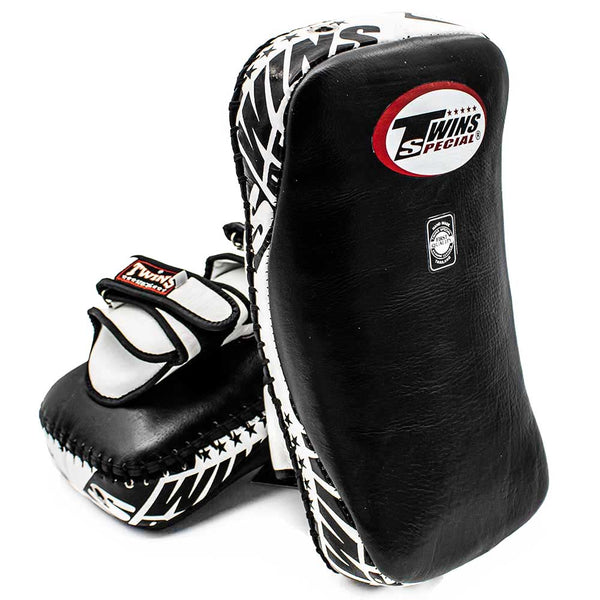
Twins PML21 is made of leather, handmade in Thailand, and has a curved design, open finger openings, extra wrist padding, and a hook-and-loop fastening. It is marketed for punches, kicks, and knees. The stated dimensions are 35 × 22 × 7 cm.
That makes it a different choice from Twins PML10, the more compact focus mitt with cowhide leather and an open-finger design. When comparing models within Twins, it is best not to treat the PML21 simply as a replacement for the PML10. The larger surface reflects a different training consideration.
Booster BPM2 Carbon Black: leather hybrid mitts
Booster BPM2 uses a leather exterior, a curved design, and a hook-and-loop fastening. The model is explicitly marketed as a hybrid mitt for punches, knees, and kicks. The side view shows the longer profile and the hand compartment behind the striking surface.
Above all, compare how the pad fits around your hand and how you can control the larger surface. The fact that the exterior is leather does not determine whether this model is a better fit than a synthetic hybrid version.
King Pro Boxing Revo Hybrid: skintex and multilayer foam
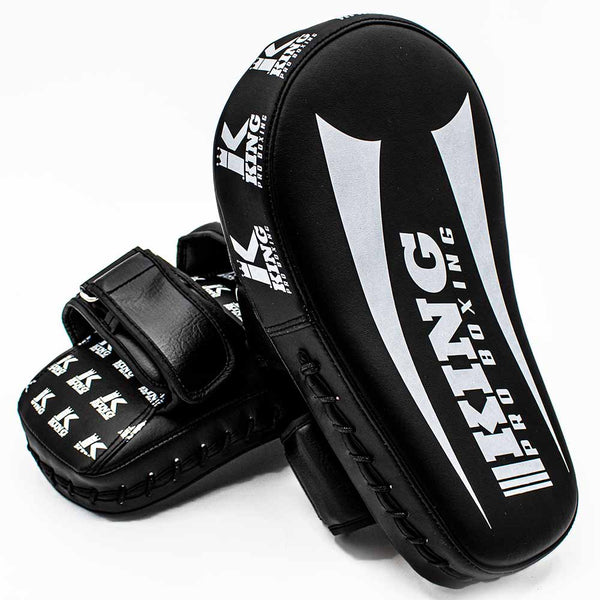
Revo Hybrid uses skintex, multilayer foam padding, a slightly curved design, and a hook-and-loop fastening. Its construction combines hand pad handling with a larger surface for mixed techniques. The side profile shows the curve and the protruding hand insertion behind the pad.
All three are interesting when you want to alternate between multiple techniques in a single session. But test their hand position and adjustment separately. A shared hybrid designation does not mean that their size, movement feel, and fastening are identical.
Training combinations without lumping everything together
Start with the exercise, not with the longest list of techniques on a product page. For a block involving the jab, cross, and hook, a compact hand pad may be suitable. For a punching combination that transitions into a kick, suitable Thai pads or a hybrid version are the more obvious choice.
That distinction is not absolute. It comes down to what you do most during the session and how often you need to move the target. A trainer who wants to indicate precise punching angles may prefer compact equipment. A trainer who regularly switches to knees and kicks may value the larger surface instead.
When practising, work with a clearly agreed sequence and pace. First, the athlete and holder must know which technique comes next and where the target will be. Only then does it make sense to make the rhythm more challenging.
Pad training is not a competition to make the loudest sound either. A clear hit can provide useful feedback, but loud does not automatically mean technically correct. Distance, balance, contact and returning to the starting position are just as much part of a successful repetition.
Proper pad holding is part of the purchase
A good pair of pads does not replace a lesson in holding for strikes. The position of the target, your stance and the moment at which you present it determine how the exercise proceeds. Have an experienced trainer demonstrate how to work with the chosen equipment.
Start slowly if you are not yet used to holding pads. Agree on what is coming and leave enough space around you. If the target is not ready in time, stop and start again. Improvising under pressure is not a good way to learn a new pad position.
Before you start, check that the hand compartments, grips and closures are secure. Also check the condition of the padding and seams. A worn pad does not become usable again by tightening the belts.
Stop if you experience pain, an unstable grip or an adjustment that pinches. More padding or a larger pad is no guarantee against injuries. Find out whether your technique, intensity or choice of equipment needs to be adjusted before continuing.
Training and practising with children at home
For extra punching practice at home, compact punching mitts can be a practical addition when you know how to hold for strikes. XPRT Strikeforce, for example, is offered for this type of extra training. Start with simple, agreed exercises that you learned in class.
An instructional video can clarify something, but it does not show whether your wrist position, distance and timing are correct. Especially with kicks and knees, it is wise to first practise using Thai pads or hybrid pads under supervision.
With children, the exercises, pace and intensity should match their level. Also think about the person holding the pads. A children's model or large target on its own does not mean that someone can safely hold for strikes without instruction.
Keep the purpose of the training simple: recognizable techniques, enjoyment and control. A missed hit is a reason to make the exercise clearer, not to immediately go harder or faster.
Maintenance: check more than the outside
Air out your pads after training and follow the model's care instructions. Check the openings, straps, handles and seams. These are the parts you rely on while holding the pads.
Leather and synthetic materials do not automatically require the same care. A maintenance product must be suitable for the finish in question. Do not simply use leather cream on Skintex, microfibre or another synthetic exterior.
Also pay attention to changes in the padding: an uneven or clearly compressed striking surface should be assessed. The same applies to a handle that is coming loose or hook-and-loop fasteners that do not grip properly. A fresh-looking exterior alone does not indicate whether the pad still functions properly.
No fixed lifespan applies to every type of use. A pair for occasional practice at home is subjected to different strain than equipment used by multiple trainers. Inspection and appropriate use are more useful than a promise that a particular brand never wears out.
Which pads suit your training?
You mainly want to practise punching combinations
Start with compact punching mitts and compare hand space, target size and closure. XPRT Strikeforce, Hayabusa PTS3, Rival RPM100 and Winning CM-5 or CM-10 are different examples. Choose what you can position in a controlled manner for the drills you want to do.
You give a lot of kickboxing or Muay Thai combinations
Look at suitable Thai pads, such as Twins TKP, Fairtex FXB-KP, Booster XP or Dominance and King Revo KP. Pay attention to the forearm attachment and the stated intended use. Take the usage limits of an entry-level model such as Booster Pao seriously.
You are looking for one pair for alternating punching, kicking and knee work
Compare the Twins PML21, Booster BPM2 and King Revo Hybrid. Their hybrid construction is specifically intended for this kind of mixed approach. Weigh the larger striking surface against the feel when switching targets, and determine which fit feels comfortable on your hand.
You are putting together equipment for a gym or trainer
You do not have to declare one category the winner. A compact mitt alongside Thai pads can offer more possibilities than a single pair used for everything. Hybrid pads can be a useful addition where the training calls for it.
Choose based on both the drill and the person holding the pads. Not every pair suits every training session, and no equipment choice makes good instruction unnecessary. If you want to compare the constructions yourself, you can view and purchase punching mitts, Thai pads and hybrid models in our showroom in Waddinxveen. Consider your training goal: it makes the choice more concrete than simply “small or large”.