Behind Cleto Reyes lies a family history of leather, craftsmanship, and Mexican boxing. Behind the Mexican brand is the story of a young leatherworker who boxed in an amateur bout, repaired his gloves, and ultimately devoted his life to making boxing equipment.
That is what makes his story remarkable. It was not the founder's medals, but the gloves he made, that brought the Reyes name to the top of the world. From a workshop in Mexico to the hands of famous champions, the story is about craftsmanship, family, and a lasting connection to boxing.
So anyone who knows Cleto Reyes only from the logo on a pair of gloves is missing an important part of the brand. The name refers to a real maker, whose work was later carried on by his son Alberto and subsequent generations.
Cleto Reyes Castro: A childhood in Mexico City
Cleto Reyes Castro was born on April 26, 1920, in Mexico City. Mexico was rebuilding after years of revolutionary struggle. Times were difficult for his family, and he began working at just twelve years old.
His workplace was a saddlery that also made baseball equipment. There, he became familiar with leatherworking and the production of sports equipment. That background is important to what came later: his involvement in boxing came together with practical experience in a craft.
The brand story therefore does not begin with a sponsorship deal or a large sports company, but with someone who learned early to work with his hands. The materials other athletes took onto the field formed his first working environment.
How his love of boxing began
In the history published by Cleto Reyes UK, 1936 named as the year in which his love of boxing began. The Peralvillo Cozumel Arena was opposite his school. The sport was literally close by.
In 1938, he stepped into the ring himself for an amateur bout. According to the family history, his performance made such an impression that spectators threw coins into the ring. Yet that very bout changed the direction of his life.
The blows he took made him decide that he did not want to box again. That did not diminish his interest in the sport. He simply chose a different place in that world: not as a fighter looking for his next opponent, but as a maker of the equipment others trained and fought with.
From an amateur bout to making gloves
After his bout, Cleto decided to repair the gloves he had used. That repair is cited in the brand's history as the beginning of his career as a glove maker. His experience with leather and his interest in boxing came together in that work.
Reyes found his place in boxing as a maker. His significance began at the workbench, making equipment that found its way to boxers and competitions.
His gloves were then approved by the local boxing commission, COMBOX DF. This marked an important step between making a product and its use in organized competitions.
The history also shows how a career in sports can take many forms. In Cleto Reyes's case, the maker behind the glove eventually became more famous than his own brief experience in the ring.
1945: the gloves on the world stage
In 1945, Cleto Reyes gloves were used for the first time in a world title fight. It was the bout between Juan Zurita and Ike Williams. Both the brand history and the World Boxing Council cite this as an important moment in the brand's development.
For a glove maker, such a fight was a crucial step. The equipment appeared not only in a local training gym, but at a world title fight. The Reyes name thus became part of the history of professional boxing.
According to the family history, 1945 was also the year Cleto went on his own, with the support of his wife and children. The sporting moment and the development of his business thus came together.
That family aspect runs like a common thread through the story. The later growth was not only linked to famous boxers, but also to family members who carried on the work and the business.
From Mexico to the United States
The next step was reaching a larger audience outside Mexico. In 1965, Cleto Reyes gained its first commercial representative in Los Angeles. This provided a basis for distribution in major U.S. cities and other countries.
It is a less conspicuous milestone than a world title fight, but just as significant for the development of the brand. Making good equipment and making it available to athletes are two different challenges.
The U.S. representation marks the expansion of the business. What began with the skills and initiative of one maker gained a commercial network that allowed the name to grow further.
The international recognition we now associate with Cleto Reyes did not happen all at once. The timeline consists of successive steps: learning to work with leather, repairing and making gloves, use in competitions, and then distribution across borders.
Alberto Reyes expanded the business further
As Cleto Reyes’s health became more fragile, his son Alberto Reyes joined his father’s work in 1970. He brought an entrepreneurial outlook and played an important role in the company’s further development.
The brand history gives 1975 as the year Alberto decided to register the name CLETO REYES as a trademark. In 1979, he founded Industria Reyes S.A. de C.V. These milestones make clear that the history of the gloves and that of the formal business cannot be traced back to a single founding date.
The World Boxing Council describes Alberto as a driving force behind the brand’s growth and someone who maintained its connection with the boxing community. After his death in 2019, the family story was carried on by later generations.
Cleto Reyes is therefore more than the name of its original maker. It is also a story of passing the torch: how a son further developed his father’s work and how the family continued to carry the name.
The boxing brand Cleto Reyes and its famous users
Cleto Reyes’s reputation is closely tied to professional boxing. The World Boxing Council names Muhammad Ali, Julio César Chávez, Mike Tyson, Manny Pacquiao, and Juan Manuel Márquez among the boxers who have worn the gloves.
These names place the brand across several generations of boxing history. Its significance lies not in a single campaign or champion, but in the name’s recurring presence among well-known fighters.
Julio César Chávez holds a special place in this story. In a WBC report about the brand’s recognition, he speaks of his confidence in the gloves. The connection between Chávez and Reyes shows how equipment can become part of a boxer’s signature gear.
This gives equipment a place in the sport’s collective memory. The logo on a glove can evoke memories of a boxer, a style, or an entire era in the ring.
Mexican craftsmanship and international recognition
In the story of Cleto Reyes, its Mexican origins remain central. The WBC describes the gloves as handmade and hand-finished and closely connects the name to Mexican boxing culture.
The brand history also mentions Mexico’s National Export Award from 1994. Another recognition followed in 2020, when Mexico’s Institute of Industrial Property (IMPI) recognized the brand as a well-known mark, according to a WBC report.
These are different kinds of milestones. The first concerns exports, the second the recognition and protection of the brand name. Together, they illustrate how the company developed from a personal enterprise into an internationally recognized name.
Craftsmanship deserves a more concrete place than just the word ‘quality’. A glove involves choices in materials, design, and finishing. These visible and tangible details are what give an item its character: the way the leather is shaped, the seams, and the transition to the cuff.
The bond with the boxing community
The story does not end with the sale of equipment. The WBC also describes the Reyes family’s involvement in WBC Cares, supporting sports facilities and community initiatives, among other things.
Those contributions feature prominently in recollections of Alberto. His role is described not only in terms of entrepreneurship, but also in terms of his willingness to support boxers and boxing communities.
The family also worked with the WBC on gloves and special editions for events and campaigns. The WBC conversation with Elizabeth Reyes and Guillermo Moreno also discusses consultations on improvements to the gloves.
That long-standing involvement helps explain why the name means more within boxing than just a logo. The brand grew alongside the sport and remained connected to the people and organizations around it.
Craftsmanship you can see in the glove
The transition from saddle making to boxing glove production may seem like a big leap, but the material connects those worlds. Leather must be shaped, joined, and finished to create an item that will be used intensively. With a boxing glove, this also happens around a moving hand: the fingers close, the thumb sits in place, and the wrist disappears into the cuff.
That is where the word craftsmanship takes on meaning. It is not just about an attractive surface, but about how the leather exterior, padding, lining, and closure work together. Separate parts have to come together to form a glove. In its description of Reyes, the WBC emphasizes precisely that handwork and manual finishing.
The lines and seams reveal some of the workmanship. You can see how the leather wraps around the knuckles, how the thumb is joined to the shape, and how the cuff forms a distinct part of the glove. Up close, the object that on television can look like little more than a patch of color turns out to be a collection of carefully assembled parts.
That is also the charm of a brand that bears its maker’s name. Cleto Reyes does not refer to an abstract idea, but to someone who once took apart a used glove to repair it. The international brand story therefore remains connected to very hands-on work.
Lace-up gloves and the ritual of the boxing corner
Few items evoke traditional boxing as directly as a pair of leather lace-up gloves. The opening along the wrist, the row of eyelets, and tightening the laces belong to a different rhythm than quickly pressing a hook-and-loop strap closed.
Someone else is usually involved in lacing them up. A boxer holds out his hand, while another person tightens the laces and finishes the fastening. This gives the material a place in the teamwork around the boxer. Not everything is done independently; preparation is part of the corner and the people who each have a role there.
That action explains some of the nostalgia surrounding lace-up gloves. Not because everything used to be better, but because the preparation visibly takes time and care. The glove is not simply put on. It is laced up.
Reyes lace-up gloves combine that familiar look with their own construction. The training versions described use, among other things, latex foam padding and a nylon lining. So the classic exterior does not tell the whole technical story. Tradition here lies in a recognizable shape and way of working, not in the idea that every component has remained unchanged since the first workshop.
Velcro Sparring: the same brand in everyday training
Alongside that classic look is the Velcro Sparring, with its wide hook-and-loop closure. This, too, is unmistakably Cleto Reyes: the leather shape, attached thumb, and large brand label give the glove a recognizable look.
The use is more everyday than a championship night. A boxer takes off his gloves to hold pads for someone else, switches drills, and then fastens them around his wrists again. The hook-and-loop closure suits the constant switching of a regular training session.
In the design described, leather, latex foam padding, and a moisture-resistant nylon lining come together. These are not just sales terms, but components with distinct roles: the exterior takes the impact, the padding forms the striking surface, and the lining sits against the hand.
A brand’s reputation is not built only on fight nights. It also lives in the gear that comes out of a gym bag week after week. That is where a famous name becomes personal: not just a champion’s gloves in a photo, but your own pair, used to work through the rounds.
Color as part of Mexican identity
Cleto Reyes does not have to be exclusively red or black to look traditional. The Mexico editions in green, white, and red prominently display their national origins. The colors make visible what keeps recurring in the company’s history: its connection to Mexico.
By contrast, some editions stand out in a different way. Steel Snake features a steel-gray snakeskin print. Pearl and the gold accents on other editions give the familiar glove shape a different look. The brown Vintage 80th Anniversary, meanwhile, is a nod to the past.
That creates an interesting tension for a historic brand. The design should remain recognizable, but it need not be frozen in one era. A classic logo on a distinctive color brings together old and new without losing the basic design.
The WBC editions also show the connection to organized boxing. The green and gold are not just decoration within the brand story, but refer to its longstanding relationship with the World Boxing Council. This way, a color scheme can carry a piece of boxing culture.
Bag training: the work outside the spotlight
A champion’s name stays with you, but most of their work happens without an audience. Bag training is part of that less visible side of boxing: repeating combinations, finding your range again, moving, and starting over.
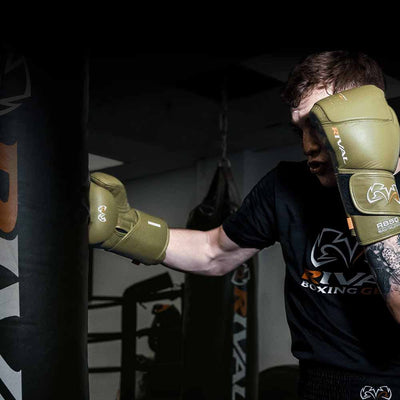
The compact Jet Black bag glove shows that Reyes has its own design for this kind of work, too. The model described is made of cowhide, with an open thumb design and a hook-and-loop closure. It looks different from the large, closed glove you associate with a fight.
That difference makes the intended use clear. This equipment is for bag and pad training, not for striking a sparring partner. A boxing brand’s story is therefore about more than just the competition glove. It also includes tools for the many rounds in which there is nothing to win except a better execution of the next combination.
That repetition is what connects the equipment to life in the gym. A round ends, the bag keeps moving for a moment, and after the rest break the same drill begins again. That is where boxing equipment takes on meaning, long before a bell rings for a match.
Head protection and the recognizable shape of training equipment
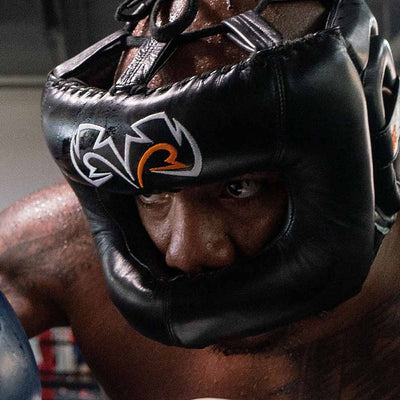
The Cheek Protector and Round Face-Bar show two different forms of head protection. The cheek pieces stand out on the first; the face bar on the second. The silhouette already hints at how the equipment is constructed.
Leather makes an appearance here too. The models described combine it with latex foam padding and several adjustment points: at the back, on top, and under the chin. The laces on top create a small visual link with lace-up gloves, though they have a different position and function here.
These kinds of details make training equipment interesting to examine up close. A headgear isn’t a smooth, one-piece helmet. Openings, straps, seams, and padding have to come together to form a wearable whole.
Their purpose remains training equipment, not invulnerability. Headgear does not make contact to the head risk-free. It is part of the conditions in which partner work takes place, not a substitute for control during the exercise.
The trainer is just as much part of the story
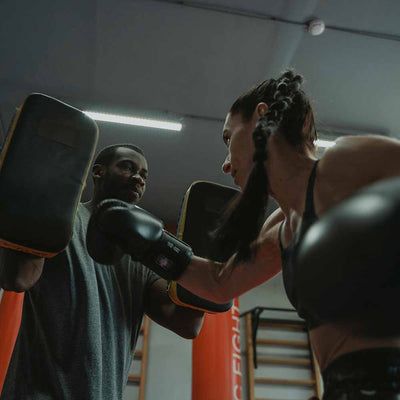
With famous gloves, attention naturally goes to the boxer. But on the other side of many combinations is a trainer holding pads. The holder determines the target, the timing, and the transition to the next movement. Without that work, pad training is only half a scene.
Reyes Coaching Hand Pads have a curved shape, foam padding, finger slots, and an extra strap around the hand. The design centers on the holder’s hand: they need to be able to position the target and move it to the next spot after a punch.
Focus paddles change the picture. They are lighter targets with a handle and wrist strap. A hand pad is worn on the hand, while the trainer holds a separate tool here. The target can quickly change position.
The intended use makes clear why a brand offers more than one type of pad. Not as a range of variants that all do the same thing, but as different ways to shape an exercise. A short combination with movement calls for a different interaction than a fixed series of punches aimed at one large striking surface.
There’s a less celebrated side to boxing: holding pads well is a skill in itself. The trainer doesn’t just catch punches. Together with the boxer, they build a rhythm in which both are active.
Round Punch and body work: equipment that shapes the exercise
The Round Punch brings a very different scale to training. According to the product details, the round leather pad is about forty centimeters in diameter, fifteen centimeters thick, and weighs four and a half kilograms. The two handles are part of the holder’s role.
That makes it a different object from a small focus paddle. The round surface provides room for focused striking, while the trainer positions the pad as a whole. Its size and weight aren’t abstract specifications: they partly determine what the exercise looks like.
With the Heavy Duty torso protector, the target for punches moves to the body of the person holding the pads. The leather exterior, padding, and marked striking areas make it possible to incorporate body shots into a combination. This puts the boxer and trainer in a different relationship than when only a hand pad is presented.
The Kidney and Foul is once again part of the boxer’s own equipment. Its more generous shape around the groin and lower body shows just how specialized the different pieces are. The shape follows the function: the round pad, trainer vest, and groinguard all belong to the same sport, but each meets a different need in training.
The speed ball and the sound of a boxing gym
Anyone thinking of a traditional boxing gym might already hear the rhythmic tapping of a speed ball beneath its platform. Not one hard hit, but a recurring cadence. An action that seems simple as long as someone else is doing it.
With a speed ball, it’s all about finding and maintaining that cadence. The ball bounces off the platform and returns to the movement. More power won’t automatically make up for missed rhythm. The boxer has to coordinate their hands with the rebound.
The leather Cleto Reyes speed balls fit this familiar picture. The Classic has a nylon lining; the Mexico edition brings national colors to this small training tool as well. The brand is thus visible somewhere other than on a boxer’s hands.
The nostalgia here lies not only in the material or the logo. It’s mainly the combination of movement and sound. Rounds on the bag, footsteps on the floor, and the regular tapping beneath the platform each give the gym its own rhythm.
A small object like this says a lot about the nature of boxing training. It’s not just about building power. Focus, repetition, and a feel for timing each have their own place in training.
The double-end ball: finding a moving target again and again
A double-end ball looks just as modest at first glance, but moves differently. Between two attachment points, the target springs back into the boxer’s space when touched. Not against a platform, but back and forth within the tension of the setup.
That creates a different relationship between boxer and equipment. The boxer has to account for the ball coming back, read the distance again, and deliver the next punch at the right moment. A combination is not just a predetermined series of movements; there’s also a target that keeps moving.
The Reyes Classic combines a leather exterior with a replaceable inner bladder in a compact training tool. The Mexico version once again features the recognizable green, white, and red. The same brand story appears on equipment with a very different purpose from a glove.
A heavy bag, a speed bag, and a double-end ball all belong in the picture of a boxing gym. Yet each tells a different story about training: making contact, keeping the rhythm, and continuing to find a moving target. Together, they show how many different tasks lie behind the simple word “punching.”
Handwraps and the small rituals before a round
Before the gloves are fastened, the hands are wrapped. That, too, is a recurring image in boxing: the roll of handwraps getting smaller, the hand opening and closing, and the final strip being secured.
The Cleto Reyes Non-Stretch handwraps are a non-elastic, five-meter version. They are less eye-catching than a distinctive glove, but they’re part of the same preparation. The hand matters long before it hits the target.
A mouthguard, such as the Double White double mouthguard, is also one of the smaller items used in training. No big logo front and center, but something that takes its place between preparation and partner work.
A boxer’s equipment is more than the gear that catches the eye in an action shot. Handwraps, a mouthguard, and the way someone gets ready give the sport its own ritual. They mark the transition from entering the gym to getting down to work.
From satin boxing trunks to a T-shirt outside the ring
Classic boxing trunks have a distinctive silhouette: a wide waistband, a longer cut, and fabric that moves with you. The satin Cleto Reyes boxing trunks carry that recognizable look, with the brand prominently displayed at the waist.
That look is part of boxing’s visual history. In photos of a match, you see not only two athletes in motion, but also the colors of their gear, the waistband, and the gloves. Equipment and clothing become part of the memory of a boxer.
With the Fighter and Champy T-shirts, that recognition extends beyond the ring. Someone isn’t just wearing a piece of clothing, but also a name associated with a sport and its history.
That explains why a boxer can feel attached to a brand without talking about technical features. Sometimes it’s a champion who made an impression. Sometimes it’s their first pair of gloves or the gym where they started. A logo can evoke a memory before it identifies a product.
Nostalgia that doesn’t have to be behind glass
Cleto Reyes’s appeal isn’t just in old photos. The gloves, pads, and training balls are also items people use today. That keeps the brand story close at hand: its history isn’t confined to an archive but can be found on the floor beside the ring.
A gym bag captures the everyday side of boxing well. Gloves inside, clothes alongside, smaller items in a pocket. It’s a very different image from a world title belt, but one that most boxers know much better.
That’s where major moments in boxing history meet personal memories. The name you associate with famous champions also appears on equipment for an evening training session. The famous brand becomes part of a very personal, often much smaller story.
Nostalgia doesn’t have to mean that everything was better in the past. It can also be an appreciation for familiar shapes, craftsmanship, and a sporting culture you want to pass on. A lace-up glove, a red, white, and green ball, or the sound beneath a speed bag platform can be enough to evoke that feeling.
The lasting legacy of Cleto Reyes
Cleto Reyes did not start out as a champion with a long list of accolades. His own amateur bout led him to repairing gloves, and that repair work led to a life as a maker. His place in boxing history was forged at the workbench.
The 1945 world title fight, the move to the United States, and the growth under Alberto are the major milestones in that story. But craftsmanship ties them together. Without the gloves, there would have been no name to carry on internationally.
The wider range of equipment shows how that name has become part of the sport: on a boxer’s hands, with a trainer and their pads, and on the platform in the corner of the gym. It’s more than a collection of products. These are items that play a role in what people do when boxing.
Family, Mexican heritage, and the daily work in the gym come together at Cleto Reyes. That makes the brand not just a familiar name in boxing equipment, but also a recognizable part of boxing culture.