A bow at the start of class, a solid stance and a kick that returns under control. Tang Soo Do has a distinct Korean character, bringing together technique, focus and respect for others. It is a martial art you cannot fully understand by watching only a sparring round.
That is why this guide takes both sides seriously: dojang culture and the gear you train with. From dobok and belt to safety punches, safety kicks and a mouthguard. Not a general Korean equipment list, but a starting point specifically for Tang Soo Do, with room for differences between schools and organizations.
What should you bring to Tang Soo Do?
A dobok and the belt appropriate to your rank and school are the starting point. You wear them while practicing stances, hand techniques, kicks and hyung. When the class moves on to sparren or other partner exercises involving contact, protection also becomes important: semi-contact gloves, safety kicks, a mouthguard and a suitable cup. Choose head and shin protection according to the exercises and the rules of your dojang.
That distinction makes your choices clearer. Performing a form is not the same as striking a moving partner, and a grading test is not an ordinary sparring round. Below, we discuss each part separately, with examples from our range. That way, you can see what a product does without automatically treating a product sold in our shop as approved competition equipment.
A sports bag, towel and water bottle are useful extras for keeping your gear together. This guide remains focused on Tang Soo Do: its Korean background, the culture of the training space and the equipment that goes with it.
Korean roots and a living tradition
Tang Soo Do is a Korean martial art. The name is usually explained as the way of the Tang hand, with Tang referring to China. This points to a cultural connection, but it does not make Tang Soo Do simply a Chinese style. Its modern development is part of the history of Korean schools and organizations in the twentieth century.
Hwang Kee and the Moo Duk Kwan, which he founded in 1945, play an important role in that history. At the same time, Tang Soo Do today is not a single worldwide school with one fixed curriculum. Different organizations preserve and develop their own traditions. You therefore cannot simply assume that names, forms, ranks and uniform requirements are interchangeable between schools.
The World Tang Soo Do Association describes the value of training as something that goes beyond earning a belt: character and respect for others are also part of its vision. In the Netherlands, the NTMB is among the organizations with its own structure and grading system. Its founding on May 19, 1979, shows that Tang Soo Do in the Netherlands has its own history and community.
For this guide, we keep the history recognisable and concrete. Stories of an ancient heritage can be meaningful to a school, but they are not necessarily proof that today’s Tang Soo Do has existed unchanged for centuries under the same name and with the same curriculum. The tradition lives on because people continue to practise it and pass it on.
The dojang: greeting, attention and training together
The training space is called a dojang. You go there for more than practising techniques: you also learn how to interact with a teacher, training partners and the class as a whole. A bow, listening quietly and changing partners considerately are visible ways to show that attention. It is less about impressive ceremony than about how you behave during training.
In NTMB terminology, you will encounter cha ryot for attention, kyung rye for greeting or bowing, and muk nyum for meditation. You do not need to master a complete vocabulary list beforehand. Recognising the terms helps you understand what is happening in class. The spelling in Latin letters may vary between schools.
Respect also shows in practical habits: being ready on time, keeping your nails short, removing jewellery and stopping when an exercise is interrupted. In partner work, control means sticking to the agreed technique and intensity. More protection is not an invitation to suddenly depart from that agreement.
Tang Soo Do also pays attention to the relationship with your school or teacher. This does not have to be a formal affair. It is about creating an environment where a beginner can learn, an experienced practitioner takes responsibility, and both partners can continue training together after an exercise.
Hyung, one-step techniques, self-defense and sparren
A hyung is a form: a pattern of techniques, stances and changes of direction. You practise without an opponent responding freely at every moment. This gives you room to focus on posture, transitions and execution. It is a different part of training from scoring as many points as possible or hitting a target as hard as possible.
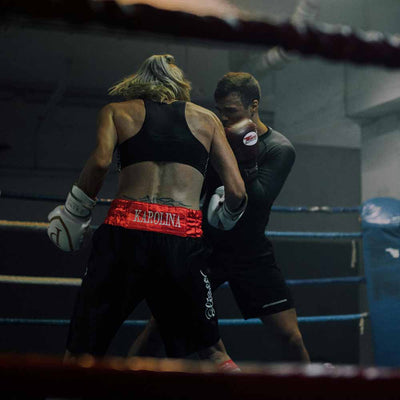
In one-step techniques, you agree on an attack and a response. Ho sin sul refers to self-defense techniques. Sparren, called dae ryun in NTMB terminology, involves more movement, distance and responding to a partner. Different components can be part of the same class, but they do not all have the same goals or require the same protection.
The NTMB exam syllabus clearly shows that range: forms, hand and foot techniques, and self-defense appear at different levels. Other components are introduced later. This is an example from one federation, not a universal sequence that every school must follow exactly.
What this means for your equipment is simple. A dobok that lets you move well remains important for every part of training. Choose protective equipment for the partner work you actually do. A sparring glove does not determine how you perform a hyung, and wearing foot protection does not make a free-sparring round the same as a prescribed technique.
The dobok: more than a white training uniform
Dobok is the Korean word for training clothes. In Tang Soo Do, you will often see a white uniform with a wrap-front jacket, trousers and a separate belt. The uniform makes the shared nature of the class visible, but above all it should let you move comfortably through stances, turns and kicks. Look at the cut and the room around the shoulders, hips and knees.
The trim can also indicate something about the school or rank. That is why contrasting trim is not an arbitrary upgrade just because it looks good. Trim, patches and the belt should all follow your organization's uniform requirements. A dobok for ITF Taekwon-do is not automatically the same uniform just because it is white.
According to the product information, the XPRT models below are made from 65% polyester and 35% cotton. That is one clear similarity. Do not choose based on fabric alone: compare the design and how much room you have to move. The listed length is a starting point for the model-specific size chart, not a guarantee that every uniform of that length fits the same way.
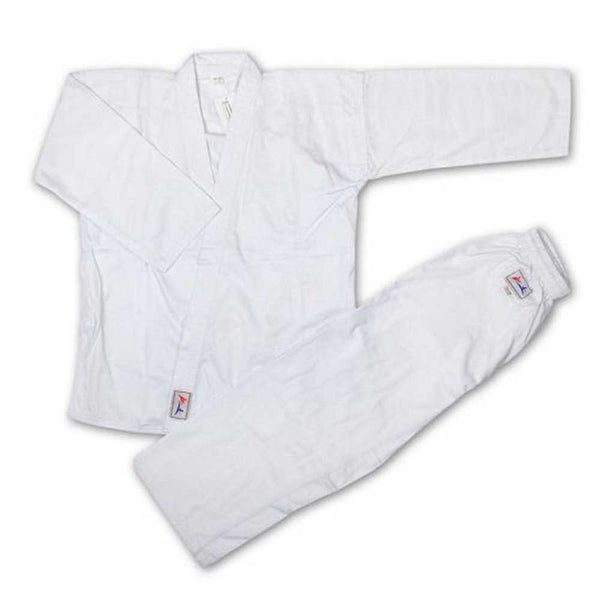
XPRT All White
A white wrap-front uniform without the dark trim of the Boosabum version. This is our starting point for choosing a uniform for a school where an all-white uniform is appropriate. The jacket and trousers make up the uniform; check the product page separately to see what is included.
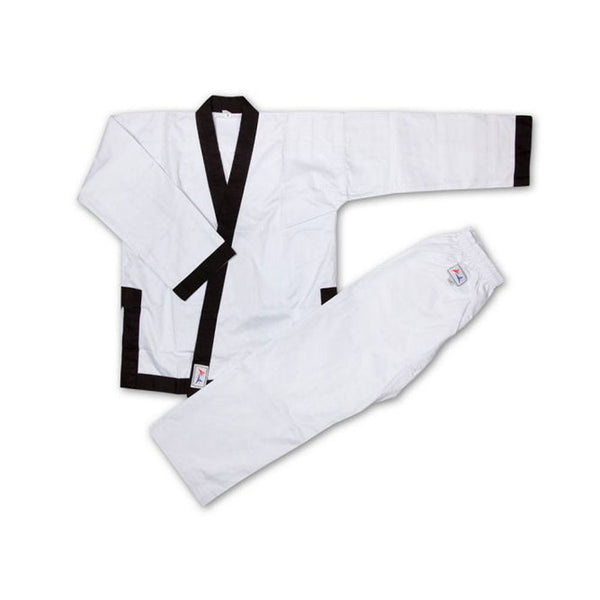
XPRT Boosabum
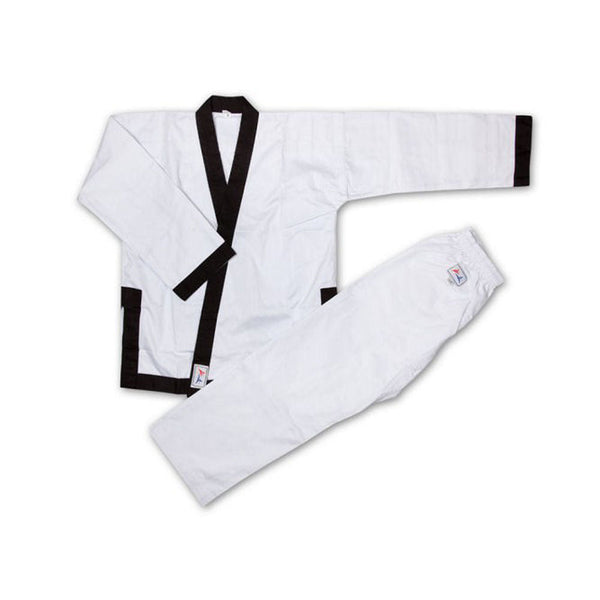
A white uniform with black trim along the lapels, bottom of the jacket and cuffs. Compare this version if your school and rank call for this trim. The product name does not prove that every association permits it.
Belts and ranks: progress without a universal color chart
The belt, or tti, fastens the uniform and shows rank within a school. Kûp or gup refers to student ranks, while dan refers to later ranks. The exact colors, stripes and rank structure vary between organizations. So a photo from another school is not a reliable guide for ordering your next belt.
A concrete example: the published NTMB program lists white for the tenth kûp, blue for the fifth kûp and red for the third kûp. That shows why one simple color sequence falls short for all of Tang Soo Do. Dark blue and black also need to be understood within the relevant tradition, not presented as a rule that applies everywhere.
A belt reflects your progress, but it is not everything training is about. The WTSDA emphasizes the changes in the practitioner while working toward a grading. When buying, choose the color, style and length required by your school. In training, focus, repetition and working with your partner remain part of every class.
Our Fight2Win selection for Tang Soo Do
Our selection makes the step from tradition to training bag concrete. The all-white dobok is the starting point for those who wear it at their school. The protective gear offers examples of suitable equipment for semi-contact partner drills. These are separate products, each with its own size, not a fixed bundle or a guarantee of approval for every grading or tournament.
XPRT All White
An all-white dobok as a basic uniform for schools that wear this version.
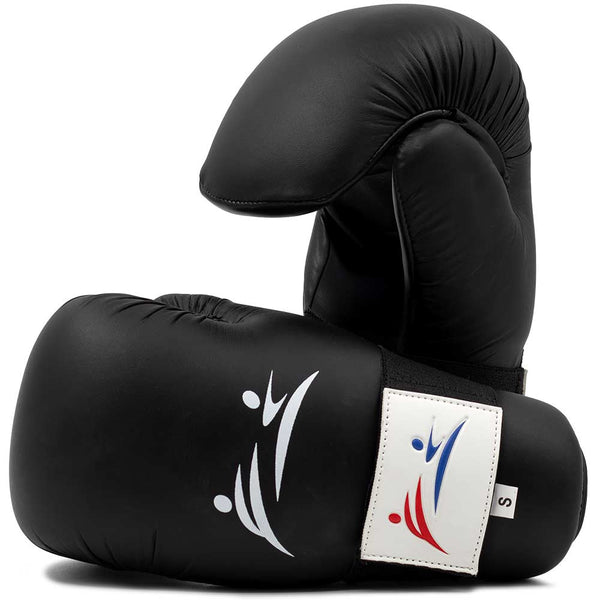
Fight2Win Safety Punch
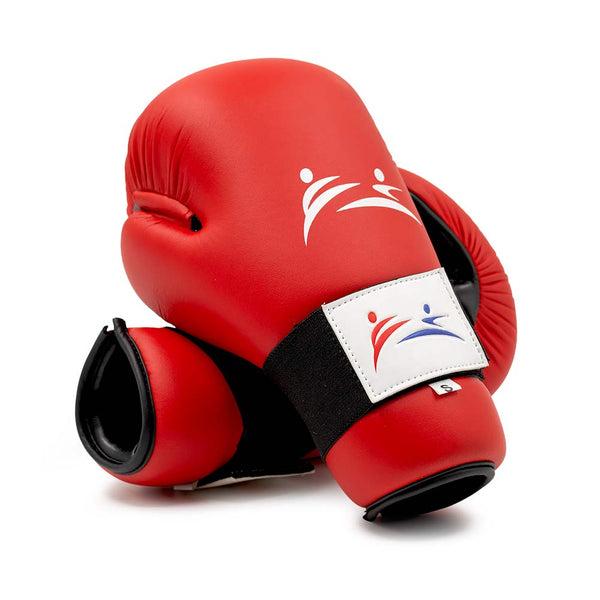
Black semi-contact gloves with an open palm and elastic closure.
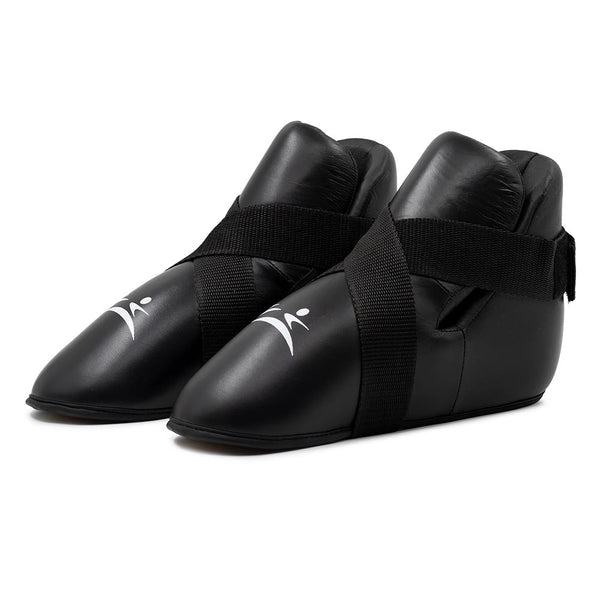
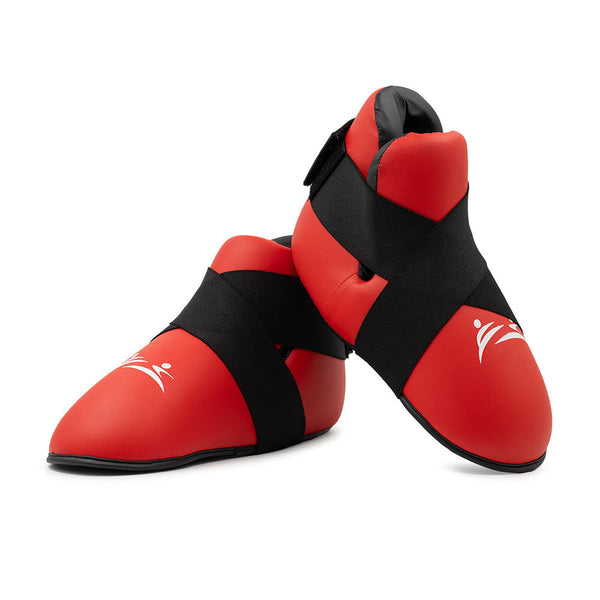
Fight2Win Safety Kicks
Separate safety kicks with elastic fastenings. Try them on together with any shin guards.
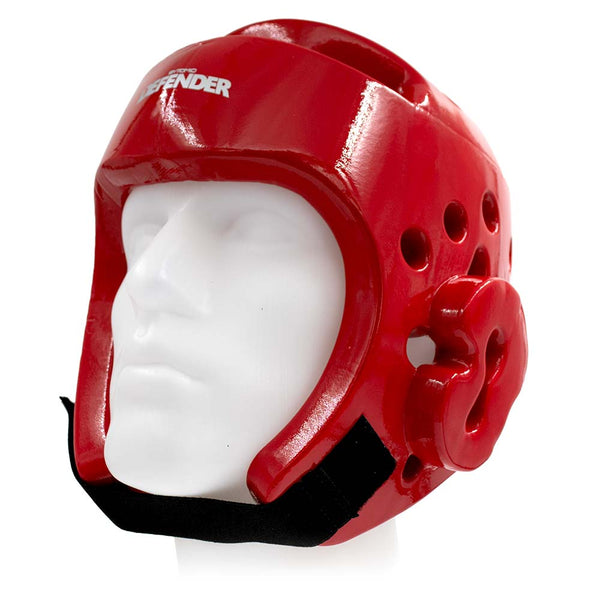
Bytomic Defender
An open foam headgear as an example for training when this type is suitable for the class.
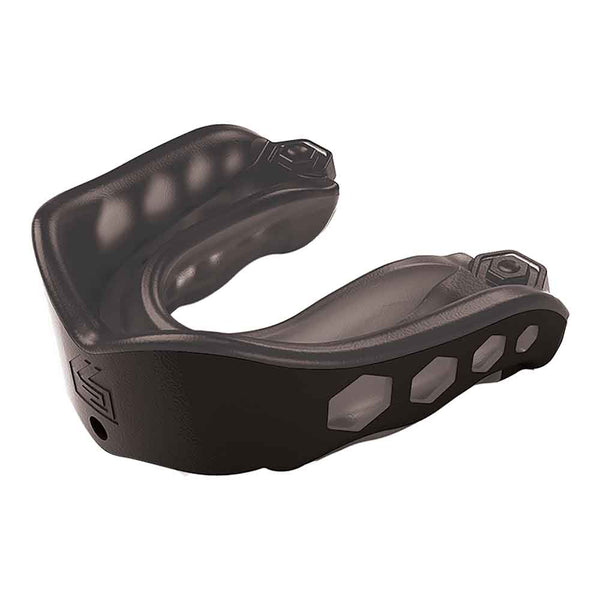
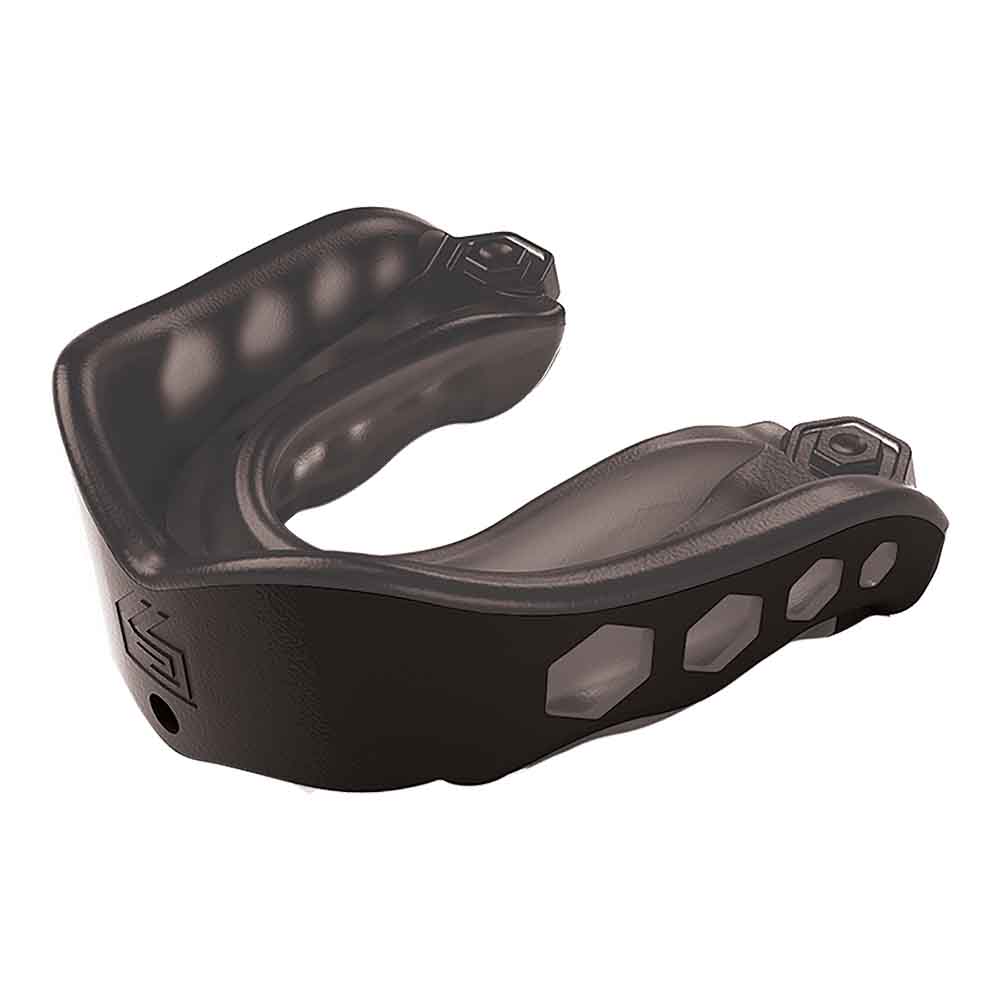
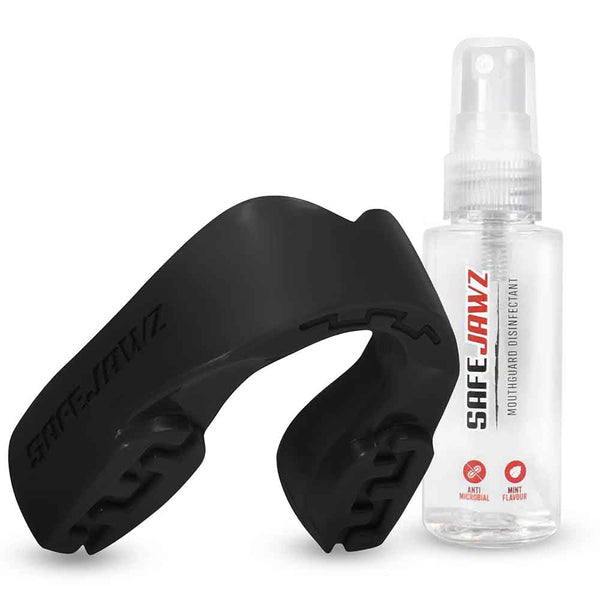
Shock Doctor Gel Max
Our starting point for a moldable mouthguard; mold it carefully and check the fit.
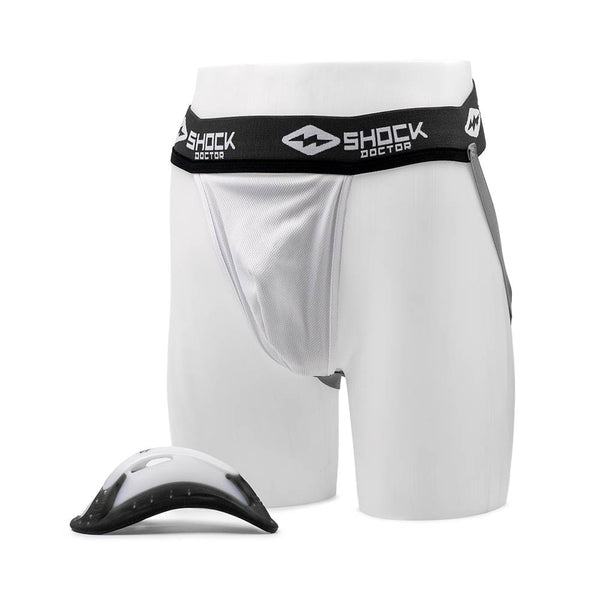
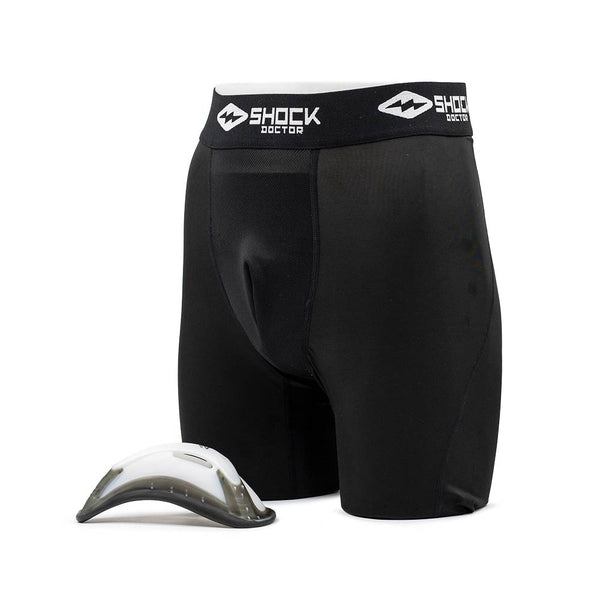
XPRT Basic men’s
A cup with a removable plastic insert. The women's version is listed separately in the cup section.
Add shin guards when the class calls for them. For uniforms with piping and for competitions, check the actual requirements of your school or event. That way, the selection remains a useful starting point without suggesting that one combination suits every Tang Soo Do practitioner.
Semi-contact gloves are not boxing gloves
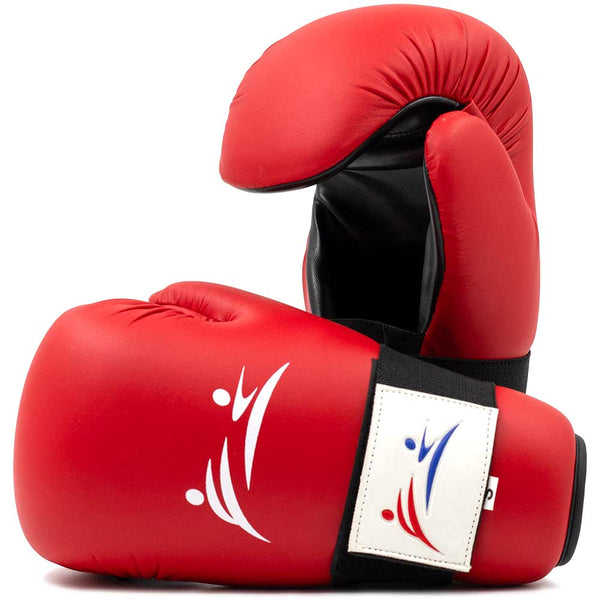
In semi-contact partner drills, you will come across what are known as safety punches. They have a different construction from closed boxing gloves. Look at the coverage of the knuckles, fingers and thumb, the open palm and the closure. The aim is to choose suitable equipment for the agreed drill, not a smaller model because it might be faster.
Try it on with your hand relaxed and clenched. Your fingers should sit in the right place, and the closure should fit snugly without pinching. A glove that twists as you move calls for a different size or shape. Use the product-specific size chart; a boxing glove weight in oz is no substitute for the actual size here.
For heavy bag training, choose equipment designed for it. A semi-contact glove does not become a bag glove because of its appearance. Conversely, a closed boxing glove is not automatically the right equipment for your school's form of sparring.
Fight2Win Safety Punch
The black version has a PU outer shell, foam padding, an open palm, a thumb protector and a long elastic closure. A specific model for assessing the fit around your hand and wrist.
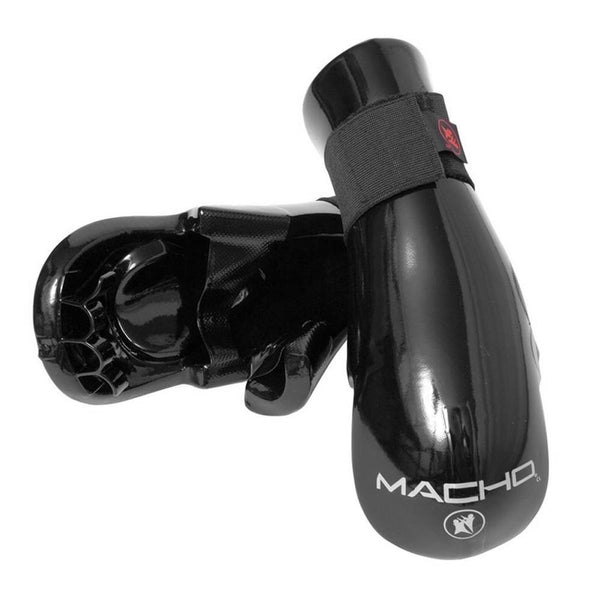
Macho Dyna
A foam version with an elastic closure. Compare its shape and the room for your hand with the Safety Punch, rather than going by the size letter or color alone.
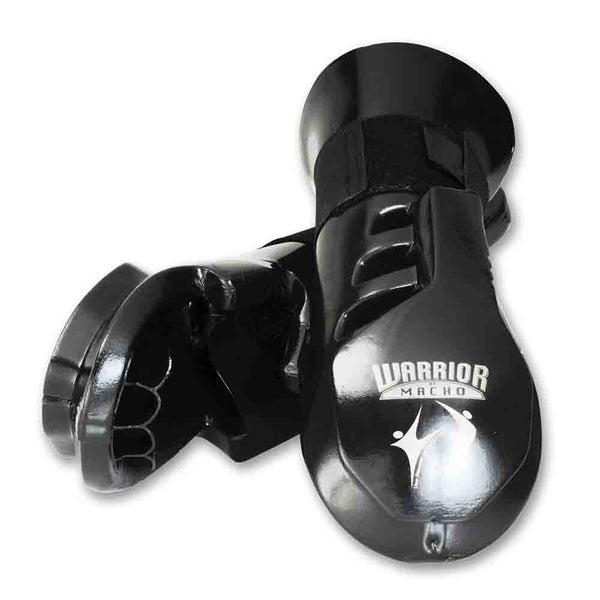
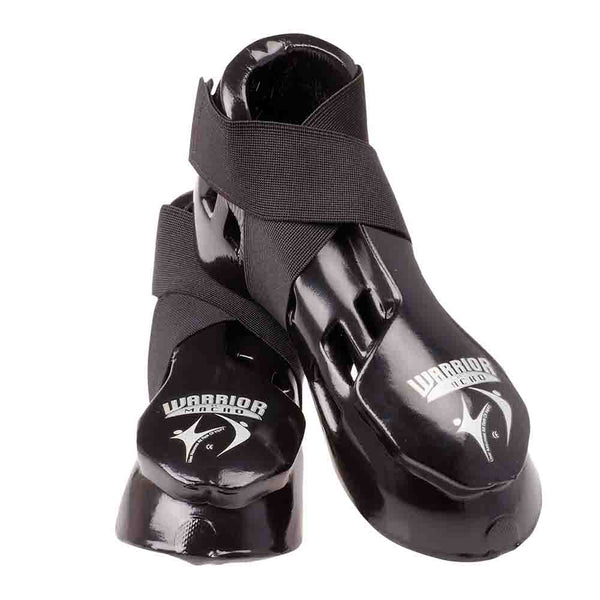
Macho Warrior
Another Macho range for semi-contact. Check the position of your hand and fingers and how the fastening fits. Comparing a different range is more useful than comparing several colors of the same model.
Safety kicks: a separate part of your sparring equipment
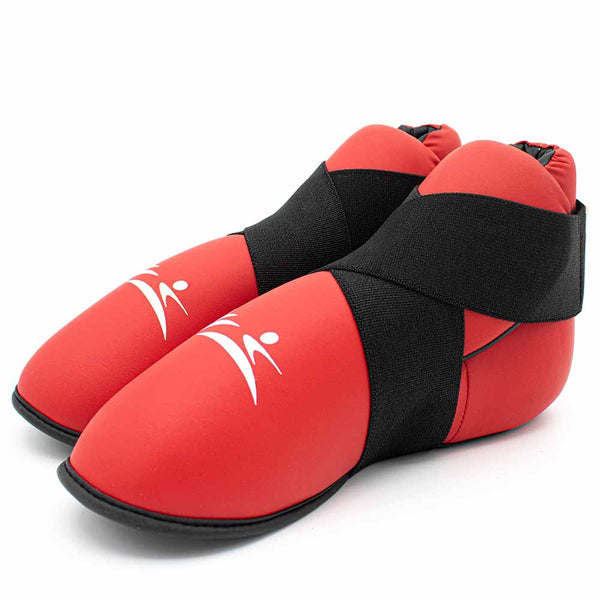
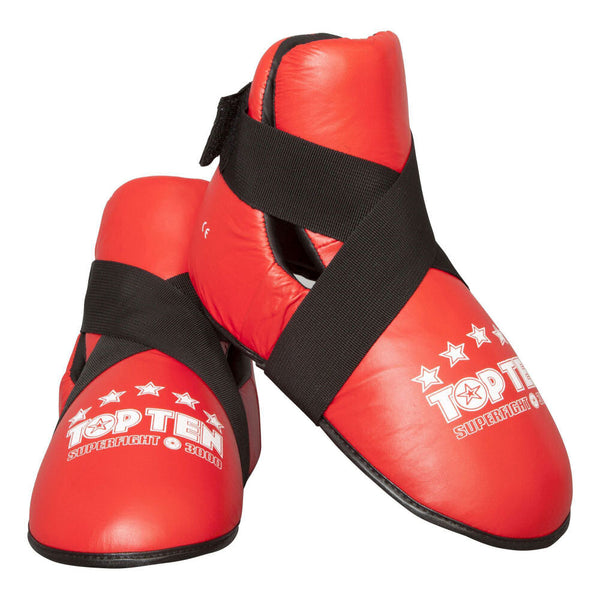
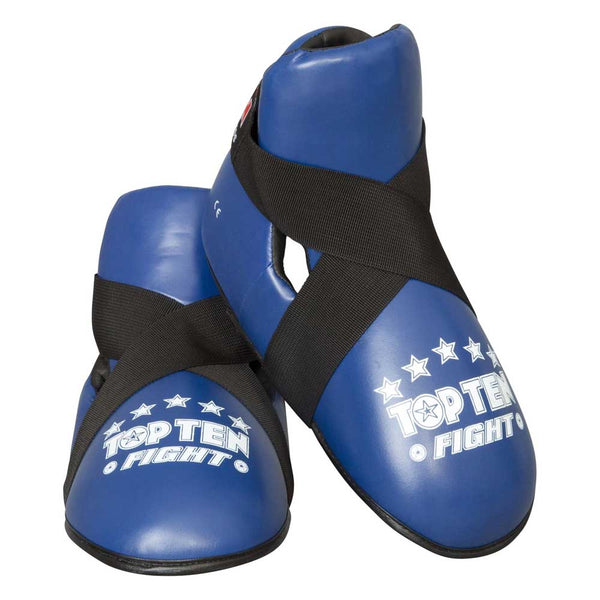
Safety kicks cover the foot and have their own fastening. That is different from a shin guard without a foot section. For a class that uses safety kicks, check the coverage over the instep and the fit around the heel and ankle. Your foot should be able to move normally without the guard immediately twisting out of place.
A shoe size can serve as a guide in the chart, but it cannot account for every difference in width and shape. Check the model you choose and try it on with the shin protection you wear. The elastic and edges should not overlap or bunch up uncomfortably.
Do not simply call them shoes, either: their construction and purpose are different. Wear them for the exercises they were chosen for, and check the underside, elastic and seams regularly. Tournaments may also have different material or color requirements from those used in class.
Fight2Win Safety Kicks
The black PU version has foam padding and a long elastic cross-over fastening. A separate safety kick to pair with suitable partner practice and, where used, separate shin protection.
Macho Warrior Safety Kick
A foam alternative with elastic fastening and extra padding over the instep, according to the product information. Pay particular attention to how it fits your foot and the space around the ankle.
Head protection for the agreed type of contact
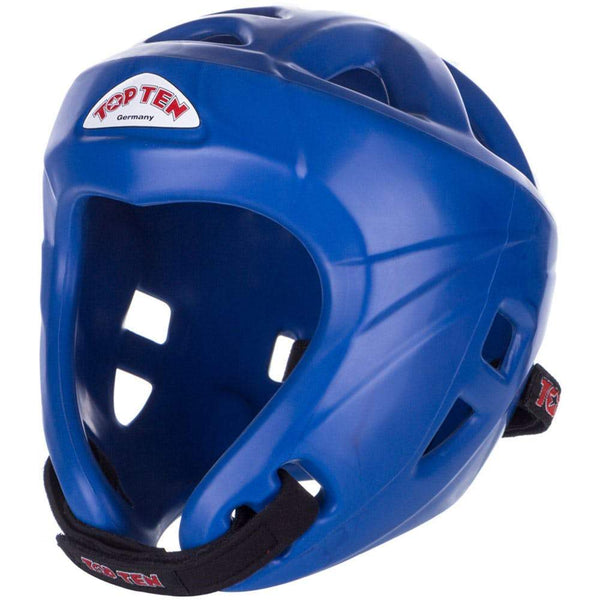
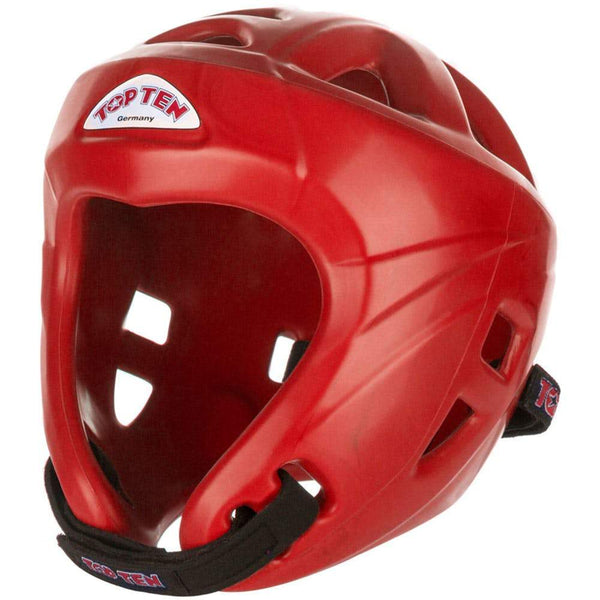
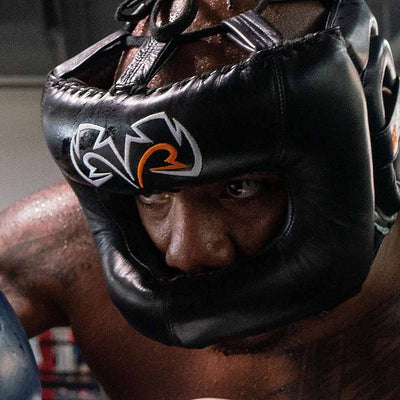
Headgear is part of your equipment when partner practice or the rules require it. For Tang Soo Do, we are looking at an open semi-contact model here, not necessarily the large cheek or nose guards seen in boxing. The space around the face, visibility and fit must suit the exercise.
Check that the headgear stays in place when you look around, turn and step. The chin fastening should not dig in, and the edges should not obstruct your vision. Tightening everything as much as possible will not fix the wrong size.
Headgear does not make head contact risk-free and does not guarantee protection against concussion. Agreed intensity, control and stopping if symptoms occur remain essential. This is about controlled partner practice, not a contest to see who can take the most hits.
Bytomic Defender
A foam headgear with an open face, cutouts around the ears and a hook-and-loop fastening. The black version is our training example. Whether this particular model and color are permitted at a tournament depends on the event.
Shin guards alongside separate safety kicks
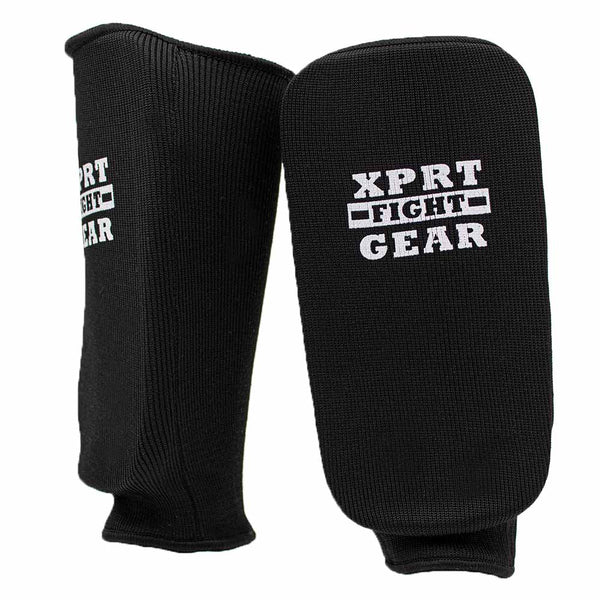
If you wear separate safety kicks, a shin guard without a foot section can be a practical combination. This splits the protection between two separate products. It is not the same design as a thick kickboxing shin guard with an attached or connected foot section.
Check the length along the shin, the fit behind the calf and the room around the knee. Move around with the safety kicks on too. A comfortable combination stays in place without the elastic and edges pushing against each other. Do not choose based only on clothing size or the wearer's age.
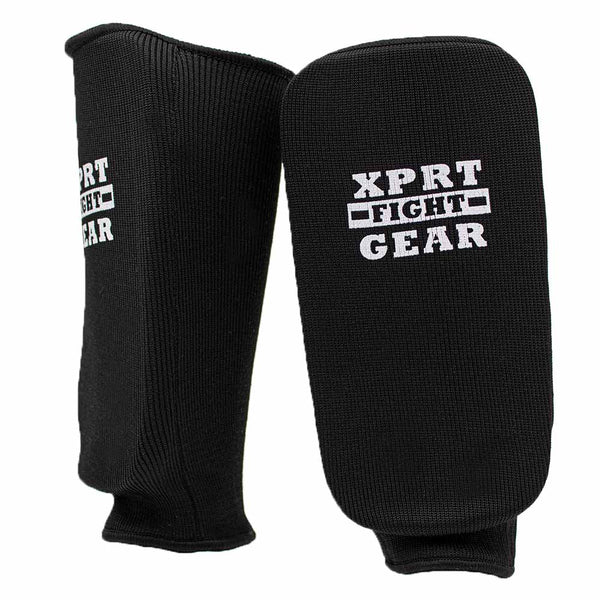
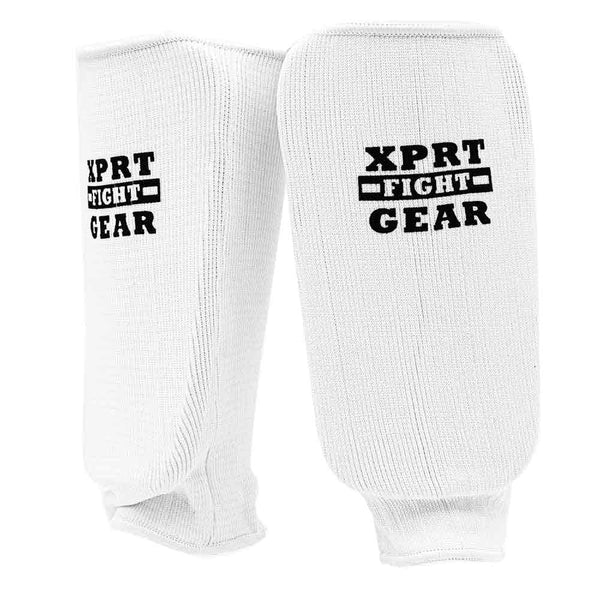
XPRT Protector V1
An elastic sleeve-style model with padding at the front of the shin and no foot protection. The black and white versions are shown in this section so you can compare them. The safety kicks are therefore a separate piece of gear; neither product replaces the other.
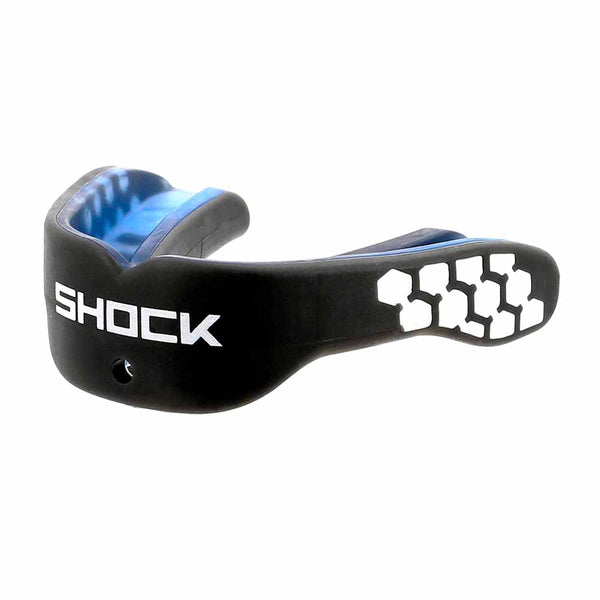
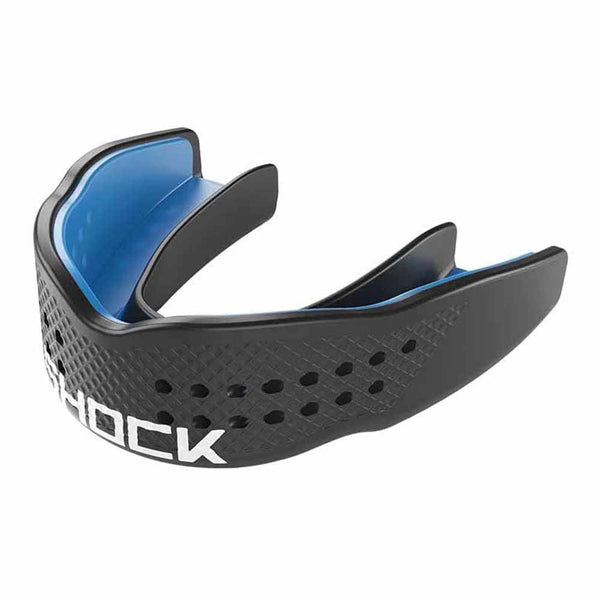
A mouthguard for contact training
A mouthguard is part of preparing for sparring and other contact drills. It is not an accessory that only matters in competition. Choose one that fits and mold it according to the instructions provided. Once molded, it should stay in place without you having to keep biting down hard.
For young people, the actual fit matters more than a general age recommendation. If you have braces, choose a model designed for them. Do not simply heat or adjust a standard moldable mouthguard to fit around braces. If your teeth change, check again whether the model is still suitable.
Rinse the mouthguard after use, let it dry and store it in a ventilated case. Check it regularly for damage and fit. The color or design can be a fun choice, but only after you have the right fit.
Shock Doctor Gel Max
A moldable mouthguard with a Gel-Fit inner layer. This is our starting point for the selection. Follow the instructions for the model and check the fit after molding it; the product name alone does not tell you whether it fits your teeth well.
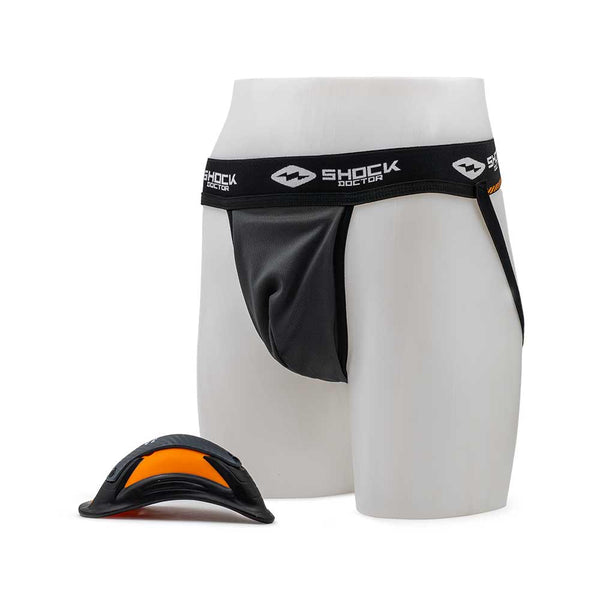
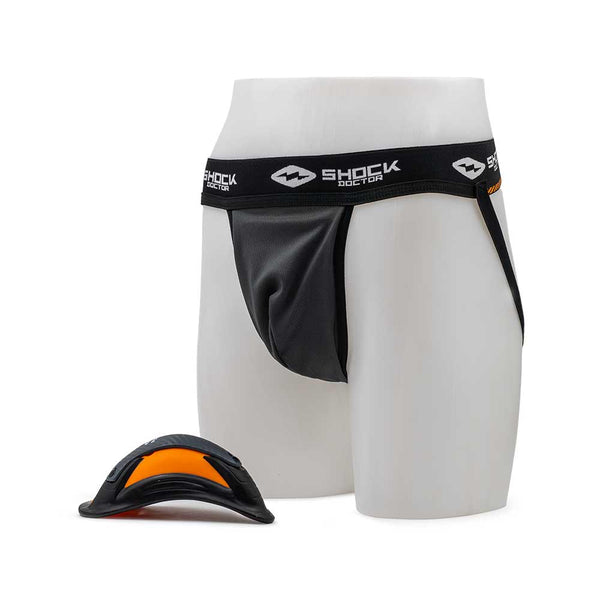
Putting on a cup and checking the fit
Even during controlled partner drills, a movement can turn out differently than intended. A well-fitting cup is therefore a practical part of your contact gear. Put it on carefully: place a removable cup in the designated pocket and adjust it so the protective part fits snugly. Check not just the waistband, but the shape of the cup too. Step, turn and lift a knee; the cup should not shift, pinch or restrict your movement.
Men's and women's versions have different shapes. Choose based on how the guard fits your body and how you plan to use it, rather than simply ordering a smaller men's model. For young people, getting the right size is important; tightening the strap on an oversized adult version will not make it fit.
Additional rules may apply at tournaments. These training examples therefore do not mean the products are approved for competition in general. Keep the cup and fabric section clean according to the product instructions, and check after putting it on that the cup stays in place.
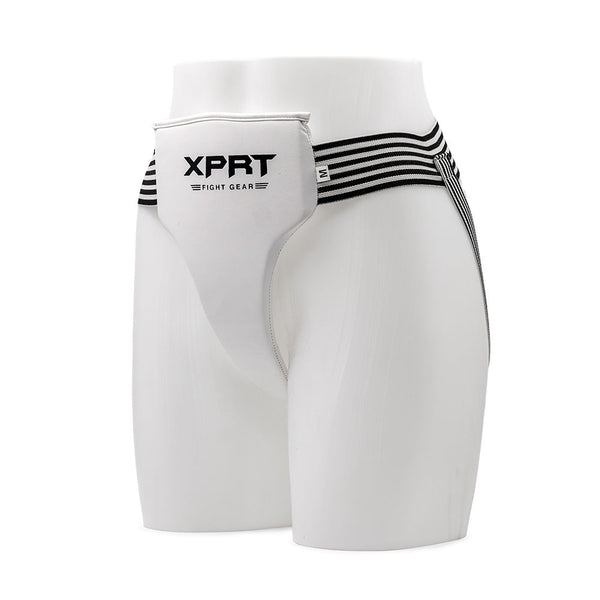
XPRT Basic men’s
A version with an elastic waistband and removable plastic cup. Removing the cup lets you wash the fabric section separately according to the care instructions.
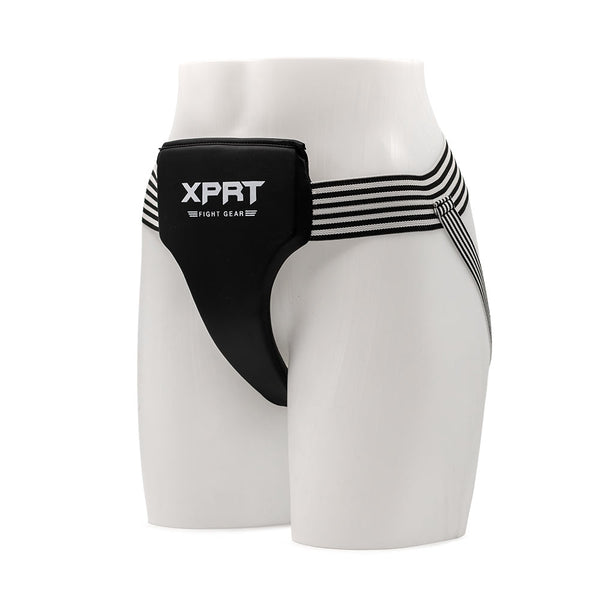
XPRT Basic women’s
A differently shaped version with a PU outer material and elastic waistband. Compare how the protective section fits around the groin and lower abdomen as you move.
Kicking a target is different from free sparren
Target training can add variety to a class with a defined point of contact: a kicking shield or a kick target designed for the purpose. You practise an agreed technique with someone holding the target, rather than against a freely moving opponent. Distance, timing and returning to your stance deserve as much attention as making contact.
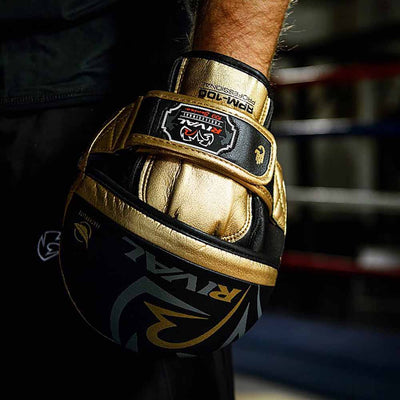
Choose equipment suited to the technique. A compact boxing paddle is not automatically suitable for taking hard kicks. The person holding the target needs to be able to hold it comfortably, keep enough space and know which technique is coming. Size, weight and fastening therefore matter to that partner too.
Your own training equipment is a useful addition to group drills. If you want to compare different pads, kicking shields and protective gear worn on the body, you can find more information in our trainer and personal trainer guide. That helps you choose a target that suits your training and the person holding it.
Gradings, demonstrations and tournaments each require their own preparation
A grading brings together the elements of the program at a particular level. A demonstration shows an audience a selected part of the art. A tournament may involve hyung or a specific form of sparring. These situations may look alike from the outside, but they do not necessarily have the same clothing and equipment requirements.
The NTMB describes competitions as an opportunity to show courage, concentration, honesty, humility and control, among other qualities. That is a meaningful perspective: the result is not the whole story. At the same time, it is this association’s description, not a rulebook shared by every organization.
Before taking part, check the current program or rules: uniform, patches, belt, type of protection and any color requirements. A webshop label such as taekwon-do or semi-contact does not guarantee that an item is permitted. That way, you buy what your event requires without assuming there is one standard competition kit for all of Tang Soo Do.
Some grading programs also include breaking tests and weapons forms. That puts these elements in the context of training. It is not a reason to try them on your own based on an article or treat them as standard purchases for beginners.
Children and adults: the same attention, tailored to each
Younger children learn not only a kick or stance, but also to listen, wait and work carefully with others. Simple fastenings and straightforward steps matter when choosing gear for them. A protector that takes a lot of effort to fit properly makes changing gear during class unnecessarily difficult.
Teenagers can vary greatly in build and experience. Being the same age does not mean needing the same glove, safety kick or dobok size. The same is true for adults: check each item separately, with the movements you make in mind.
These age groups are a guide to reading, not a universal size chart or a statement about contact levels. The class content and the actual fit remain the deciding factors. Suitable gear supports practice and helps keep training organized.
Care is part of preparing for your next class
Take your dobok and damp protective gear out of your sports bag when you get home. Open the fastenings and let the items air-dry. Wash the uniform according to the care label, taking belts, trim and patches into account. A white uniform is not a reason to use bleach or high temperatures without checking.
Wipe the outside of gloves, safety kicks and headgear with a soft, slightly damp cloth. Do not use Sukkiri or FreshKO on the outer material, including PU or a coated foam exterior. A suitable leather cream should only be used on appropriate smooth leather, not on synthetic material or foam.
Gloves do not go in the washing machine, the dryer or under water. Do not use direct heat to speed up drying for the other protectors either. Check the elastic, seams, coating and fastenings as you put your gear away. It is better to spot a tear or loose fastening before the next exercise than halfway through it.
Choose Tang Soo Do with the whole art in mind
Your Tang Soo Do gear starts with a dobok and belt that suit your school. For contact practice, semi-contact gloves, safety kicks, a mouthguard, a cup and the agreed head and shin protection come into play. Choose each item for its own purpose and fit, not as part of a list automatically borrowed from another martial art.
The culture is part of it too. Bowing in the dojang, performing a hyung carefully and being considerate of your partner show how you train. Your belt says something about your progress within a school; it does not replace that everyday care.
That combination keeps Tang Soo Do recognizable as a martial art while making it easier to choose practical gear. You understand what you use each item for, which traditions need context and why a training choice is not automatically a competition requirement. Below is a brief recap by product group.