A small gym, a trainer demonstrating combinations and a group practicing the movements over and over. That is where much of the history of Dutch kickboxing begins. The major finals in Japan and the sold-out arenas came later. First came curious instructors, trips abroad and gyms that turned new experiences into everyday training.
The Netherlands did not invent kickboxing. But it became one of the countries that gave the international sport a recognizable identity. That happened through Amsterdam and Breda, through Mejiro and Chakuriki, through Johan Vos, Luciën Carbin and Cor Hemmers, and through generations of fighters who each wrote a different part of the story.
From Rob Kaman, Ramon Dekkers and Lucia Rijker to Peter Aerts, Ernesto Hoost, Remy Bonjasky, Sem Schilt, Badr Hari and Rico Verhoeven: their careers show the breadth of that influence. This is the story of the people behind Dutch Style, the gyms where they developed and the international encounters that made the Netherlands a distinctive kickboxing nation.
How a small country developed a major kickboxing culture
Dutch influence can be seen in several places. In classic K-1, Dutch heavyweights were major players for years. In Thailand, Ramon Dekkers made a name for himself in a different fighting scene. Lucia Rijker built an exceptional career in both stand-up combat sports and professional boxing. And in gyms far beyond the Netherlands, the combination of boxing and low kicks became recognizable as Dutch kickboxing.
Behind those successes lies no single invention or method devised by one trainer. A network of gyms, exchanges and international contacts emerged. A fighter brought back experience from Japan or Thailand. A trainer adapted an exercise. An opponent forced a gym to rethink distance, defense or fight preparation. That knowledge did not stay in one place.
The sport was also shaped by people from diverse backgrounds. Dutch, Surinamese, Moroccan and other life stories came together in the same training spaces. Foreign fighters also chose Dutch coaches or came to train here. The history of Dutch kickboxing is therefore about both a country and an international meeting place. That is what makes it more interesting than a tally of national titles.
The foundation: karate, boxing and the Japanese connection
Before kickboxing became a familiar name, there was already interest in karate and other martial arts in the Netherlands. Instructors looked for ways to use techniques in a continuous fight. Boxing offered knowledge of punching combinations, footwork and defense. Karate brought kicking techniques, a sense of distance and different ways of moving, among other things. For the pioneers, how to bring those worlds together was a practical training question.
Japan was an important link in this process. Kickboxing had developed there during the 1960s through contact with Muay Thai. Dutch visitors therefore encountered a sport that had already moved beyond a theoretical combination of punches and kicks. There were trainers, experienced competitors and gyms where the techniques were practiced together every day.
Thailand remained a vital source of inspiration. The Dutch sport grew through contacts in Japan and direct experience with Thai ring culture. The distinction between kickboxing and Muay Thai was then shaped in part by competition rules and the choices of trainers. Its origins are not a straight line from one country to another. This is a history of people who went to see for themselves, took part, learned and continued building on what they had learned back home.
Thom Harinck and Chakuriki: forging their own path from Amsterdam
Thom Harinck is one of the people who gave Dutch kickboxing its own direction. In 1972, he founded Chakuriki in Amsterdam. His approach brought together experience from various martial arts. On his website, he describes influences including karate, boxing, judo, jiujitsu and wrestling. The name Chakuriki became associated with a training environment focused on what worked in a fight.
That early history matters because it shows that Dutch kickboxing had more than one starting point. Harinck did not wait for an official starting signal before combining techniques and preparing students for competitions. At the same time, his school continued to evolve. International encounters and experiences with other fighting styles prompted him to refine his approach further.
As both a trainer and an organizer, Harinck helped raise the sport's profile. Chakuriki became a name recognized beyond the Netherlands. Branko Cikatić and Peter Aerts are among the well-known heavyweights he coached. Their international careers show how a local gym could play a role on the biggest stage.
Harinck's significance therefore lies not only in the champions associated with him. He helped build a structure in which students gained competition experience, trainers passed on knowledge and a new generation found its place. Dutch history needs builders like these just as much as the fighters who eventually posed for photos with a trophy.
Jan Plas, the 1975 trip to Japan and Mejiro Gym
Another important thread runs through Jan Plas. In 1975, he traveled to Japan with Peter van den Hemel and Jan van Looijen. The WMTA’s historical account describes their training with Kenji Kurosaki and their contact with fighters such as Toshio Fujiwara and Shima. There, they encountered a hands-on approach to kickboxing that they could develop further in the Netherlands.
At the time, such a trip meant more than a brief training camp. Knowledge was less readily available than it is now. Visiting a gym abroad was a way to experience how strong fighters moved, how a trainer structured a class and how punches and kicks could complement each other throughout a fight. Those experiences then had to be adapted for their own students.
Mejiro Gym became closely associated with Plas and that Japanese tradition. The gym grew into an important place for passing on and refining kickboxing technique. The later prominence of Rob Kaman immediately shows how far its international influence could reach.
Chakuriki and Mejiro are part of the same history, but they were not identical schools. Different backgrounds, trainers and students gave each its own emphasis. The presence of several strong gyms was precisely what kept the sport moving: it created opponents, points of comparison and new ideas. The Dutch style was not established in a single day, but shaped again and again on the training floor.
The Jaap Edenhal in 1976: kickboxing takes the stage
On May 31, 1976, a fight night took place at Amsterdam’s Jaap Edenhal that is regarded as an important starting point in accounts of Dutch history. Jan Plas and Thom Harinck were involved in organizing it. A wider audience could see what the new ring sport involved and how the different gyms presented themselves.
The significance of such an evening goes beyond a date on a timeline. A sport needs a place where students meet opponents, trainers see the results of their preparation and spectators understand what is at stake. A recognizable fight night gives the work done in the gym a public face. The gym remains the foundation, but the ring makes that development visible to others.
Contact bouts and full-contact initiatives had already taken place. The story of 1976 is therefore part of a broader history. The Jaap Edenhal became a particularly clear milestone for organized Dutch kickboxing. The event helped launch a competition culture that then spread through new fight nights, gyms and international encounters.
Johan Vos: the trainer behind a major technical tradition
Johan Vos deserves a place of his own alongside the early names of Chakuriki and Mejiro. His name is inseparably linked to a training environment where strong fighters developed their technique. Ernesto Hoost and Lucia Rijker are among the best-known athletes associated with that history.
A coach's influence often becomes clear only through a student's career. With Vos, you can see how a trainer can help develop an approach that reads the fight as a whole. A punch is more than an isolated strike; it affects the opponent's response and, with it, the opportunity to follow up with combinations. Timing, position and choosing the right follow-up are just as important as the initial contact.
Hoost and Rijker developed very different personalities in the ring. That makes their shared training background all the more interesting. A good gym does not produce copies; it gives athletes a foundation they can use in their own way. Dutch history is therefore not just about the recognizable styles of different gyms, but also about the freedom individual fighters had to develop their own approach.
Luciën Carbin: champion, mentor and lasting influence
Luciën Carbin represents both the early generation of competitors and the long tradition of passing on knowledge. He made a name for himself as a fighter and then became an influential trainer. In doing so, he connects two sides of the sport: experiencing firsthand what happens under pressure and turning that experience into lessons for others.
His place in the story is also important for understanding Dutch gym culture. Great gyms are more than a logo on a tracksuit. They are built by people who correct one another, demonstrate techniques and keep looking for solutions. A trainer like Carbin passes on his knowledge not only through explanations, but also through the rhythm and focus of a training session.
Among the early Dutch figures, Carbin and Rob Kaman are often mentioned together as part of the generation that brought the sport to a wider audience. Their careers took different paths, but both helped build the reputation of Dutch ring sports before the major K-1 finals came to define the international picture.
Carbin also reminds us that a fighter's story continues after they stop competing. An experienced athlete can influence dozens of other careers as a coach. In this way, an individual career becomes part of a much longer sporting history.
Rob Kaman: the face of the powerful low kick
Rob Kaman became one of the biggest international names in Dutch kickboxing. His ties to Mejiro Gym and his reputation as a powerful, technically well-rounded fighter make him a central figure between the pioneering years and the later K-1 era. Anyone looking to understand the Dutch style will soon come across his name.
His low kicks in particular became a defining part of his reputation. The nickname Mr. Low Kick sums that up, but his importance goes beyond a single technique. A low kick becomes more effective when the opponent is first occupied with punches, is out of position or is caught mid-movement. What matters is how the attacks work together and the ability to keep the pressure on.
According to his own biography, Kaman began training at Mejiro Gym under Jan Plas in May 1978. His career record lists nine world titles in kickboxing and Muay Thai, including a reign as WKA middleweight champion beginning in 1983 and later ISKA titles. This makes his role as a bridge clear: emerging from the early development of Dutch gyms, he became a fighter who succeeded in multiple international organizations.
Kaman helped generate international interest in the Dutch approach. Fighters and trainers from abroad could see that strong combinations of boxing and kicks were more than a theoretical ideal. In fights against experienced opponents, that training approach produced visible results.
His role in this history is that of a bridge between eras. Through his career, the knowledge developed in the early gyms reached a much wider audience. Later generations would make their breakthroughs on other stages, but Kaman had already helped show that the Netherlands had a serious place in international ring sports.
Cor Hemmers and Breda: a second major hub
The history of Dutch kickboxing extends well beyond Amsterdam. Breda became an important center around Cor Hemmers. The history of Hemmers Gym shows how a local training environment could grow into a school with an international reputation. It is another chapter in the same broad Dutch development.
Hemmers is best known for his work with Ramon Dekkers. Their story connects daily training in the Netherlands with tough international challenges. Developing a fighter takes more than a set combination on the pads: preparation, choosing fights, learning from experience and continually adjusting the approach are all part of it.
The gym’s own history gives June 1984 as its founding date in Breda. The first team was called Maeng Ho Breda. That name linked the school to Martin Borneman’s gym in Rotterdam, where Hemmers developed his own full-contact background. Alongside Dekkers, the early teams included Duc Nguyen, Silvio Zimmerman and, later, Peter Smit. Breda was thus part of a wider network, not an isolated formula for success.
A gym carries those experiences forward. Training partners learn from one another, young fighters look up to older athletes, and coaches build on past fights. When a school achieves international success, it also attracts other strong athletes. In this way, a regional center can become part of a worldwide training network.
The Brabant chapter adds depth to Dutch history. It shows that the sport did not depend on one capital city or one coach. Several places could become influential at the same time, each with its own people and its own competition story.
Ramon Dekkers: from Breda to the Thai ring
Ramon Dekkers is one of the Dutch names that took on an almost mythical status even beyond kickboxing fans. He came from Breda and, under Cor Hemmers, developed into a fighter with a major international reputation. His nickname The Diamond remained closely associated with a career spent facing strong opponents on stages abroad.
Dekkers holds a special place because his reputation is so closely tied to Thailand and Muay Thai. While later Dutch heavyweights became known mainly through K-1, his story also involved facing top Thai fighters in their own ring world. That required him to adapt to different customs, opponents and competitive demands.
Hemmers Gym's biography credits him with eight world titles in Muay Thai. His international career also included a series of four bouts with Coban Lookchaomaesaitong, one of his best-known Thai rivals. Each fighter won twice. That back-and-forth rivalry says a great deal: Dekkers made his name by repeatedly seeking out strong opponents and building on what he had learned in earlier fights.
He also faced other big names in the Netherlands. His bouts with Gilbert Ballantine directly link the Breda story to Chakuriki. Encounters like these show how Dutch combat sports history forms a network: behind two opponents stand different gyms, coaches and training partners, all learning from the same evening.
His style was recognizable for the pressure he could build with combinations. His hands were an important weapon, but his strength lay in how he brought the whole fight together. Opponents had to respond to more than one attack and had little chance to settle into their own rhythm.
Dekkers' legacy is cultural too. He helped a generation of Dutch athletes see that training at a local gym could lead to facing the best in international combat sports. Through his career, Breda became a recognizable name on a much bigger map. His story is therefore part of both the development of Dutch combat sports and the continuing exchange with Thailand.
Lucia Rijker: an exceptional fighter between two ring worlds
Lucia Rijker does not belong in a footnote to the men's story. She is a central figure in Dutch combat sports history. She built an international reputation in stand-up combat sports and then made a major impression in professional boxing too. Her connection with Johan Vos is an important part of her Dutch background.
Her career shows how skills can develop across different types of competition. Judging distance, choosing the right moment and maintaining sound technique under pressure are familiar parts of good ringcraft. At the same time, boxing requires its own specialization. Rijker's success in both settings makes her story remarkable, precisely because it spans two different sporting worlds.
The International Women’s Boxing Hall of Fame covers her career extensively and inducted her in 2014. This also underscores her place in the international history of women’s boxing. In the Dutch story, she is both an exceptional athlete in her own right and an example of the talent developed in its gyms.
Her early international breakthrough included a victory over Lilly Rodriguez in 1984. In the 1990s, she went on to build her boxing career in the United States, making a comeback in Los Angeles in 1996. She later gained recognition outside the ring through her role in the film Million Dollar Baby. In this way, an athlete from the Dutch gym scene reached different international audiences.
Rijker also showed that a woman could become one of the ring’s most respected figures for her technical skill and sporting achievements. Her significance therefore extends beyond results. She gave later athletes a recognizable example of ambition, composure and an international career that did not have to end with one discipline.
Dutch Style: boxing and kicking as one attack
The term Dutch Style often brings the same image to mind: a series of punches followed by a powerful low kick. There is a recognizable core to that image. Dutch gyms made their name by combining boxing technique with kicks, with each attack setting up the next. Hands and legs do not work as separate elements; they continually affect the same opponent.
That requires good positioning. A combination is only useful if the fighter can defend, move again or follow up appropriately after an attack. Guard, footwork and regaining a balanced stance are therefore all part of the same approach. The low kick stands out, but the setup often determines when there is room to throw it.
Training on the gym floor reflects this. Combinations are repeated on pads and with a partner, while the fighter on the receiving end also learns to respond actively. The partner feeding the attacks helps with rhythm and distance; the other practices timing, technique and spotting openings. Well-executed repetition makes the connections between them increasingly familiar.
That does not make Dutch Style a one-size-fits-all formula for every gym. A tall fighter uses different options from a shorter pressure fighter. Coaches differ in their preferences for movement, blocking or countering. The term primarily describes an influential family of training ideas. The best examples show just how much individual variation it allows.
The gym as a network: training partners make the difference
A champion does not prepare alone. Behind a major fight is a group of people who put in rounds, hold pads, ask technical questions and keep training moving. Strong training partners make each other better. They provide the resistance and varied reactions an athlete needs to avoid practicing only their favorite solution.
The presence of several good gyms strengthened that network. Competitions brought schools into contact with one another. Athletes shared experiences and took what they learned into other training environments. The Dutch approach thus developed through both repetition and change: a recognizable foundation remained, while new opponents called for new answers.
Passing on that knowledge is an important part of what the Netherlands has shared with the world. International athletes came for more than a famous name on the door. They sought a training environment with experienced partners and coaches who knew how to prepare for a fight. The strength lay in the day-to-day environment, not just in a theory about style.
That also explains why a gym can remain influential after a champion leaves. Experienced students become trainers, training partners begin competing themselves, and a new group grows up with the knowledge already in place. A school can therefore endure far longer than any one sporting career.
K-1: Dutch gyms on a Japanese world stage
From 1993, K-1 gave heavyweight kickboxing a major international stage. The tournament format brought together strong fighters from different training backgrounds and turned a single evening into a compelling sporting story. Winning multiple bouts demanded technique, preparation and the ability to perform again under different circumstances.
The first World Grand Prix was won by Branko Cikatić, the Croatian fighter associated with Thom Harinck and Chakuriki. His victory is a good example of the international reach of Dutch gyms. A training tradition developed in the Netherlands and an athlete's nationality are not the same thing, but they can come together in one career.
After that, Dutch heavyweights became regular headliners. Peter Aerts, Ernesto Hoost, Remy Bonjasky and Sem Schilt each won the classic final tournament multiple times. Their styles differed greatly. That made their success all the more convincing: it extended beyond one exceptional athlete or one particular technical approach.
K-1 also increased the visibility of trainers and gyms. A televised fight suddenly brought years of daily work in the Netherlands to a worldwide audience. For many international viewers, Dutch kickboxing took on a recognizable face during this period, with familiar fighters and recurring matchups.
Peter Aerts: The Dutch Lumberjack and three K-1 crowns
Peter Aerts became one of the most recognizable heavyweights of the K-1 era. His nickname, The Dutch Lumberjack, suited his image as a powerful fighter with dangerous high kicks and a direct attacking style. At the same time, a long career at that level required much more than physical strength. Experience, timing and tactical awareness kept him competitive for years.
Aerts won the original K-1 World Grand Prix in 1994, 1995 and 1998. His first two victories came back to back; the third showed that he could dominate an entire finals tournament again years later. He became a fixture in an era when Dutch heavyweights increasingly dominated the Japanese stage.
His partnership with Thom Harinck and Chakuriki is part of that story. Trainer and fighter forged a clear link between the expertise of Amsterdam gyms and an international fighting career. For a new generation, Aerts showed just how far a path that began in a Dutch gym could lead.
Part of his popularity came from how easy his fights were to follow. A high kick could suddenly end a bout, but it was set up by pressure, positioning and earlier moves. Aerts combined simplicity for the casual viewer with technical depth for the expert. That is why he remains an important point of reference in discussions of Dutch heavyweights.
Ernesto Hoost: Mr. Perfect and the logic of the combination
Ernesto Hoost showed another side of that same international success. His nickname, Mr. Perfect, became associated with a remarkably precise, well-rounded style of kickboxing. He could build an attack through combinations that repeatedly targeted his opponent’s head, body and legs.
One of Hoost’s signature moves is a punching combination that ends with a low kick. What makes it interesting is not just that final strike. The opponent first reacts to the punches and then has to deal with another attack. The timing and order turn what look like separate techniques on paper into a cohesive combination.
His own story begins not at a major final in Japan, but at Sokudo in Hoorn, where he trained with Ton Vriend for about six years. That was where he fought his first bouts. In the late 1980s, he also won titles in several stand-up disciplines. So the future K-1 specialist had already developed a broad range of skills before the biggest heavyweight stage emerged.
In the first K-1 World Grand Prix in 1993, Hoost reached the final straight away, after victories over Peter Aerts and Maurice Smith. There he lost to Branko Cikatić. That run placed him among the biggest names from the very start of K-1 history. His later titles therefore came after an early introduction to the tournament at the highest level and years of further development.
Hoost won the classic K-1 World Grand Prix in 1997, 1999, 2000 and 2002. Four victories spread over several years give him a special place in the heavyweight era. The Johan Vos influence on his development links those achievements back to everyday training in the Netherlands.
His career is a good answer to the idea that the Dutch style is only about toughness. Power can matter a great deal, but Hoost showed above all how important it is to build a fight intelligently. A strong technique at the right moment can open up the next opportunity. That logic still makes him an interesting fighter to study if you want to understand how the elements of Dutch kickboxing work together.
Remy Bonjasky: defense, explosiveness and a style of his own
Remy Bonjasky brought yet another look to Dutch heavyweight kickboxing. His nickname, The Flying Gentleman, evoked images of high kicks and jumping knees, but his style also rested on a recognizable tight guard. He could wait, react and then suddenly accelerate.
Bonjasky won the classic K-1 World Grand Prix in 2003, 2004 and 2008. Those three titles put him alongside Peter Aerts as a three-time winner of the final tournament. His own account of his career describes his journey from a job in finance to international combat sports. It gives his sporting development a human starting point alongside the famous final nights.
What stands out in Dutch kickboxing history is the variety. Bonjasky was no copy of Hoost or Aerts. The way he used his guard, chose his position and launched explosive attacks gave his fights a rhythm of their own. A shared sporting environment can produce very different solutions.
After his major tournament years, he put his knowledge to work at the Bonjasky Academy in Almere, which his own account of his career dates to 2010. In doing so, he follows a recurring Dutch pattern: a champion creates an environment where new athletes can learn from the experience he gained in the ring.
That is also a useful way to look at style. A nickname or spectacular technique makes a fighter recognizable, but it does not tell the whole story. For Bonjasky, high attacks and a solid defensive foundation went hand in hand. That combination helped him hold his own against several generations of strong opponents.
Sem Schilt: reach, distance and four Grand Prix victories
Sem Schilt, also known internationally as Semmy Schilt, brought an exceptional combination of height, reach and technical mastery to heavyweight kickboxing. His background in karate and other forms of competition gave his development a distinctive path. In K-1, he became an opponent for whom almost everyone needed a specific plan.
His reach was a clear strength, but it does not explain his achievements on its own. Distance only becomes an advantage when you use it well. Schilt could keep opponents at a distance that worked for him and counter their attempts to get closer. His stance, timing and straight attacks suited that style of fighting.
He won the classic K-1 World Grand Prix in 2005, 2006, 2007 and 2009. The three consecutive titles at the start of that run made his dominance especially clear. In 2012, he also won the GLORY Grand Slam, marking his career's transition to another major international organization.
Dave Jonkers also has a place in Schilt's story as a coach. Schilt went to train in Zuidlaren and developed his career through various international circuits. His connection with Golden Glory then brought him into a broader professional team environment. His development shows that a Dutch kickboxing career could also gain a strong foundation outside the well-known Amsterdam and Brabant hubs.
Schilt's own academy then illustrates a familiar pattern in Dutch sporting history: competition experience becomes knowledge for others. A champion's impact does not end with the last final. As a coach, he can help athletes understand how distance, technique and personal strengths combine to form an effective approach.
Albert Kraus and Andy Souwer: the world beyond the heavyweights
The big heavyweights attracted a lot of attention, but Dutch influence did not stop there. From 2002, K-1 World MAX gave the up-to-70-kilogram weight class a prominent international tournament stage. The pace, the matchups and its own generation of stars made MAX an important chapter alongside the World Grand Prix.
Albert Kraus won the first edition in 2002. That put a Dutch fighter at the start of this international series. His victory shows that the knowledge built up in gyms could also lead to major achievements at a different weight and with a different competition pace.
Andy Souwer won World MAX in 2005 and 2007. His career continued the Dutch presence and brought another distinctive technical approach. His bouts against top international fighters made the weight class familiar to an audience that extended far beyond his own gym.
Kraus and Souwer therefore belong in a broad account of Dutch history. Without them, it is easy to get the impression that the Netherlands was mainly a country of big, heavy fighters. MAX shows a different reality: different weight classes, a range of personalities and the same constant exchange between Dutch gyms and international opponents.
Badr Hari: explosive power, major bouts and a fan base of his own
Badr Hari became one of the best-known and most talked-about heavyweights in modern kickboxing history. He was born in Amsterdam and represented Morocco. His career thus reflects the international, diverse nature of Dutch gym culture: where an athlete grows up or trains and the country he represents can be different parts of the same story.
In the ring, Hari was known for his explosive attacks and his ability to apply pressure quickly. His fights often came with a sense of anticipation: a lot could happen in a short time. That appeal helped him reach a wide audience, including people who did not follow every fight card.
When looking at his record, the distinction between titles matters. Hari won the K-1 heavyweight title in 2007, but not the classic World Grand Prix. In 2008, his final against Remy Bonjasky ended in disqualification; in 2009, he lost the final to Sem Schilt. These different competition formats and outcomes are part of an accurate account of his career.
His later bouts with Rico Verhoeven became major sporting events for audiences in the Netherlands and abroad. They pitted different sporting personalities, styles and fan bases against each other. Hari’s place in history is therefore defined not only by the tournaments he won, but also by how widely known he and his fights became.
Golden Glory and the international training environment
The rise of international teams made it even clearer how difficult it is to capture Dutch influence in a simple list by nationality. Golden Glory became a familiar name in the world of major stand-up combat sports events. The history of Hemmers Gym shows how training, coaching and international connections reinforced one another.
The history of Hemmers Gym names Sem Schilt, Gökhan Saki, Nieky Holzken, Stefan Leko and Alistair Overeem among the athletes in that professional environment. Their backgrounds and competitive careers differed. That makes their shared approach to training all the more relevant: Dutch influence also spread through international teams and athletes competing in different disciplines.
A team environment brings together different careers. Athletes may come from different countries, compete in different circuits and still share part of their preparation. The coach does not try to make every fighter the same. The aim is to provide a useful foundation, strong training partners and preparation tailored to each athlete’s strengths.
In this way, Dutch sporting expertise found another route abroad. It was not just a famous Dutch fighter winning a match; foreign fighters also drew on coaches and training environments developed here. That influence traveled with people, training camps and partnerships.
This chapter connects to the earlier history of the gyms. What began with the pioneers traveling to learn later became a setting that others traveled to. The Netherlands remained both student and teacher in an international sport that was constantly changing.
From major fight nights to GLORY: new stages, familiar threads
After the great K-1 years, international kickboxing continued to evolve. Events and organizations offered new stages, while established gyms and fighters brought their knowledge to other competition circuits. Dutch fight nights and the international reach of It’s Showtime were also part of that transition.
GLORY then became a major name in professional kickboxing. For the Dutch story, it brought a new series of memorable sporting moments. The generation of Aerts, Hoost, Bonjasky and Schilt had shown how much interest heavyweight kickboxing could attract. A new generation built its own audience on different stages.
A change of organization also means a change in competitive context. Not every title represents the same kind of championship, and not every trophy comes from the same format. A final tournament with multiple bouts in one evening demands something different from a single title defense. To understand a career, that context matters more than lumping all the honors together.
The common thread remained training in the gym. A new logo above the ring does not change the fact that an athlete must learn to handle distance, pressure and different opponents. The earlier Dutch training traditions therefore remain recognizable, even as the commercial and organizational landscape changes.
Rico Verhoeven and Dennis Krauweel: a new era in heavyweight kickboxing
Rico Verhoeven became the face of the next major era in Dutch heavyweight kickboxing. His career with GLORY brought together a distinctive combination of technical development, physical preparation and a long-standing partnership with his team. Coach Dennis Krauweel is an integral part of that story.
On his own website, Verhoeven describes his partnership with Krauweel as a relationship dating back to 2006. He calls him not only his kickboxing coach but also a mentor. He particularly values their openness to other coaches: Peter Fury’s contribution to his boxing technique also had a place in that partnership. It is a concrete example of a team using new knowledge to help a fighter improve.
Verhoeven’s style also shows how varied heavyweight kickboxing can be. Movement, choosing the right distance and building a fight over several rounds are key parts of his distinctive approach. His work with Krauweel makes clear that such a style takes a long time to develop, with repetition and adaptation going hand in hand.
According to his own website, Verhoeven voluntarily relinquished the GLORY title in November 2025. His place in this history is as a long-reigning titleholder who shaped a new era. His fights and public profile also helped draw a large audience back to Dutch heavyweight kickboxing.
Women write their own chapter of history
Lucia Rijker is a central figure, but the Dutch story of women in the ring goes beyond one exceptional career. Jorina Baars and other top Dutch athletes showed that international ambitions continued to take shape in later generations. Their presence deserves a place in the broader story of the sport, not just on a separate list of exceptional examples.
Kickboxing also became meaningful for women who did not choose a professional fighting career. A gym can be a place to learn technique, build fitness and enjoy an intense workout. Research into women-only classes adds these everyday experiences to the picture of a sport often represented by major fight nights.
The Wereldmuseum Amsterdam also presents kickboxing as a story of people, identity and achievement. This shows how broad its cultural significance is. A champion can be a role model, but a sport’s everyday success also lies in the groups that meet on the training floor every week.
Dutch kickboxing history has several layers at once: top-level international achievements, trainers passing on their experience, and people entering the gym to pursue their own goals. These layers reinforce one another and make the sport bigger than the professional circuit alone.
The everyday kickboxing class as living sports history
Many people encounter kickboxing not through a title fight, but through their first class. They learn a stance, the basics of punches and kicks, and how to practice with a partner. Parts of the sport’s history are still present in that everyday training. The combination of boxing techniques, kicks, pads and partner work is the result of years of development.
A recreational class is also a sporting experience in its own right. Participants work on fitness, coordination, and technical control, often in a group with a range of ages and ambitions. The quality of the training lies in the instruction, the structure, and the opportunity for everyone to take part at an appropriate level. The gym is more than a waiting room for future champions.
This broad foundation keeps the sport alive. A well-run gym makes room for new students, experienced recreationalists, and competitive athletes. Trainers continue to develop too, learning how to support people with different goals. As a result, Dutch kickboxing culture keeps changing, even beyond major international events.
Anyone practicing a combination on pads today is drawing on knowledge that has traveled a long way. From international journeys to local classes, from experienced coaches to new students: the history continues on the training floor.
Organization and quality assurance: the sport keeps developing
A mature sport needs agreements and cooperation as well as good gyms. In the Netherlands, this development took shape in part with the establishment of the Dutch Martial Arts Authority in 2017. The VA works on organization and quality development in kickboxing, thai boxing, and MMA, but is not itself a conventional sports federation.
The quality mark for martial arts schools and the Fightpassport are part of that ongoing development. They focus on different aspects of the sporting environment: the gym on one hand and the registration of competition participation on the other. This also brings greater clarity and structure beyond the ring.
Responsibilities continue to evolve. According to the VA, management of the Fightpassport has been handled by the Dutch Martial Arts Federation since December 2024. Since July 2025, that federation has also issued the quality mark; the VA remains involved in the audits. Changes like these are part of a sport that continues to strengthen its organization.
This history cannot be separated from the pioneers. An early event, a gym with a new training approach, and a later quality framework each addressed the same broader question in their own time: how do you create an environment where people can train, follow competitions, and develop as athletes?
Equipment follows the way people train
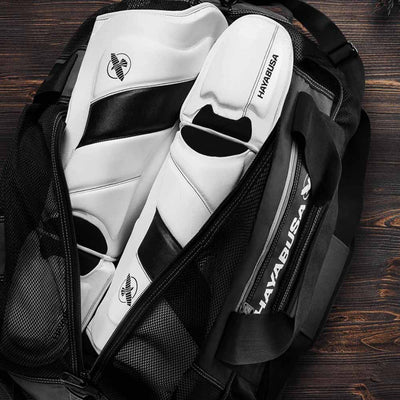
Dutch gym culture is also recognizable by the equipment used during a class. Gloves support punch training; shin guards are a standard part of partner drills involving kicks and blocks. Handwraps or gel wraps prepare the hands before the gloves go on, and a mouthguard provides protection during contact training.
Pads are important for practicing combinations. The pad holder and athlete work together on rhythm, distance and linking punches, kicks and knees. This equipment fits the history of a sport in which connecting techniques plays a major role. The pad holder’s preparation is just as much a part of a good drill.
Your choice of equipment depends on what you do. Bag work, pad work and sparring place different demands on your gear. Kickboxing shorts allow freedom of movement, while a set brings together various essentials; the exact contents vary by version. This gives the history of the training floor a practical connection to the gear you use today, without every session having to be the same.
The Dutch legacy travels with people
Ultimately, the best way to trace Dutch influence is through people. A coach passes on a combination, a fighter takes experience to a new gym, and a visitor from abroad incorporates a training idea into their own classes. That exchange began with the pioneers and has never stopped.
That is why there is no definitive, fixed Dutch Style. The recognizable link between boxing and kicking remains, but new generations add their own solutions. A different opponent, body type or set of rules can prompt a change in approach. In a good gym, tradition and innovation are not opposites.
Together, the big names show this. Kaman, Dekkers and Rijker wrote different stories from Aerts, Hoost and Schilt. Bonjasky, Hari and Verhoeven each brought their own strengths and audiences. Their differences do not weaken the Dutch tradition; they show just how fertile its sporting environment could be.
That legacy is about more than trophies. It lives in a coach’s expertise, a pad holder’s work and the curiosity of a student who wants to understand a movement better. These are the small, repeatable moments from which the sport’s next great chapter grows.
The history of Dutch kickboxing in fourteen milestones
- 1972: Chakuriki takes shape. Thom Harinck establishes a school in Amsterdam that brings together influences from different martial arts.
- 1975: learning in Japan. Jan Plas, Peter van den Hemel and Jan van Looijen travel to Japan and bring their training experiences back to the Netherlands.
- 1976: a shared stage. The May 31 event at the Jaap Edenhal becomes a defining milestone for Dutch kickboxing.
- The 1980s: the international reputation grows. Dutch gyms and fighters make a name for themselves abroad; Rob Kaman and Luciën Carbin are among the key early figures.
- Ramon Dekkers and Lucia Rijker broaden the story. Their international careers in different worlds of combat sports show the versatility of Dutch kickboxing.
- 1993: the K-1 era begins. Branko Cikatić wins the first World Grand Prix; his connection to Chakuriki highlights the international influence of Dutch gyms.
- 1994, 1995 and 1998: Peter Aerts wins three times. The Dutch Lumberjack becomes one of the best-known faces of the heavyweight tournament.
- 1997, 1999, 2000 and 2002: Ernesto Hoost wins four times. Mr. Perfect brings his technically crafted combinations to a global audience.
- From 2002: World MAX. Albert Kraus wins the first edition; Andy Souwer follows with tournament victories in 2005 and 2007.
- 2003, 2004 and 2008: three titles for Remy Bonjasky. His distinctive style adds further variety to the Dutch heavyweight generation.
- 2005, 2006, 2007 and 2009: Sem Schilt wins four times. He also wins the GLORY Grand Slam in 2012.
- The next generation reaches a wide audience. Badr Hari and Rico Verhoeven become headliners on major international stages.
- 2017: the Combat Sports Authority is established. Efforts to improve the sport’s organization and standards gain new momentum.
- 2024 and 2025: responsibilities grow. The Dutch Combat Sports Federation takes over management of Fightpassport and later the issuing of the quality mark.
Conclusion: a world title starts on the training floor
The Netherlands became a major kickboxing nation because people sought out knowledge, put it into practice and kept passing it on. The connections with Japan and Thailand, the Amsterdam pioneers and the developments in Breda together laid the groundwork. Trainers such as Thom Harinck, Jan Plas, Johan Vos, Luciën Carbin, Cor Hemmers and Dennis Krauweel show just how important the people behind a sporting career are.
Each fighter gave that history a face of their own. Rob Kaman brought Dutch ring skills to international attention early on. Ramon Dekkers forged a special connection with Thailand. Lucia Rijker bridged different worlds of combat sports. Aerts, Hoost, Bonjasky and Schilt formed an exceptional line of K-1 champions, while Kraus and Souwer showed the importance of the lighter weight classes. Badr Hari and Rico Verhoeven then reached a new generation of viewers.
Their shared legacy lives on in the gym. In a combination practiced again and again, a coach who explains something more clearly, and a training partner who sets the right pace. That is where the enduring strength of Dutch kickboxing lies: international ambition, sustained by daily work and a willingness to keep learning from one another.