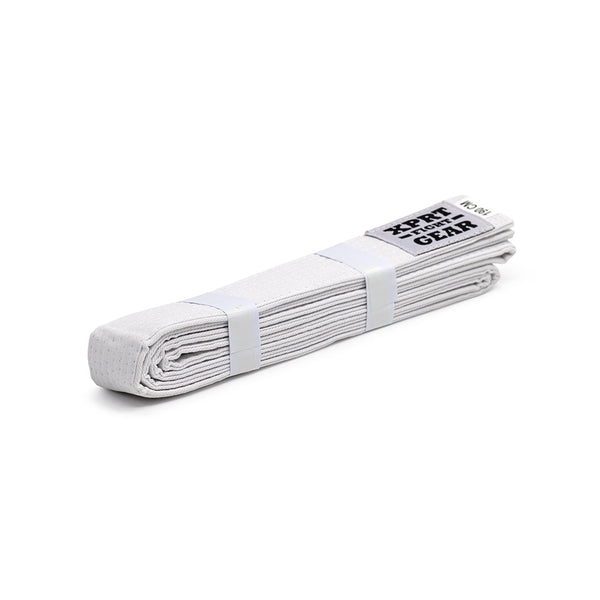
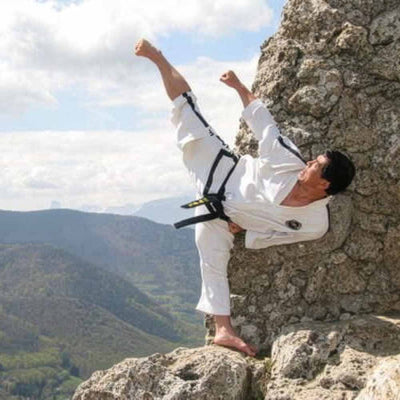
A white belt tied before the first lesson, a colored stripe after passing an exam and, eventually, a black belt: the grading system gives visible form to progress in ITF Taekwon-do. Each color belongs to a stage of learning. Together, they tell the story of starting out, building a foundation, growing and taking on ever greater responsibility.
There is more behind those familiar colors than a sequence. The symbolism draws on images from nature, such as the earth, a growing plant and the sky. The belt connects those images to what you do in the dojang: practice techniques, develop focus and learn to work with your own abilities.
In this article, we follow the path from the white belt to the dan grades. We look at the meaning of the six main colors, the intermediate steps marked by stripes, and the place of masters and grandmasters within the tradition. Throughout, the belt represents a journey that takes shape on the mat.
1. Why Taekwon-do has a grading system
You do not learn a martial art all at once. You start with simple movements and gradually discover how posture, balance, direction and timing work together. The grading system brings structure to that learning process. Each new grade shows the progress you have made and gives you a new starting point.
In ITF Taekwon-do, there are ten kup grades and nine dan grades. Kup is also written as gup. The kup grades count down from 10th to 1st kup. The dan grades then begin at 1st dan and go up to 9th dan. The belt color and any stripes make these distinctions visible.
The original idea behind the grades is both educational and motivational. The material is divided into manageable steps, and each step gives you something to work toward. A belt is therefore a reminder not only of an exam you have passed, but also of the training that still lies ahead.
2. Ten kup grades, five colored stages
The first stage consists of white, yellow, green, blue and red. Within those five main colors, the ten kup grades are marked by intermediate steps. For example, the white stage includes both 10th kup and 9th kup, but the second step has a yellow stripe. The main color remains recognizable, while the stripe points toward what comes next.
The same principle continues throughout the sequence: yellow with a green stripe, green with a blue stripe, blue with a red stripe and red with a black stripe. You can see not only where someone is, but also which main color they are working toward next.
This makes the system more than five separate colors. Each stage has room for growth and is then developed further. The intermediate step recognizes that progress without changing the entire uniform. Against the white dobok, the belt remains the clearest sign of rank.
3. White: starting with an open mind
In the traditional explanation, White stands for innocence and a fresh start. The practitioner is introduced to Taekwon-do and still has a whole world of movements and concepts to discover. The image of a blank page fits: there is room to learn, ask questions, and develop new habits.
That beginning has value in its own right. Getting a first stance right, learning to distinguish left from right in an exercise, and listening attentively to an explanation together form the foundation for what later becomes more natural. The white belt marks this first stage without making it any less important.
At 10th kup, the belt is white. The yellow stripe of 9th kup marks the first step toward the yellow belt. Every experienced practitioner has had such a beginning. Even someone with a high dan rank once tied a belt for the first time and practiced a basic technique.
4. Yellow: the earth in which the foundation takes root
In common ITF symbolism, Yellow is associated with the earth in which a plant takes root. The image is about laying a foundation. The first movements are no longer simply new; they begin to fit together, and the practitioner starts to understand what further development can build on.
The image of the plant also shows the importance of guidance. Just as a plant needs nutrients and light, what has been learned takes shape through good instruction and regular practice. The core meaning of the yellow belt remains the earth: the ground on which further development can rest.
The yellow belt corresponds to 8th kup. Yellow with a green stripe indicates 7th kup and points to the next stage. In the image of the plant, the soil has been prepared and there is room for further growth. The color thus connects the foundation with what can grow from it.
5. Green: growth takes shape
Green represents a plant as it develops. The roots have taken hold, and more of its growth becomes visible. For the practitioner, this is a fitting image: individual elements begin to work together better, and confidence in performing familiar techniques grows.
Growth also means noticing more details. A movement that you first had to focus on remembering can now be examined more closely. How is the foot positioned? Where is the weight? How do preparation and execution fit together? The green phase can be seen as a further development of the foundation.
Green corresponds to 6th kup, and green with a blue stripe to 5th kup. The blue stripe refers to the sky toward which the plant reaches. The sequence of colors thus becomes a continuous story: development does not start over each time, but builds on what was learned before.
6. Blue: the sky you grow toward
Blue represents the sky toward which the growing plant stretches. Traditionally, this is associated with further development in Taekwon-do. The horizon broadens, and the practitioner discovers how much there is to explore within a technique, an exercise or a training situation.
It is a fitting image for deeper understanding. Being able to do more does not just mean knowing more movements. It also means recognizing connections: how balance supports a kick, how distance affects when you act, and how attention helps you perform an exercise with control.
The blue belt corresponds to 4th kup. A red stripe marks 3rd kup. The plant reaches higher, while the next color already points to a new emphasis: learning to use the skills you have developed with care.
7. Red: skill calls for control
Red traditionally represents danger. This has two sides: the color warns of what the techniques can do and reminds the wearer of the importance of control. As movements become more powerful and confident, how you use them matters more.
That makes red a color of responsibility. When practicing with a partner, attention, distance and control are part of performing a technique. The meaning lies not only in an impressive technique, but also in the ability to act with care and make sure the exercise goes well for both partners.
Red corresponds to 2nd kup. The black stripe of 1st kup marks the final kup grade. The black belt is in sight, but what matters most is still the training itself. This phase brings together the foundation built so far and marks the transition to the next series of grades.
8. Black: a new phase of learning
The black belt is traditionally associated with maturity and skill. In contrast to the white beginning, black shows that a foundation has been built. The practitioner has come a long way in their training and can continue working on Taekwon-do with greater insight.
The universe, a vast space with much still to discover, offers another image for thinking about that further development. The traditional explanation remains centered on maturity and skill. The first black belt is not the end of learning, but the beginning of a new, deeper phase.
From 1st dan onward, the main color remains black. Further steps are shown by the dan grade, for example in Roman numerals on the belt. The appearance therefore changes less than it does with colored belts, while development continues. The focus shifts to refining, deepening and passing on what has been learned.
9. What the stripes on a belt mean
A stripe on a colored belt makes an intermediate step recognizable. On a white belt, yellow points toward the next main color; on a red belt, black marks the transition toward first dan. The five striped intermediate steps correspond to 9th, 7th, 5th, 3rd and 1st kup.
This differs from the marking on a black belt. Roman numerals can show the dan grade: I for first dan, II for second and III for third. The color remains black, and the grade is shown with a separate symbol. These are two ways of showing further progression on a recognizable belt.
A name or embroidered text can also appear on a belt. Such details give the belt a personal touch, while its color and rank marking retain their purpose. A name identifies the wearer; a rank marking indicates the rank achieved.
10. Dan grades, instructors, masters and grandmasters
The nine dan grades run from 1st through 9th dan. In the usual ITF system, the first three dan grades form a phase in which the foundation is developed further. The higher grades are also associated with teaching and passing on the martial art.
The title for 1st through 3rd dan is assistant instructor (boosabum), for 4th through 6th dan instructor (sabum), for 7th and 8th dan master (sahyun), and for 9th dan grandmaster (sasung). A title and authorization to teach each have their own meaning; formal instructor and examiner roles also require training and certification. The dan grade indicates rank within that progression.
A black belt does not automatically make someone a grandmaster. Between first dan and ninth dan lies a long path of further learning. That idea makes the first black belt all the more meaningful: much has been achieved, and there is still a great deal left to explore.
11. High ranks as part of a living history
The ranking system is part of the modern development of Taekwon-do. The official ITF history links the name Taekwon-do to April 11, 1955, and the founding of the International Taekwon-Do Federation to March 22, 1966. These are notable moments in the history of a martial art that spread internationally from Korea.
In his 2013 explanation of ranks and belts, Han Sam Soo also describes this development as a learning journey. The colored belts provide the foundation, the first dan ranks deepen skills, and at higher ranks, passing on knowledge receives more emphasis. In this way, a high rank is linked to contributing to others, not just to personal achievement.
The history of Taekwon-do is told not only through techniques and organizations, but also through the people who have passed on their knowledge. Names such as Choi Hong Hi, Park Jung Tae, Park Jong Soo, Hwang Kwang Sung, Rhee Ki Ha, Leong Wai Meng, and Charles Sereff appear in that history. They place the discussion of high ranks within the broader story of how the martial art developed and spread.
Names such as Jhoon Rhee and Hee Il Cho are also part of the broader history of Taekwon-do. A historical overview like this is different from a current ranking within a single organization. Above all, it shows how knowledge has been passed on through different people and generations.
At the highest ranks, the story goes beyond what someone can do on the mat. Teaching, guiding others, and making a lasting contribution to the martial art take on greater importance. The belt is visible, but its meaning is built through the way someone fulfills that role.
12. Your place in the dojang
Rank also has a practical role in group training. In a typical lineup, higher-ranked practitioners stand at the front and to the right, as seen from the group's perspective. Lower-ranked practitioners line up farther to the left and toward the back. The instructor sets the lineup before class.
This arrangement makes the group's structure clear. Experienced practitioners can set an example, and beginners know where they fit in. It can also be motivating: your place reminds you of what you have learned and what you can still build on.
Training together remains central. A higher rank brings experience and gives someone the opportunity to help others get started. A lower rank represents a different point in the learning journey. Both are part of the same group and the same practice.
13. An exam as a milestone
A grading exam makes a longer period of practice visible. What has been developed during lessons is demonstrated at a set time. This gives structure to preparation and makes the next step concrete: you work not only on individual movements but also on bringing them together.
The exam may cover different aspects of Taekwon-do, such as basic techniques, tul, partner exercises, and theoretical knowledge. The exact exam requirements depend on the grade and the program used. The guiding principle throughout is that the next belt gains meaning from what the practitioner has learned.
Passing an exam is therefore a moment to be proud of. It recognizes effort and progress. At the same time, regular training continues afterward, now from a new starting point. The next color does not replace what you have already learned; it builds on it.
14. Wearing the belt as part of the uniform
The belt belongs with the jacket and trousers as part of the dobok. The white base visually brings the group together, while the belt shows each person's grade. This brings the meaning of the colors into every training session, not just exams or special occasions.
In the ITF tradition, the belt is wrapped once around the waist and tied at the front. The right length allows you to do this neatly. The belt fits snugly without unnecessarily restricting breathing or movement, and the ends hang neatly down the front of the uniform.
That attention to wearing the belt fits into the broader story. You put on your dobok, tie your belt, and get ready to practice. This simple, recurring gesture connects everyday use with tradition and with the progress made visible by the color.
15. Conclusion: every color makes progress visible
From white to black, the grading system tells a continuous story. White marks the beginning, yellow the foundation, green growth, and blue further development. Red emphasizes control and responsibility. Black then opens a new phase of deeper learning.
The kup and dan grades bring structure to that journey. Stripes make the intermediate steps recognizable, and higher grades connect experience with passing on knowledge. Ultimately, the belt gains its meaning in the dojang: through regular practice, staying focused, and building on what you have learned.