My experience has taught me that many martial arts trainers in Karate, Taekwon-do, Kickboxing, and other “stand-up striking arts” have their own style of (competition) training.
This is why I believe it is beneficial for all-round fighters to take lessons from various instructors and study various fighting styles in order to master different techniques and gain insight and skills in different ways. Let’s be honest: the top fighters in MMA do the same.
Which factors are important in a stand-up fighting match?
- flexibility and mobility
- reaction speed and speed
- strength
- fitness and endurance
- technique, tactics, and insight
- ability to absorb impact and recover
- balance, coordination, and equilibrium
In my view, good competition training consists of elements that help improve the factors mentioned above, with emphasis naturally being placed on one or more factors in each training session.
Naturally, you begin a training session with a warm-up, and it is wise to finish it with a cooling down. The actual training and the aspects you want to train logically take place in the middle of this sequence.

Warm-up
A warm-up prepares fighters both physically and mentally for the physical exertion ahead. This significantly reduces the risk of injury. The temperature of the facility and the outdoor temperature affect how the warm-up should be started.
We all know that a warm-up is essential. Particularly with younger athletes (children), however, it is important to vary the exercises in order to maintain their attention and interest in sports. The trainer/instructor therefore needs sufficient creativity and an extensive range of exercises to keep the class interesting.
Some simple exercises that can be used to start the training include jogging, swinging the arms, hopping, rotating the hips, butt kicks, high knees, side crossover steps, rotating the shoulders, and knees–torso–arms. Naturally, countless variations can be devised, and the trainer’s creativity is essentially the limiting factor. These exercises are also known as a circulation warm-up.
For martial artists, there are many more ways to vary the warm-up: shadowboxing with and without a partner, jumping rope, jumping jacks, burpees, and dozens of other types of exercises.
A warm-up generally takes about 15 to 20 minutes of the training session.
The effects of a warm-up in martial arts are:
- Body functions are brought from resting levels to performance levels. This includes redistributing blood from areas such as the intestines to the muscles.
- Heart function is strengthened, and the heart rate increases from 60 beats per minute to 120–150 or even above 180 after strenuous physical exertion. The amount of blood pumped per beat also increases. All of this can cause the heart to work 6 to 8 times as hard as it does at rest.
- lungs must absorb more O2 and release more CO2, causing more alveoli to open.
- Thermoregulation. Due to the change in temperature in the muscles, the
Metabolic processes speed up. As blood vessels in the skin open, heat release and heat production are properly balanced. - The nervous system. Nerve impulses must travel faster so that coordination and control improve.
- The muscle-tendon system. These tissues become warmer and receive better blood flow, making them more elastic and stronger.
- Mental preparation for what is to come. Concentration increases.
Warm-up: stretching exercises
After the warm-up, it is advisable to perform some stretching exercises, varying in duration depending on the training that follows. It is always wise to perform stretching exercises for the entire body.
In most martial arts, such as boxing, kickboxing, MMA, and karate, virtually all parts of the body are used during the exercises.
Reaction ability and speed for martial artists
Reacting in time is one of the most important elements in free fighting. Scientific tests have shown that executing a technique, whether a kick or a punch, takes only slightly more than 0.1 seconds for trained fighters.
Those same scientific experiments showed that it is virtually impossible to react to this, since the brain needs more time to process this information and generate a response. For these reasons, many martial arts teach that the initiator will always be faster than the defender.
The only way to be prepared for an attack, therefore, is to learn to anticipate. Unconscious senses can enable a trained martial artist to react automatically to techniques initiated by their opponent. This reaction time can be sharpened by training it constantly.
For this reason, it is very useful to train regularly with pads to learn to react to imaginary targets. The pad holder is very important, as they must monitor the logic of the techniques and also ensure that the attacker constantly learns to move.
A good tip is to train in a way that creates as little rhythm as possible when calling out the pads. Calling them out according to a fixed pattern results in “static” movement, which should actually be unlearned.
An additional benefit of pad training is that the attacker learns to maintain the correct fighting distance. They automatically recognize the necessary and safe distance, making their techniques increasingly effective. It is also important to keep in mind that the fighting distance in boxing, for example, differs from that in taekwon-do, thai boxing, karate, or kickboxing.
During pad training, it is also important to hold the pads in the correct positions. Many beginners are accustomed to holding the pads far away from themselves so they do not have to deal with the impact of the technique in question. This is understandable, but it should not be condoned.
Because training focuses on the attacker’s reaction and choosing the right distance, this creates a bad habit: unconsciously misjudging distances. It is better to hold the pads where the technique should land, as this teaches the fighter exactly when an appropriate technique can be delivered and what the correct distance is.

Flexibility & mobility in martial arts
Dynamic stretching, the most effective for martial artists
Every martial artist knows how important it is to perform stretching exercises during training. Without performing stretching exercises, you risk injury, and it is unlikely that your flexibility will increase. As a result, without flexibility, your techniques will not improve or be performed with ease.
So the major questions for martial artists are:
- “How can I improve my flexibility?”
- “Which techniques produce the best results in the shortest time?”
- “Which stretching routine can I follow to achieve these results?”
The following section on dynamic stretching is based on the book “Stretching Scientifically” by Thomas Kurz, the Elastic Steel media channel, and various seminars given by Taekwon-do grandmasters.
Dynamic stretches are simple leg swings in all directions. First, you need to learn to move your limbs at a moderate speed through their full range of motion. You should start with lower movements to prevent injuries caused by muscles being stretched too quickly.
Do not “throw” your legs. Instead, guide your legs while maintaining full control over the movement throughout its entire range. When you are nearly at the end of the movement, you can increase the speed so that the final few centimeters of the stretch are less controlled, but not unexpected.
Practice leg swings forwards, backwards, and to the sides. It is advisable to do 12
repetitions per set and as many sets as it takes until you feel you have reached your current flexibility limit.
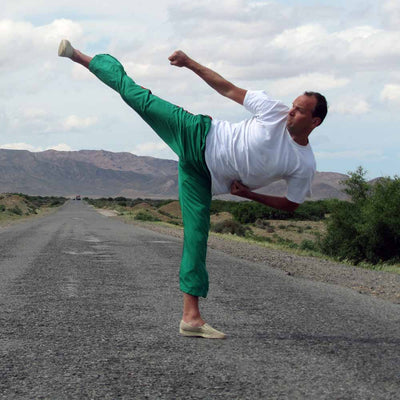
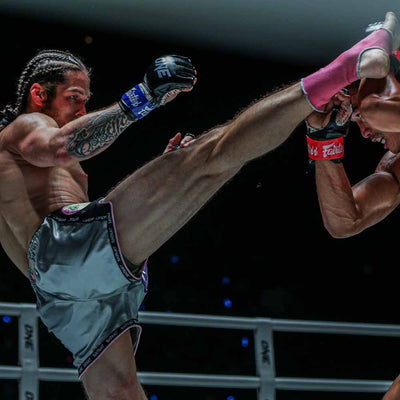
In many martial arts, except boxing, (high) kicks are primary attacking weapons, and if you want to be able to perform them at any time, regardless of age or gender, without warming up, you should perform brief dynamic stretches twice a day.
Research has shown that dynamic stretching twice a day is particularly effective: once in the morning and again later in the day. On training days, it is effective to perform dynamic stretching exercises before you start kicking.
"8 to 10 weeks is sufficient to develop maximum dynamic flexibility."
According to Matveev (1977), 8 to 10 weeks is sufficient to develop maximum dynamic flexibility. Grandmaster Park Jong Soo also emphasizes the importance of dynamic stretching exercises during taekwon-do training, whether in the form of leg swings or kicking techniques.
Is it wise to stretch statically, for example by doing the splits, as so many people do before performing kicking techniques? No, absolutely not! Never perform static stretching exercises before dynamic stretching exercises, kicking techniques, or other dynamic movements.
For several seconds or even minutes after performing a static stretching exercise, you cannot achieve your maximum flexibility or speed. Rosenbaum and Hennig demonstrated this in a study in which they subjected the calf muscles to 30-second stretching exercises and measured their strength afterward.
Kokkonen, Nelson, and Cornwell stated that the development of maximum strength is inhibited for several minutes after strenuous static stretching exercises. When you attempt to perform a fast, dynamic movement immediately after static stretching, you are very likely to injure the stretched muscle.
When determining the stretching exercise, you (the instructor) should determine the physical requirements of the planned activity. In standing martial arts, where the focus is often on kicking techniques, dynamic hip flexibility is very important. To increase your range of motion, you should therefore perform plenty of dynamic leg swings in all directions.
“It is impossible to learn dynamic skills by using static exercises, and vice versa.”
A common exercise in martial arts gyms is holding the leg up, either to the side or to the front. Although this type of exercise does develop static balance and strength, it contributes nothing to the development of the dynamic flexibility or strength required. It develops static active flexibility, which is needed in sports such as gymnastics, but is not important for kicking techniques and martial arts such as kickboxing, karate, and taekwon-do.
This type of exercise requires intense tension in the muscles on one side of the body, making heavy strain on the lower back unavoidable. When someone with insufficient lower-back strength or other back problems performs these exercises, it can lead to spinal injury.
McArdle, Katch, and Katch state very clearly in the textbook "Exercise Physiology: Energy, Nutrition, and Human Performance": “It is impossible to learn dynamic skills by using static exercises, and vice versa.”

Strength and strength training
Any athlete—including combat athletes—who seriously wants to improve their sporting performance can do so at any age through strength training. Whether you are ten or seventy or older, male or female, a weekend athlete or a seasoned professional, at some point you have made the decision to further develop yourself. Strength training enables you to achieve this goal.
Every male or female athlete wants to improve their performance. At some point, they decide to train for strength. After all, strength is one of the many components that make up athletic ability.
In a combat sport, strength can be developed just like flexibility or endurance. Once developed, it can help improve your existing sporting performance in combination with the other components you wanted to improve.
Strength does not have to be the decisive factor, but it is certainly important for every serious fighter.
Although strength does not have to be the decisive factor in most stand-up combat sports, it is certainly important for every serious fighter. Naturally, certain muscle groups are more important than others for combat athletes.
The gluteal, abdominal, back, and leg muscles are particularly important in karate, kickboxing, and taekwon-do. The gluteal muscles are necessary for performing kicking techniques and keeping the leg raised.
In addition to providing strength for every technique (the body's center), the abdominal muscles also enable you to absorb your opponent's techniques.
The back muscles are needed to perform the many rotations, while also providing counterbalance for the abdominal muscles. The leg muscles are particularly important for performing powerful kicking techniques properly and for evasion.
Strength training is training with a certain form of weight resistance and gradually strengthens your skeletal muscles. These muscles move your body, both visibly and invisibly, in countless directions. This allows you to adopt any body position and make any movement you need when practicing your sport. When your muscles are stronger, you reinforce such positions and perform such movements more easily and efficiently.
There are many types of strength training: exercising with weights attached to your ankles, wrists, or waist; running quickly up stairs; doing rhythmic gymnastics, and so on.
Strength training is one of the many elements that contribute to your athletic performance. Other components include physical factors such as height, bone length, and leverage, endurance, reaction speed, motivation, mobility, and movement skills.
In most martial arts, many exercises are performed without using separate equipment. In many cases, the weight of one’s own body provides the resistance for the exercise. Examples include simple exercises such as jumping, push-ups, sit-ups, knee bends, leg swings, or performing kicking techniques in various ways (slowly, quickly, with resistance).

Training combinations
Training combinations is one of the most important forms of competition training in virtually all stand-up martial arts. By training combinations, the execution of techniques becomes, as it were, an automatic response or reflex.
The fighter learns to anticipate in a form of semi-sparring. In addition to the previously mentioned advantage, the fighter learns to judge the distance to the target, recognize open or undefended targets, improve accuracy, and develop a degree of anticipation.
Combining offense and defense
There are several forms of combination training: offensive, defensive, or as a counterattack. Each of these forms can be trained in different ways and requires a different approach.
When training combinations, it is important for the fighter to learn not merely to move forward, but to seize opportunities without becoming too eager. The defending party or holder is also important, as they must keep the other fighter alert by correcting defensive weaknesses and adopting a good starting and fighting position after every action.
Practicing combinations with pads and shields
Combinations can be trained in various ways: using “pads” (round, square, or elongated, depending on the technique), larger kicking shields (for more powerful execution of techniques), or while wearing boxing gloves and protective gear. Each method has its advantages.
In practice, you will find that the pads in particular are ideal for reaction training, speed, and accuracy, that the larger kicking shields are especially suitable for developing powerful kicks, and that training combinations with boxing gloves and protective gear most closely mimic real-life practice.

Shock absorption and recovery capacity
There is no martial art in which the ability to absorb blows is unimportant. Naturally, all combat sports and martial arts differ in this respect, but a basic level of the ability to absorb blows is always necessary.
In some martial arts, the emphasis is more on evading and blocking techniques, but you cannot avoid toughening the body and the body parts used for offensive and defensive techniques.
You build up the ability to absorb blows by training this area regularly and maintaining it. It is wise to toughen and prepare all parts of the body, with a few exceptions, for the techniques that can be performed. You must not only be able to absorb blows; you must also train the body parts with which you perform offensive and defensive techniques yourself.
Important areas to train include: the abdominal muscles, chest muscles, wrists, fists, upper and lower arms, thighs, shins, instep, heel, ball of the foot, and parts of the hand.
Vital areas
Your vital areas in particular cannot be trained, or can barely be trained. You must therefore ensure that they are properly protected and defended at all times. Important vital points include the groin, genitals, head (face, temple, eyes, etc.), sternum, kidneys, and liver.
Breathing when absorbing blows
In addition to toughening the body parts, proper breathing at the moment of impact is also very important. This breathing training enables you to absorb blows much more effectively, minimizing discomfort.
Correct breathing ensures exhalation at the moment of impact, causing the muscles to tense and absorb the blow more effectively. A good exercise for “teaching” the muscles to react is to receive (light) blows with your eyes closed. This builds a natural response in the body and makes it stronger.
Partner exercises for absorbing blows
You can learn to absorb blows by exchanging strikes with a partner and gradually building up the power of those strikes over several training sessions. You will be amazed at how much your ability to absorb blows improves, even with light strikes. In a short period of training with the right motivation and concentration, you can therefore achieve tremendous results.
"To Rest Or Not To Rest: A Fighter’s Guilty Conscience"
However, just as quickly as it can be built up, the ability to absorb blows can also decline drastically. This is often the result of missed training sessions or illness. As with so many forms of training, however, a period of rest and recovery is essential. If you do not “listen” to the signals your body is sending, you will soon notice that negative results follow.
There are many different types of training for developing the ability to absorb impact and harden the body. Many basic exercises also prove to be highly suitable for this purpose: for example, you can train stronger wrists and a more technically correct fist by performing push-ups on your fists instead of on your open hands.
The abdominal muscles can be trained twice as effectively by performing, for example, scissor exercises while a partner drops their elbows onto the abdomen (gradually increasing the distance, of course).
It is also certainly wise to train the upper legs to improve their ability to absorb impact. The best exercise for this is exchanging “low kicks” with a partner.

Conditioning training for combat sports athletes
Even the fastest car in the world cannot run without fuel. This saying emphasizes that no matter how many techniques someone may have at their disposal, they are worthless if they lack the ability to execute them.
In short, conditioning is, as in almost all other sports, essential for success in every standing combat sport. Kickboxing, MMA, boxing, and karate are highly explosive sports that often involve short bursts of power.
“The more you can train, the more you can improve.”
Interval training in combat sports
It requires a very different type of conditioning than, for example, long-distance running or soccer. The type of conditioning needed to perform successfully in combat sports or simply during training is best developed through interval training, in which rest and exertion alternate in short periods.
As an example, consider a running workout in which you sprint for 45 seconds and jog for 45 seconds repeatedly. In the training room, you can achieve the same result by continuously performing short exercises of approximately 15 seconds, with a rest period of, for example, 5 seconds.
Conditioning training with pads
Technique training on “pads” is ideal for this. This type of training is obviously very demanding and requires the necessary discipline and commitment. It is particularly successful in a group setting, where the group provides positive, motivating pressure.
There are countless forms of conditioning training to consider: sport-specific conditioning, conditioning combined with strength training, circuit training, etc. In principle, every training session consists partly of a conditioning component, but of course it is sometimes wise to devote the entire session to conditioning.

Cooling down after training
After exercising, the cool-down allows the body to gradually return to rest. During training or exercise, the various muscles and muscle groups are placed under intense strain. As a result, waste products accumulate in the muscles. These accumulations cause muscle soreness and therefore need to be removed.
This requires adequate blood circulation. Therefore, after exercising, you should not immediately come to a complete stop, but should continue to walk it off and/or perform gentle exercises.
Please note: stretching is not a cool-down
Stretching should be done before the cool-down (if you want to stretch after training). The purpose of the cool-down is to keep the cardiovascular system (heart rate) operating at a higher frequency than the resting rate, so that lactic acid can be removed more quickly.
This leads to a faster recovery time. If lactic acid remains present for longer (causing the cellular environment to become too acidic), vital substances can no longer function properly. Another reason to do a cool-down is to improve blood circulation in the “lower extremities” (fingers and hands, toes and feet).
In conclusion:
The cool-down is essential for a healthy and responsible end to the training session.
Why do you stretch before exercising?
Preparing the muscles for strenuous activities. Preventing injuries. Better blood flow to the muscles, which guarantees better performance.
Why do you stretch after exercising?
Reducing muscle tension. Relaxing the entire body. Improving blood flow to the muscles, allowing waste products to be removed.
How should you stretch?
Take your time and stretch in a relaxed manner. Start with a light stretch and slowly increase it. Build up the stretch gradually; it should certainly not hurt. Above all, do not bounce, as this creates tension, which is precisely what you want to avoid.

Equipment for stand-up martial arts
In principle, very little equipment is needed to practice martial arts successfully and effectively. The successful fighters from Dagestan are a very good example of this. Nevertheless, modern training equipment available to martial artists in general offers advantages. In principle, a fighter only needs sportswear and some protective gear.
Floor and/or boxing ring
The choice of flooring in the training hall often depends on the owner and/or instructor. Some clubs train on a hard floor, while others use mats. This generally depends on the purpose of the hall and whether other sports are practiced there. Nowadays, more and more boxing clubs and kickboxing clubs have their own proper “competition ring,” which is of course extremely useful if you can prepare for competitions in it.
Punching mitts, Thai pads, and kicking shields
“Pads” are very convenient and also excellent for training: small kicking shields that can be used to practice countless exercises and techniques. The larger kicking shields are also highly useful, particularly when training children, beginners, or powerful techniques.
Punching bags and dummies
Nowadays, in addition to traditional Punching bags, “dummies” are also available on the market. These are
Punching dummies on a base filled with sand or water. The advantage of these dummies and/or a punching bag is that you can always train without a partner. In addition, you can perform techniques as hard as you want without injuring anyone else.
Stretching machines are also particularly modern. Although they are quite expensive, they are very comfortable to use and allow you to stretch to the maximum whenever you want without a partner. For conditioning, you can make good use of, for example, a jump rope.
The familiar “steps” found in almost every gym can be used in any martial art for various exercises: strength training (e.g., triceps “dips”), jumping exercises (distance, height), or as an obstacle when performing a technique.
Boxing gloves and protective equipment
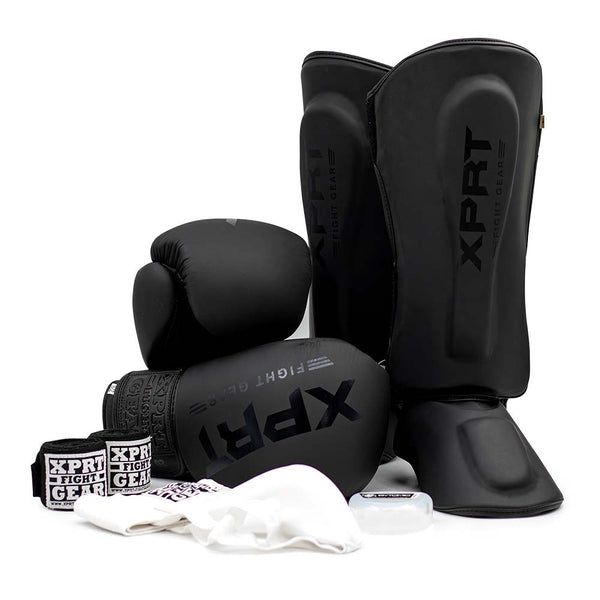
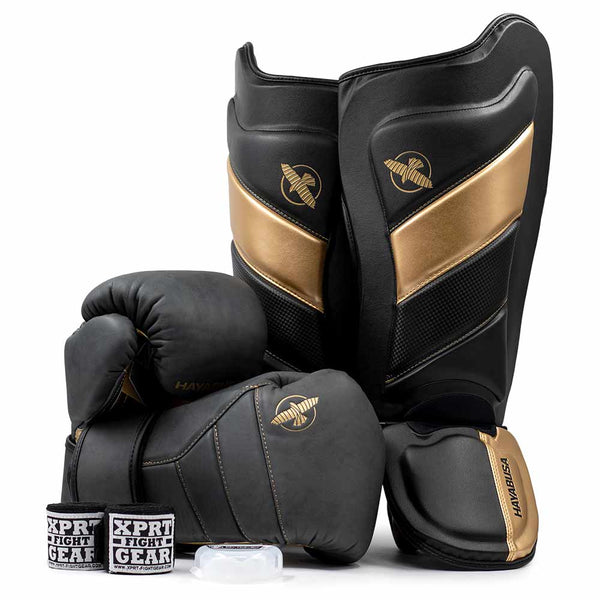
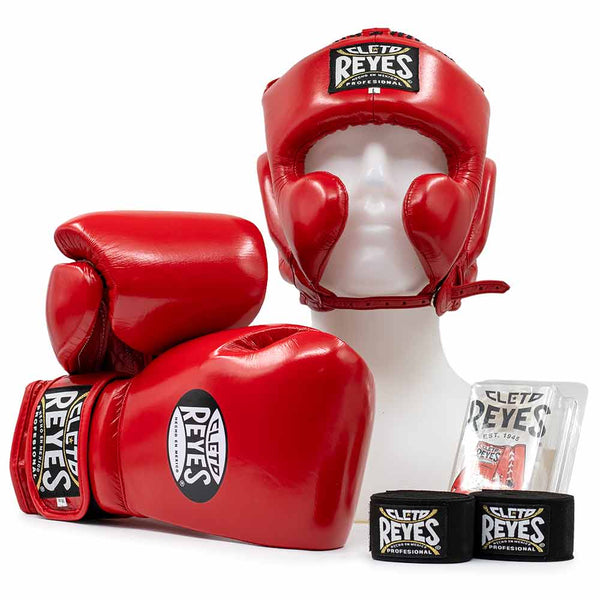
For sparring sessions, having Boxing gloves and protective equipment is essential. The equipment used depends on the sport and fighting style.
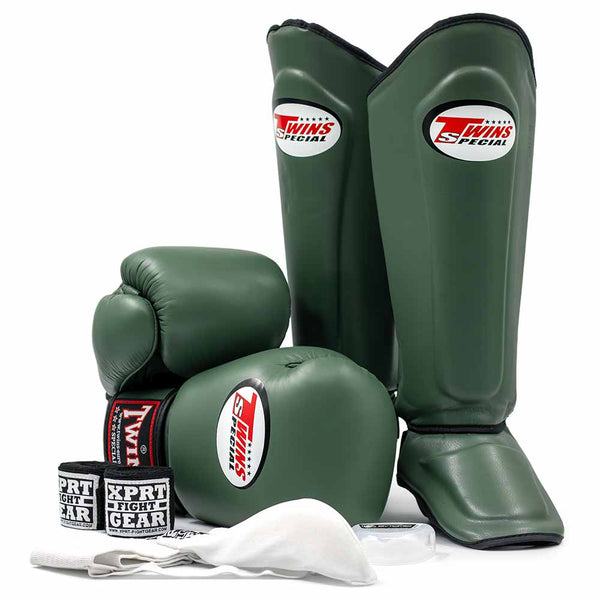
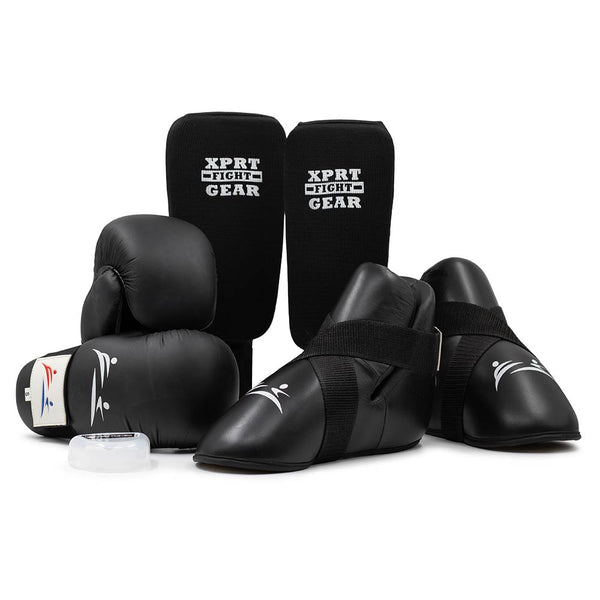
Most stand-up martial arts use Boxing gloves, shin guards, a mouthguard, headgear, and a cup. It is customary during training for everyone to provide their own Boxing gloves and protective equipment.
Make creative use of simple materials that are available
Sometimes during training I used a hoop that both fighters had to keep one foot inside while boxing a round using their hands. Doing this regularly teaches the fighters in question to keep looking at each other. This is important because it is crucial to always maintain eye contact with the opponent, even when an attack is directed toward the face.
External sources and more information:
- Sportzorg.nl
- Allesoversport.nl
- Exercise Physiology: Energy, Nutrition, and Human Performance (1991) - McArdle, Katch, and Katch
- Lev Matveyev: Sports periodization
- Stretching Scientifically - A Guide to Flexibility Training, Tom Kurz
- The influence of stretching and warm-up exercises on Achilles tendon reflex activity - Rosenbaum and Hennig
- Acute muscle stretching inhibits maximal strength performance - Kokkonen, Nelson and Cornwell (1998)
- Elastic Steel
- Elastic Steel Youtube - Paul Zaichik, Expert in movement science
- Never Gas Out! – Fighter Interval Training - Joel Jamieson